
How Gulf Oil Disruptions Threaten Australia and New Zealand’s Energy Security

The Global Context: A Crisis Without Precedent

The closure of the Strait of Hormuz has created what the International Energy Agency calls “the largest supply disruption in the history of the global oil market” . Flows through the Strait—normally carrying 20 million barrels daily—have fallen to “a trickle,” with oil exports from Gulf producers dropping from approximately 20 million barrels per day to just 3.8 mb/d in early April .

This isn’t just about crude oil. The crisis has triggered unprecedented price spikes in refined products, with Singapore middle distillate prices reaching all-time highs above $290/barrel . For Australia and New Zealand—nations at the end of global supply chains—the implications are immediate and severe.


Price Forecasts: What to Expect by June 2026

Given that the war against Iran by Israel and the US is an existential one for Iran- i.e. Israel, and likely the US’s intent, is to destroy Iran as a cohesive state and break it into statelets who can no longer pose a threat to Israel’s Greater Israel project or disrupt future US control over Iranian oil, any peace agreement for Iran must include continued control over the State of Hormuz to ensure the state of Iran’s continued viability. It is unlikely that the US will concede to this in the short to medium term, especially given the control that Israel currently has over US foreign policy.

Additionally, should the US attempt further substantial attacks on Iranian infrastructure after the ceasefire likely ends on May 20th 2026, Iran has promised to destroy other Gulf States energy infrastructure.

If the Strait of Hormuz remains closed or severely constrained through June 2026 or longer, energy markets face a prolonged supply crisis with cascading price effects:

Crude Oil and Refined Product Prices

ProductCurrent/Recent PriceJune 2026 Forecast (Hormuz Closed)Source
Brent Crude~$103/bbl (March avg)$115+/bbl (EIA peak forecast for Q2 2026)
Singapore Gasoil (Diesel)$192/bbl (April)$200-250+/bbl (IEA alternative scenario)
Singapore Jet FuelSurged 114% since Feb 28$250-300+/bbl (record highs sustained)
VLSFO (Bunker Fuel)S$2.30/litre (Singapore)S$2.50-3.00+/litre (competing demand from refiners)
Australian Retail DieselAUD $3.20+/litreAUD $3.50-4.00+/litre (potential doubling if crisis persists)
Australian Retail Petrol~$2.20/litre (post-excise cut)AUD $2.50-3.00/litre
US Retail Diesel~$5.80/gallon (April peak)$6.00-7.00+/gallon

The International Energy Agency (IEA) has presented two scenarios: a base case assuming gradual resumption of Hormuz flows by mid-year, and an alternative “prolonged conflict” case where “energy markets and economies around the world need to brace for significant disruptions in the months to come”. Under the prolonged conflict scenario, physical crude prices could sustain levels near $150/bbl, with refined products trading at unprecedented premiums .

As of mid-April 2026, oil futures traders are maintaining an almost constant West Texas Intermediate (WTI) crude oil price per barrel of around $100 US, while real Dated oil prices hover around the $140 mark. Futures traders are for some reason responding to oft repeated wild claims by Trump that victory, a peace agreement or at least an opening of the Straits, is imminent.

The IEA estimates it will take 2 years for global oil supplies to return to their previous levels once the Strait is reopened because of the extensive damage to Gulf refineries, storage facilities and docks.

Key Price Drivers

  • Diesel shortage structural: The IEA estimates 3-4 million barrels per day of diesel supply loss (5-12% of global consumption) directly tied to Hormuz disruptions
  • Refinery capacity offline: Middle East and Asian refineries cut runs by ~6 mb/d in April, tightening global product markets
  • Brent-WTI spread widening: The spread reached $12/bbl in March and is projected to peak at $15/bbl in April, reflecting Asian supply anxiety

Australia: The Diesel Nation at Breaking Point

The Dependency Problem

Australia is perhaps the most vulnerable developed nation to a liquid fuel emergency. In FY2021, 91% of all fuel consumed in Australia was imported—including 68% as refined products and imported crude for our remaining refineries .

Over the past 20 years, Australia like many other Western countries has substantially reduced the number of oil refineries on shore, opting instead for those refineries to become solely storage facilities for distilled oil products; predominantly from Asia. Two active refineries remain in Australia with the smaller one recently impacted by a refinery fire.

Australia sits at the end of a complex supply chain stretching thousands of kilometers from Singapore, South Korea, Malaysia, and Japan. While only a small fraction of their diesel imports come directly from the Middle East, almost half of the crude oil for production of that diesel originates in the Middle East when traced back through those Asian refineries.

The Diesel Consumption Profile

Australia’s economy runs on diesel. In 2025, the nation consumed approximately 35 billion litres of diesel—far exceeding the 15 billion litres of petrol and 10 billion litres of aviation fuel . The consumption breakdown reveals critical vulnerabilities:Table

SectorDiesel ShareAnnual ConsumptionVulnerability Level
Mining40% of total diesel~14 billion litresCRITICAL
Road Transport/Trucking24%~8.4 billion litresHIGH
Agriculture8%~2.8 billion litresHIGH
Manufacturing7%~2.5 billion litresMEDIUM
Marine/RailSignificant~3+ billion litresMEDIUM
Passenger Vehicles~25% of remainder~4+ billion litresMEDIUM

Australia has one of the highest per capita diesel demands in the world—7.4 barrels per person annually—far exceeding the US and other major economies .

The Refinery Crisis

Australia’s domestic refining capacity has collapsed. Five refineries closed over the last decade, leaving just two operational: Ampol’s Lytton refinery in Brisbane and Viva’s Geelong refinery in Victoria. These facilities were already struggling before the current crisis—and then came the April 2026 fire at Geelong.

The fire at Viva Energy’s Geelong refinery—built in the 1950s—shut down critical units. As analyst Kevin Morrison noted: “This creates the conditions for higher prices, as it pushes up international demand for refined products when supply is massively constrained. It could not happen at a worse time.” Victoria alone consumes 252,000 barrels of fuel daily—41% diesel, 22% jet fuel—and now faces sourcing these volumes from already-tight Asian markets.

The structural problem? Our remaining refineries are configured to produce mostly petrol rather than aviation fuel and diesel—precisely the fuels most critical for agriculture, road freight, mining, and defense .

Stockholding: The 90-Day Myth

Australia has been in breach of International Energy Agency (IEA) obligations since 2012. The IEA requires 90 days of net import coverage; Australia holds just 68 IEA days, and when measured against actual consumption, this equates to roughly 30-34 days of real fuel security .

The government counts “fuel in transit”—on foreign-flagged tankers in foreign ports—toward reserves. But as the Australia Institute notes: “In the event of a global emergency, there is no guarantee that the oil that Australia has been promised access to… would be practically accessible.” These ships are not Australian vessels; they sail under foreign flags and owe no allegiance to Australian fuel security.

With the Strait closed, Australia is now pulling diesel along some of the longest and most expensive trade routes in the world—13,000-mile journeys from the US Gulf Coast taking up to two months .

Mining Sector: The $4.5 Billion Diesel Addiction

The mining industry is Australia’s most diesel-exposed sector, consuming approximately 9.6 billion litres annually—roughly 40% of national diesel consumption and 10% of total national energy use . The sector operates more than 50,000 large diesel-powered trucks, each consuming approximately 900,000 litres annually .

Cost Impact Calculations:

  • At pre-crisis diesel prices (~AUD $1.75/litre), a large mine’s annual fuel bill for a 200hp tractor running 1,500 hours was ~$74,000
  • At current prices (~AUD $2.25-2.50/litre), that same operation costs $100,000-112,000 annually—a 35-50% increase
  • If prices reach $3.50-4.00/litre by June, costs could double from the original baseline

According to S&P Global and BMO estimates using Wood Mackenzie data, every 10% increase in oil prices drives mining cost increases of:

  • Iron ore: +4.2% mining costs
  • Copper: +3.5% mining costs
  • Gold: +2% mining costs

With crude oil potentially averaging $100+/bbl (47% above 2025 average), mining costs could rise 16-20% for bulk commodities .

Operational Risks: The mining industry faces a shutdown timeline measured in weeks if diesel supplies are interrupted:

  • Best-positioned mines: 4-8 weeks of operational capacity
  • Typical remote diesel-heavy mines: 2-6 weeks before curtailment
  • Weakest operations: Days to 2 weeks

The ASX Materials Index has already plunged 20.3% since the conflict began, with fund managers dumping stocks amid fears of fuel shortages forcing production cuts .

Agriculture: Harvest Season Crisis

Australian agriculture consumes approximately 2.5 billion litres of diesel annually, with diesel accounting for 84% of on-farm energy consumption . The crisis has hit at the worst possible time—during harvest season when fuel demand peaks .

Impact on Farm Economics:

  • A farm using 80,000 litres annually faced fuel costs of ~$140,000 at $1.75/litre pre-crisis
  • At current $2.25+/litre, costs have jumped to $180,000+ annually—a $40,000+ increase per farm
  • If diesel reaches $3.50/litre by June, that same farm faces $280,000 annual fuel costsdouble pre-crisis levels

Farmers are already making critical decisions about whether to proceed with crops given uncertainty about diesel allocations later in the year . Adding diesel and freight costs means nearly 60% of farmers’ cost base is increasing rapidly .

The Fuel Tax Credits Scheme (FTCS)—which provides AU$4.5 billion annually to mining and AU$1.3 billion to agriculture—has become a critical but increasingly inadequate buffer .

Food Supply Chain: From Farm to Shelf

Australia’s food supply chain is diesel-dependent at every stage:

  • Production: Tractors, harvesters, irrigation pumps
  • Processing: Generators, machinery
  • Distribution: Road trains, trucking (24% of national diesel consumption)

Higher diesel costs cascade through the food system:

  • Transport costs increase directly with fuel prices
  • Processing costs rise due to diesel-powered equipment
  • Retail prices must absorb these increases or face margin compression

The Australian Industry Group warns that disruption to fuel markets creates cascading supply chain impacts, with businesses already reporting fuel-related operational challenges .

Tourism and Aviation

The tourism sector faces a triple hit:

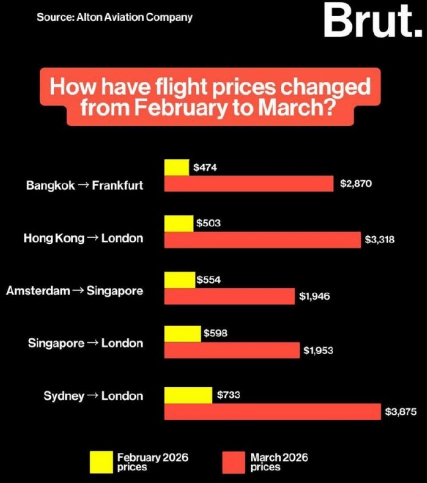
  1. Jet fuel costs: Singapore jet fuel surged 114% since February 28
  2. Airfare increases: AirAsia X has increased fares by up to 40% due to fuel costs
  3. Ground transport: Higher petrol and diesel costs affect rental cars, tour buses, and visitor travel patterns

Air New Zealand has already canceled 1,100 flights impacting over 44,000 passengers between March and early May due to fuel cost pressures .

The Australian Government Response

On March 30, 2026, the Australian National Cabinet activated the National Fuel Security Plan, currently at Level 2 (“Keeping Australia Moving”) . Measures include:

  • Halving fuel excise from 52.6 cents to 20.6 cents per litre for three months
  • Temporarily reducing minimum stockholding obligations by 20% for diesel and petrol
  • Amending fuel quality standards to allow higher sulfur levels, releasing ~100 million litres/month of additional petrol supply
  • Appointing a Fuel Security Taskforce Coordinator
  • Underwriting additional fuel cargoes and strategic reserves

However, energy analysts question whether the excise cut was optimally targeted. Macquarie University’s Lurion De Mello notes: “Petrol is not the pain point. Diesel is the pain point” . Deakin University’s Samantha Hepburn warns: “Any disruption in diesel supply or sustained high prices… will directly affect production capacity, increase operating costs and ultimately push up food prices” .

The Australia Institute recommends accelerating electric vehicle adoption to reduce petrol demand, thereby freeing refining capacity for diesel and jet fuel security .


New Zealand: The Marsden Point Gamble

The Refinery Closure Decision

New Zealand made a calculated bet in 2022—and now faces the consequences. The Marsden Point refinery, which produced half the country’s petrol, two-thirds of diesel, and most jet fuel, was converted to an import terminal. The rationale was economic: the refinery was inefficient by international standards, and importing refined products from mega-refineries in Asia was cheaper.

The government and industry argued this improved security: “Closing the refinery has actually improved our security of supply, as there is now more than twice as much fuel on the water to replenish domestic stocks than when we produced it locally.”

But this logic contains a fatal flaw. New Zealand no longer imports crude oil—but the Asian refineries we depend on do. In 2024, New Zealand’s top four source countries (Singapore, South Korea, Malaysia, Japan) sourced almost 80% of their crude oil imports from Persian Gulf countries .

As MFAT’s July 2025 analysis states: “In the event of disruption of Middle Eastern supply, Asian refineries would be forced to source crude product from elsewhere, pushing up the global price for oil” . New Zealand faces indirect but severe exposure to Gulf disruptions through our refined product suppliers.

Current stock levels provide approximately 47 days of diesel, 51 days of petrol, and 49 days of jet fuel coverage—better than Australia but still precarious if Asian refining capacity falters .

As of mid-April 2026, the New Zealand government’s sole strategy has been to monitor the volume and consequent days left of the various oil substrates in the country. The reality is that the risks to New Zealand’s economy are the combined factors of stocks available and the cost at the pump of those stocks New Zealand may well find that by June there are still tankers available to supply oil substrates to New Zealand but at a price that is unaffordable to the public.

Already truck operators are warning of hugely increased supermarket food prices in the pipeline because of the massively increased transport costs involved in supplying the supermarkets from New Zealand’s highly centralised grocery supply chain. Decentralisation of essential services across new Zealand is thus a very urgent priority.

Economic Impact Forecasts

ASB Bank has downgraded New Zealand’s growth outlook due to the fuel crisis, forecasting:

  • GDP growth slowing through 2026
  • Inflation rising toward 4% before easing in 2027
  • Households facing $4,000-6,000 annual hit if fuel prices stay elevated

Westpac identifies tourism as particularly vulnerable, forecasting that “the most direct impact of the shock on exports will likely show up in falling visitor numbers” due to flight disruptions, higher airfares, and consumer reluctance to travel internationally during heightened tensions .

Tourism Sector Impact

New Zealand’s tourism sector—still recovering from COVID-19—faces severe headwinds:

  • Flight cancellations and route reductions: Air New Zealand has already cut capacity
  • Higher airfares: Jet fuel costs have surged 114%, forcing ticket price increases
  • Reduced international visitor numbers: Westpac expects reversal of recent strong growth in arrivals
  • Domestic tourism pressure: Higher petrol prices reduce Kiwis’ willingness to travel domestically

Regional Variations: Regions dependent on self-drive tourism—West Coast, Tasman, Southland, Gisborne—face particular pressure. These areas already have disproportionate visitor spending on fuel, primarily because of a lack of local international airports, making them vulnerable to petrol price volatility .

Tourism Industry Aotearoa reports businesses are experiencing “sharp increase in business costs as a result of the leap in fuel prices” . The NZX50 fell nearly 6% in March 2026, with travel and tourism stocks—including Serko, Air New Zealand, Tourism Holdings, SkyCity Entertainment, and Auckland International Airport—among the hardest hit .

The Political Reckoning

The Marsden Point closure has become politically contentious. New Zealand First MP Shane Jones, now Associate Energy Minister, has called the previous government’s decision “reckless.” Westpac chief economist Kelly Eckhold has challenged critics: “Would you close it if it was open today?”

Reopening Marsden Point is likely impossible. The refinery was configured to process imported Middle Eastern crude—not New Zealand’s own light, sweet domestic production, which is entirely exported. Even if the infrastructure remained intact (it doesn’t), the facility couldn’t process local oil.

Government Response

New Zealand has activated its Fuel Response Plan 2026, currently in Phase 1: Watchful . The plan outlines four clear phases responding proportionately to fuel security risks, assessed separately for petrol, diesel, and jet fuel. The government is:

  • Monitoring fuel stocks and shipments
  • Publishing twice-weekly stock updates
  • Coordinating with international partners
  • Preparing demand reduction measures if needed

MBIE emphasizes: “There is no need to change how you purchase fuel. Sticking to your usual habits helps keep the system running smoothly” .

However this ‘plan” does not seem to acknowledge the high probability of both lack of, and high prices for diesel, jet fuel and bunker oil in the longer term. Strategies that prioritise and create backup storage now for essential fuel service issues such as food transportation and health and emergency services are sadly lacking.

Its also important to acknowledge that for New Zealand to continue to received international shipping and jet flights it needs to have adequate fuel storage for that transport to return to their original port.


The Bunker Fuel Dimension

Both Australia and New Zealand face parallel challenges with marine fuel. Very Low Sulphur Fuel Oil (VLSFO)—the 0.5% sulphur fuel required by IMO 2020 regulations—depends on specific low-sulphur crude grades that are now being competed for by refiners seeking diesel replacements.

Australian and New Zealand ports rely on Singapore and regional refineries for bunker fuel. As Vortexa analysis warns: with Hormuz disruptions, bunkering hubs like Singapore, Malaysia, and the Netherlands could face VLSFO supply shortages as refiners outbid bunker blenders for suitable crude grades .

This threatens not just commercial shipping but coastal trade, fishing fleets, and offshore industries that keep both economies functioning.


Strategic Implications & Recommendations

For Australia:

  1. Diesel is the vital risk: Agriculture, mining, and road freight depend on diesel. The BADSP program addresses storage but not supply diversity .
  2. Refining vulnerability: Two aging refineries cannot meet national demand. The Geelong fire demonstrates how quickly capacity can be lost .
  3. Transit risk: 21+ days of “reserves” exist only on paper—on foreign ships that may never arrive in a crisis .
  4. US Strategic Petroleum Reserve access: The 2020 agreement to access US reserves sounds reassuring, but fuel would take three weeks to reach Australia—and in a global crisis, American domestic needs would take precedence .
  5. Mining sector transition: Rio Tinto’s renewable diesel trials at Boron and Kennecott mines show potential, but these transitions were planned for 2030-2050—not 2026 .

For New Zealand:

  1. Refined product dependency: 100% reliance on Asian refineries creates single-point-of-failure risk .
  2. Indirect Gulf exposure: While NZ doesn’t import Gulf crude directly, our suppliers do—making us hostage to their sourcing challenges .
  3. Storage limitations: Current stock levels are adequate for normal operations but insufficient for prolonged disruption .
  4. No refining fallback: Unlike Australia, New Zealand has zero domestic refining capacity to fall back on .
  5. Tourism vulnerability: The sector’s recovery from COVID-19 faces reversal due to fuel costs and flight disruptions .

And let us also not forget the hugely significant global impacts of the loss of 20% of the world’s synthetic fertilisers, of sulphuric acid, and of LNG because of the Straits’ closure and the partial destruction of refining in the Gulf states.

The Path Forward

Both nations face the same fundamental challenge: they are price-takers in a volatile market, with limited ability to influence supply or substitute fuels in the short term.

Both Australia and New Zealand have optimised for economic efficiency (Just In Time processes) over energy security. In a world of renewed geopolitical conflict and supply chain fragility, that calculation desperately needs revision.

Increasing frequency and intensity of global weather events will undoubtedly and increasingly put severe pressure on global supply chains . Transitioning to a less oil dependant economy and one which is less dependant on global supply chains for all essential services, is vital.


Sources:

  • Australia Institute: “Over a Barrel: Addressing Australia’s Liquid Fuel Security”
  • Australian Government: National Fuel Security Plan
  • Australian Industry Group: “Fuel Supply and Supply Chain Watch”
  • ABC News: “Energy analysts raise concerns on fuel excise cut”
  • Commonwealth Bank: “How Aussie farmers are navigating fuel and fertiliser pressures”
  • Deloitte Access Economics via Financial Post: “Australian Fuel Supply to Get Even Tighter After Refinery Fire”
  • EIA Short-Term Energy Outlook, April 2026
  • Fortune: “Oil prices may be falling, but for the wrong reason”
  • IEA Oil Market Report, April 2026
  • IEEFA: “Mining’s costly diesel addiction must be a budget priority”
  • Living More With Less: “Implications of the Iran war on Australia’s Fuel Supplies”
  • MFAT: “NZ economy not immune to conflict in the Middle East”
  • MBIE: “Middle East conflict and New Zealand’s fuel stocks”
  • Newsroom: “Economic growth forecasts downgraded as fuel price rise bites”
  • NZ Ministry of Business, Innovation and Employment: “Understanding variability in tourism spend”
  • P2P Agri: “Iran Fuel Crisis and Australian Farm Costs”
  • RenewEconomy: “Diesel replacement: Australia’s billion-dollar opportunity”
  • The Oregon Group: “Strait of Hormuz diesel shock threatens mining industry”
  • Transporting NZ: “Energy security – was closing Marsden Point a mistake?”
  • Vortexa/IEA analysis on VLSFO supply and bunker fuel markets
  • Westpac IQ: “NZ business feedback on recent oil price moves”
  • World Socialist Web Site: “War-driven fuel crisis threatens recession in Australia”
  • https://energyandresilience.substack.com/p/the-limits-to-the-energy-transition

Biocentrism (Kaitiakitanga): the only future we have

Bill Mollison , the brilliant developer of the concepts and actions of permaculture once said; “We are not superior to other life-forms; all living things are an expression of Life. If we could see that truth, we would see that everything we do to other life-forms we also do to ourselves. A culture which understands this does not, without absolute necessity, destroy any living thing” .

Biocentrism in environmental ethics emphasizes that all living things have intrinsic value and moral standing. It extends moral consideration beyond human beings to encompass the entire biosphere. This perspective suggests that every living organism, whether sentient or not, possesses a right to exist and be protected. 

Such a human culture, is able to live, sustainably alongside its fellow species. Able to acknowledge that all species are part of the web of life that also supports humans. Without that web, humanity, and most other current species, will inevitably die.

Anthropocentrism: the belief that human beings have superiority over nature has driven 6000 years of human’s ecological destruction, biodiversity loss, and now climate crises. This worldview contrasts sharply with Indigenous perspectives (like kaitiakitanga) and emerging ecological ethics that argue for biocentrism (all life has intrinsic value) or ecocentrism (whole ecosystems matter).

Anthropocentrism’s drivers appear to be derived from humanity’s view that the attributes that humans have- particularly the capacity to manipulate his/her environment, make humans a superior being to all other species on the planet. Our self-defined view of what is superior is derived from our own attributes; rather like an elephant determining that it is superior to all other species because it can reach high places with its trunk.

However our “superior” capacity to manipulate our environment is also our downfall; through 4000 years of manipulation of the natural world around us we have progressively destroyed the living world we rely on to survive.

Many like to think that if we did not have capitalism, we would somehow return to a world where humans could co-habitat in sustainable peace with other species – however it is clear that capitalism is simply one of many manifestations of anthropocentrism. Our belief in our inherent superiority allows us to consider capitalism and the pursuit of ‘wealth” by exploiting and destroying other living things as though that had no cost, as a sane objective.

6000 years ago, humanity’s anthroprocentric view of the world did not impact on the rest of the natural world as it does now. There were perhaps 7 million humans in the world, mainly hunter/gatherers who made use of the environment around them, but whose capacity to create systemic damage to the living world was limited in scale. As our capacity increased to not only defend ourselves against more ‘naturally’ efficient predators but also to kill and destroy other living things, so did the human population. Within two thousand years , the global human population had exploded to 160 million. In 2025 the global human population is estimated at around 8.2 billion people. Most humans now live in towns and cities ( what the Romans called ‘civis” – or ‘civilisation’). Surrounded by an inanimate world of asphalt and concrete we have lost our link with the rest of nature. We do not see its value because we cannot see it- except perhaps to see it as ‘entertainment on a hiking trip in the ‘wilds’.

Many of the world’s religions, particularly but not exclusively, the Abrahamaic religions of Judea, Christ and Mecca instruct their followers to believe in humanity as superior beings before their god.

Perhaps part of that wanton destruction has been because humans not only do not understand the inter-relationships between living things, but are also largely oblivious to the living things around us- the insects, the microbes, the fungi, the birds and mammals that help sustain our lives. We do not see how we are ourselves inextricably woven into that intricate web of life.

This sense of superiority has also led humans to become largely compassion-less for the suffering of others- except perhaps for those people and other animals that we focus our attention on and value for whatever reason. e.g. Cats, dogs, dolphins, whales are somehow living things to be valued- but sheep cattle, rats mice can be killed mercilessly; they do not suit our purposes. Or, as in New Zealand, humans may decide that this living animal is to be exterminated because we value this other living species – it is perhaps cuter, more indigenous, more suitable, more useful for exploitation.

Like most other species on earth, humans do not have the capacity to view the world long-term. We are oblivious to the ever encroaching tide year by year of concrete and asphalt into the living world, or of the one more old growth tree cut down to make way for ‘progress’. We cannot see what we have so tragically lost and the many lives we have destroyed.

If we are to save this planet from ourselves, we must re-learn how to value ALL living things; to see their beauty, their intrinsic value , their importance- and to act with compassion to all living things.

Without that compassion, we may continue to find fine and ultimately futile ways to lower our carbon footprint while we continue to destroy the rest of the living world, but we are nevertheless simply hastening our species’ (and many others) demise.

We can start now. Instead of our media pushing us to buy more and more ‘things’, or to travel here or there-we need our media to begin displaying how it is to become interlinked with our world. To grow trees in every back garden and park, to teach young people that they do not need to be ‘somebody’ important- but instead to be kind and caring to all, to learn how to be at ease with what we have; to ‘need’ less.

Politicians need to understand that GDP is a meaningless piece of garbage that does nothing to improve human’s quality of life and certainaly nothing to sustain our living world.

Politicians also need to be educated to understand the vital importance of bringing an end to anthroprocentrism; that given the destruction we have caused, we must now become true guardians of the natural world or ‘kaitiaki’ as New Zealand’s Maori say. We must make more and more of our living world legislatively sacred -that all of nature itself has rights or ‘personhood’, like the sacred Whanganui River in New Zealand.


Links

Introduction to Permaculture Bill Mollison Tagari Publications Tasmania, (2011) Page 1

Understanding Our Collapsing World- https://open.substack.com/pub/predicament/p/understanding-our-collapsing-world

https://www.theguardian.com/environment/2021/apr/14/rights-of-nature-laws-gaining-momentum

https://www.nature.com/scitable/knowledge/library/intrinsic-value-ecology-and-conservation-25815400/

https://link.springer.com/rwe/10.1007/978-3-319-09483-0_41

The Sacredness of Life

Life on our planet is a complex and often invisible intertwining of organisms; each  one dependant on many others for its survival.

The World Wildlife Fund states that half the planet’s wildlife population has vanished since 1970 as a result of human activity.   52 percent of Earth’s mammals, birds, reptiles, amphibians and fish disappeared over those 50 years, 40% of all insects species and 60% of birds are declining globally.

And those figures do not take into account the total populations of the different species of birds, insects and wild mammals that are being killed off or starved from lack of natural habitat. When did the moths last bang themselves against your lighted nightime windows?- when did the smashed insects last cover your windscreen with their bodies on that last holiday in the natural world?- when did you last see the huge flocks of birds that used to be everywhere?

That absence may seem of no  consequence (or even a relief!) to many humans (especially those who live in  urban spaces) but in  fact  we are all reliant on the multiplicity of other species for our survival-whether it be for pollination for our food, the birds that spread the seeds of life, the Mycorrhizal fungi  that  ensure plants and trees grow healthily, or the many predators and ‘pests” who keep life in  balance.

We need to  revive our lost understanding of our linkage to all other life on this planet. Not just  the species that humans ‘like’; our native fauna and flora and our pets, but ALL life. We must begin again to look and listen with respect and compassion to the living world around us and help  rebuild the natural  world that  sustains us. We are perilously close to cutting the remaining  threads that bind us to life on Earth.

Acknowledging that human ‘growth’ is in fact creating more dead spaces, (more concrete sealing over the soil, more trees felled, and fewer wild spaces to name just a few of our nature destruction options) . Planting trees, reviving diverse habitats and nurturing all other species  with compassion are just some of our key steps towards a better and sustainable world.

‘Cant Find My Way Home’

The heading for this post comes from one of the great compositions by Stevie Winwood and the UK band ‘Blind Faith’ in 1969.

It perhaps symbolises in 2024, the journey this human world is travelling and its likely future…

A world where pointless and savage wars in West Asia, Ukraine and Africa are spurred on by the quest for power and profit and where infantile ideologies predominate.

And a world where climate change continues its seemingly inexorable march towards a planet destroyed through the pure blind stupidity and ignorance of our ‘world leaders’.

Never before have we all been able to witness the savage brutality of a war of genocide in technicolour- never before have we seen Western media and politicians proselytising so blatantly for that inhumanity. An oh so stark reminder of the difference between Western weasel words about ‘freedom and democracy’ and their support of mass-murder when it profits them.

A reminder too that this has been the Western theme for 500 years of colonial exploitation of more vulnerable populations- that these centuries of exploitation are, in the immortal words in 2022 of EU’s blatantly racist and furiously stupid foreign policy chief Josep Borrell,  the reason why Europe and the West is a garden and the rest of the world (in his view), a jungle.

To support this meme, our Western mainstream media continues to idolise the fiction of Western supremacy in all things. As the evidence that this is no longer the case continues to pile up, Western media have resorted to ever greater contortions and lies to support that meme. The recent violence in Amsterdam between Israeli and Dutch football fans – characterised as ‘antisemitism’ is just one of many examples.

Time and time again we have seen European (and U.S. ) political leaders make decisions based on an outdated and irrelevant ideology which ignores all rationality and the reality of the situation.

The most telling, and likely deadly, example of this, is their farcical contortions to prove to their electorates that they doing something about climate change when they are in fact doing worse than nothing. There are no reductions in CO2 emissions, and the hype about the electrification of energy and transport is just that- electrification is not substituting for coal or oil, it comes as an addition to the continuing use of high rates of coal and oil burning.

Our ‘civilisation;’ is locked into endless ‘growth’ (an awful word given that economic ‘growth’ is the total opposite of true organic living growth) – a paradigm that is destroying the planet, but from which we apparently have no wish to escape from.

While climate and environmental scientists have long been steadily ratcheting up their estimations of the devastating impacts of global warming and biodiversity to the living fabric of our world, it is only now that economists from the ‘Network for Greening the Financial System’ are beginning to estimate the true fiscal costs to climate warming- something that could and should have been done 50 years ago, as it would have provided some leverage for real change in this money obsessed world. In the latest estimates economists estimate that global GDP will contract by 33% by 2100 from a 3C rise in global average surface temperatures. That 33% reduction in global GDP is almost certainly a huge underestimation of the real fiscal costs of global warming.

That ‘canary in the coalmine’ early warning system for economies, the cost of insurance, is already rising rapidly as a result of the rapidly increasing unpredictability of our climate systems.

We still do not know for certain what is going to happen to global sea currents and sea level rise as a result of ice melt , but early indications are that there will be a complete collapse of the Atlantic Meridional Overturning Circulation (AMOC) within a few decades. When that collapse occurs, not only will much of the Northern Hemisphere become much colder, but the Southern Hemisphere will warm much much faster.

If that’s not enough, the 1972 bestseller Limits to Growth (LtG) authors (70 years ago) concluded that, if global society kept pursuing economic growth, it would experience a decline in food production, industrial output, and ultimately population, within this century. Recent remodelling of that study indicate ‘a halt in welfare, food, and industrial production over the next decade or so, which puts into question the suitability of continuous economic growth as humanity’s goal in the twenty-first century.’

And then we can go to the annual farce of the COP global conferences: the pretence that global leaders are in fact doing something about climate change, when in fact they are doing less than nothing- actively promoting more oil and gas exploration and consumption because endless ‘growth’ on a finite planet is a logical and sensible thing to do -isn’t it?

To hold everything together, so that we don’t lose our trajectory and deviate from accelerating over the climate change cliff, our mainstream and social media incessantly promotes consumption and the vital importance of the constant expansion of each country’s mythical GDP.

Have we completely forgotten our way home?

_______________________________________

References

https://www.theguardian.com/business/2024/nov/08/climate-breakdown-will-hit-global-growth-by-a-third-say-central-banks

https://www.nature.com/articles/s41467-023-39810-w

https://onlinelibrary.wiley.com/doi/abs/10.1111/jiec.13084

https://www.independent.ie/opinion/editorial/editorial-cop29-climate-summit-is-indeed-like-a-dark-joke-given-the-lack-of-buy-in-from-world-leaders/a131893267.html

Sustainable Communities and Climate Change

As global  supply chains are increasingly threatened by  sea level rise and unpredictable weather,  insurance costs  will rise exponentially  and we will inevitably be forced to produce as much  food and essential  items locally as possible.

The sooner we begin  to develop sustainable  communities, the greater opportunity we have to mitigate those inevitable risks and keep  people and our environment protected. The strengthening of community  communication, connections and skills is a key aspect  of those changes.

While  communities will  gain  much from  greatly strengthened community and local  skills, we will  need to shed much of our current consumerist ‘growth’  mindset- a mindset  that  says our towns, businesses,  GDP and exploitation of the natural world, needs to  constantly increase. The  project  ‘Take the Jump’ provides excellent advice on reducing our footprint.

We know we live on  a finite planet  which is already exploited beyond its limits. As climate change accelerates, we will  be forced to get off the treadmill  of  ‘ growth’  and consumerism.

We need to  change the paradigm now from the god of ‘growth’,  to a respect  for all  living things-to  acknowledge that  we are inescapably  and thankfully part of nature and have to live within  its means.

A Few Little Pieces of Gold and Silver

A Revised Letter to the Editor to a local New Zealand newspaper:

The current New Zealand government has, in  a  few short months, proposed a Fast Track  Bill to permit friendly quick-rich developers to effortlessly destroy  our natural  environment  which  we  all rely upon, not just for our wellbeing, but for our survival. 

Similarly  the proposed revisions to  the Resource Management Act  not only assist in this quick-rich process by stopping Councils from  designating  for at  least  3 years  Significant Natural  Areas, but also permit farmers to  resume ‘mud-farming’ and other farm process  that not only destroy water quality  but significantly impact on the wellbeing  of farm animals.

But perhaps the pinnacle of achievement of this government to date in putting cash before humanity, is its proposal  to  resume Livestock Export by Sea. Thousands of cattle spend weeks at sea in pens wading in their own faeces horrific and terrifying conditions – but it makes lots of money!

The mark of a good human being is one who  treats all other living beings with kindness, compassion and respect.I find it extraordinary  that supposedly educated government ministers put money that they  and their mates dont really need  more of, before our long term  survival and our humanity.

I would therefore respectfully suggest  that  Prime Minister Luxon  and his Cabinet  Ministers, spend a month  at  sea in a livestock  transport  ship  wallowing in  their faeces as a learning experience.

____________________________________

Links

https://eds.org.nz/resources/documents/media-releases/2024/make-a-submission-on-the-fast-track-approvals-bill-using-edss-template/

https://www.rnz.co.nz/news/political/514993/government-reveals-first-changes-to-resource-management-act

https://www.rnz.co.nz/news/political/511689/government-drops-need-for-councils-to-comply-with-significant-natural-areas-provisions

https://www.scoop.co.nz/stories/PO2407/S00001/live-exports-a-global-animal-welfare-crisis.htm

The Beginning of a Journey into the Unknown

The famous Chinese ‘Book of Changes’, the I Ching; which provides guidance on becoming a wise person, notes in Hexagram 56 “The Wanderer” that “We are all wanderers in the Unknown. Those who travel beside the Sage are unharmed’.

Increasingly for people in the West particularly, there is a strong sense of the uncertainties that lie ahead of us. What was solid before: our economies, our climate, our status in the world, our future in general -are no longer certainties. And increasingly it is made apparent that we are being led by the blind- our ‘leaders’ who choose not to see, to look beyond their own immediate needs and greed and who ignore all the impending warning signs of a very different world ahead, and who choose not to implement plans for that new world ahead.

Israel’s genocidal attack on the people of Gaza has been enthusiastically supported by parties on the ‘left’ and right in the Western world, and Western mainstream media has carefully followed that line while pretending to be impartial.

We now have the spectre of elections in both the U.K and US where the choices in each case are between political leaders who demonstrate no morality and even less intelligence and who display minimal differences in their unconditional support of the already rich and powerful and mesmerisingly stupid foreign policy decisions. And with the further spectre of the Ukraine war being inexorably won by Russia with the soft backing of China and the global south, these Western ‘leaders’ see their power and illgotten wealth slipping away: there is panic.

Once again (for the hundredth time over the past two centuries) the ridiculous argument that “The Russians are coming!” is being promoted in MSM media to scare the bejeesus out of naive Western populations. Not only do the politicians agree on their brain-dead racist assumptions about Russia and China and the Global South, but their advisors are also in lock-step! The quality of decision-making in the West has (hopefully) reached rock-bottom!

Much of Africa has taken the opportunity of the West’s dissaray to rid themselves of the incredible exploitation by the last of the African colonisers- the French. Now, once again the indigenous Kanaks of New Caledonia are rising up against their colonialist French masters- but President Macron is holding firm- there is too much money to be gained from the nickel mine in New Caledonia.

A recent Canadian piece of analysis characterised one of the major risks to its population is ‘disinformation’ (otherwise known as perspectives on the world that are not aligned to the official perspective). It had previously been accepted in the West that expressing alternative views on the world was a key element of democracy (provided that it didnt actually change the power structure!)-but no longer…Diversity of opinion and knowledge is one the key factors that can help ensure humans’ evolution does not come to a sticky and dead end sooner rather than later.

Now, young people who express their opposition to Israel’s appalling genocide can be arrested as agitators and ‘antisemites’ and those who oppose the West’s involvement in the Ukraine war are ‘Putin’s puppets’. Rational analytical thinking is not permitted.

That Canadian analysis also points to climate change as a major threat to Canada’s (and the world’s ) wellbeing , but nowhere in any state’s manifesto across the globe are we informed that one of the key rational ways to address climate change and loss of biodiversity is de-growth. Economic “Growth” (an oxymoron if ever there was one) is our true God. Everything is measured against the ‘God of Growth’ who knows nothing and cares for nobody.

The only little problem with the fiscal measurement process called GDP is that it cannot measure the health and living viability of the planet nor the wellbeing of the multitude of species who inhabit it, and on whom human beings are totally reliant upon for our survival.

In my own little part of the world, our new New Zealand coalition of right wing zealots have in a remarkably short time, slashed 5000 government jobs, (or ‘red tape’ as they prefer to call it!), made access to government welfare that much harder, attacked the core premises of Te Tiriti o Waitangi (our founding document), enhanced payments to rich landlords and promised tax breaks which will inevitably only benefit the wealthy. To add to the flavour they are currently working on a “Fast Track Act’ with their big business ‘colleagues’, to ensure that ‘development’ is not stifled or delayed by foolish issues such as environmental protection. Short term greed must always out-weigh long term human wellbeing and environmental protection.

Sadly New Zealand’s politicians , like so many Western politicians, seem to be progressively dumbing down to the point of becoming brain-dead zombies mesmerised by dollar signs, and where honesty, compassion and an understanding of the complexity and fragility of the living world and our total dependancy upon it, are things of the past..

And all the while, climate change pushes all living things on the planet ever more rapidly into a totally unrecognissable and unpredictable new world..

____________________________

Links


https://www.theguardian.com/environment/article/2024/may/17/economic-damage-climate-change-report

Climate ‘poses systemic financial risks’ (theecologist.org)

https://www.aljazeera.com/features/longform/2024/5/18/refuge-of-the-last-dreamers-luang-prabang-a-city-suspended-in-time

https://simplicius76.substack.com/p/last-dance-at-the-vampire-ball-west

SOME THOUGHTS ON  FISCAL  IMPLICATIONS OF CLIMATE CHANGE AND BIODIVERSITY LOSS FOR NEW ZEALAND (and others)

SOME THOUGHTS ON  FISCAL  IMPLICATIONS OF CLIMATE CHANGE AND BIODIVERSITY LOSS FOR NEW ZEALAND (and others)

Climate change fiscal  costs are largely currently assessed as solely the impacts of major weather events and consequent  restoration costs. While restoration costs after extreme weather events are likely to  rise exponentially over the next  century  and  beyond, there are significant other fiscal  impacts that also need to  be factored into planning. Note also  that  damage to infrastructure from climate change will  steadily increase in  both intensity and frequency over the next  100  years and beyond.

Ignoring future planning for these certainties will  result in  even more damage to  New Zealand’s economy and its citizen’s livelihood   safety and wellbeing  than is necessary. The impacts of climate change will be disproportinately felt by  those with limited incomes.

The longer we delay  anticipating and responding to the impending fiscal risks from  climate change, the greater the impacts will be on New Zealanders.

Food security for all, but particularly those with limited or no  income, is a key issue in  maintaining the wellbeing of New Zealands’  human population.

As climate change increasingly impacts New Zealand,  food supply chains are likely to  become more and more disrupted, resulting in  increasing costs  and decreasing volumes for food and other supplies.

Supply chain  disruption will occur for  a number of  reasons:

  • More and more frequent intense  climate events will  result in more  frequent road/rail  washouts  and flooding of increasing magnitude both within  New Zealand and beyond.
  • Sea and airline cargo  will  be increasingly disrupted by  extreme  weather events  (including a significant rise in  flight turbulence)  and  intense oceanic storms,  resulting in increase  damage to  transport vehicles and food stocks, higher  insurance costs and resultant food price increases, as well  as disincentives for farmers to produce more produce as export costs rise.
  • Drought,  flood and increases in  temperature in New Zealand and overseas  will  result in  reductions in animal numbers  and plant based food.
  • Rising sea temperatures, along with  ongoing unsustainable  fisheries exploitation are likely to  mean  the large NZ fishing industry  will  collapse within  a few decades
  • The recent  expansion of the dairy ’industry’  into  areas of New Zealand which  are  totally reliant on  intensive irrigation, like the majority of the East  Coast of the South Island, means such  areas will  become completely unsustainable for water intensive crops and  animals. Already  high irrigation levels  in Canterbury,  as a result of drought, are resulting in  unsustainable levels of water being drained from  local  rivers and aquifiers as well  as nitrate and other pollution of potable water supplies
  • Rising sea levels will  increasingly impact  on  both sea and airport  infrastructure. Most of New Zealand’s major airports are built in  flood prone areas or  close to the sea,  and  rising tides will  impact  on port sea  walls,  wharves, cranes and  container storage areas. The cost of rebuilds and/or relocation of air and sea port infrastructure are very  significant.
  • Consequent reduced  food production for export  by  New Zealand food producers will result in  increasing balance of payment’s deficits which  will  likely  result in  fewer overseas food and other  imports, as well  as less government taxation, resulting in  less income to  finance climate change mitigation.
  • As climate instability increases, specific areas of New Zealand like Northland and the East  Coast  of the North Island are increasingly vulnerable to major ongoing  flood and slip  damage and  consequent food production losses. South Island East  Coast  and Nelson droughts are  also becoming more frequent, with similar consequences.

Climate Change is also not only impacting of food supply but is  also beginning to  significantly impact  on  overall  insurer costs for housing,  businesses and new ‘developments’. As insurance premiums rise, all  fiscal  transactions will  slow, as  fiscal risks to  suppliers and purchasers  increase. A slowing economy ( estimated  conservatively as  a reduction of at  least  20% in 30 years) will result in  job losses and further risks to  human wellbeing, unless forward planning and implementation occurs now

Disruptions to and increased risk in  air flights will also  inevitably  result in  progressive reductions  in  tourism  income into  New Zealand (currently 11.4% of GDP)

The recent  analysis of Civil  Defence responses to the Hawkes Bay weather event has demonstrated that  Civil  Defence is not sufficiently resourced to   respond adequately to  even the current level  of extreme events.   Two  cyclones within  a few weeks,  as a Vanuatu  has recently  experienced, would stretch CD to breaking point. Significant increases in central   and local CD resourcing are going to be essential. Similarly, Police and NZ Army will  need upgrades to  cope with  the increasing frequency and magnitude  of climate extreme events.

Energy Consumption

New Zealand’s increasing consumption of energy, particularly in  increased use of EVs and other machinery that is being transitioned to  electrification and also IT /AI/Cloud based impacts. While NZ currently has just  sufficient sources of renewable energy, if current electricity  demands continue to increase, considerable investment in  renewable energy production in  solar  and wind will  be required.  

Carbon Credit Offset  Costs

If we continue under this current government policies to  take less action on  local  carbon reduction, we will  need to  purchase increased offshore  carbon  credits in  the billions of dollars to  meet  our international  obligations. Additionally, failure to meet  our international  obligations will  impact  on  our capacity  to export our produce to many countries.

Biodiversity Loss

The loss of New Zealand’s indigenous biodiversity is  well  documented and acknowledged as a major ongoing concern. However biodiversity loss of both  indigenous and non-indigenous flora and fauna  is occurring at an  alarming rate in New Zealand.

 We do  not  fully understand the intricate interconnections that occur between all  species in Earth’s  soil  and air  and the risks to  inadvertently tripping ‘tipping-points’ resulting in extreme  and sudden biodiversity loss are  consequently high. There are also  significant  difficulties in  attempting to  measure the fiscal  implications of biodiversity loss. However the current trajectory  of biodiversity loss in New Zealand and across the world, has the potential to  not only severely contract  GDP globally,  but potentially to  extinguish  all  life on  earth.

Piwakawaka (NZ's fantail)

The fertility of our soil, increasingly contaminated with  artificial  fertilizers, pesticides and weedicides is rapidly  deteriorating, particularly as mycorrhizal fungi; essential  to soil fertility, cannot survive in toxic environments. New Zealand’s continued capacity to  produce high volumes of agricultural  exports will  therefore be compromised in  the medium  to long term. The loss of pollinators  through toxicity, loss of habitat  and  introduced viruses is also a  major risk

Population Impacts

In recent years  NZ  governments have  increasingly used  migrant labour as a  cost-effective  mechanism  to increase GDP, however without the consequent   necessary increased development of critical  infrastructure in housing,  health or education. Rapidly increased populations have also  put increasing pressure on  biodiversity as ‘developed’ urban areas have expanded exponentially, and factors like recreational  fishing and foraging by  ever  larger numbers of people , impact  on  species numbers.

Potential  Solutions

Forward planning is urgently required  to both proactively  reduce the inevitable adverse impacts of climate change and to  ensure sufficient funding and other resources are available to  local  and regional  government and local  communities. The human  and fiscal  costs  of not proactively planning  for the inevitable will  be exponentially larger unless work is begun  now.

 Every Local community  must  be encouraged  and resourced to become as self-sufficient as possible as supply chains are increasingly disrupted.

Local  versus National

It is clear that  local  governments will  not be able to  finance the continuous work  to  both  reduce  local  climate change impacts and to  respond to local   adverse events through rates increases. A  formalised collaborative practical  partnership  between local and national  funding bodies needs to be established specifically to  address climate change risks.

National Resourcing

National  systems are  becoming  increasingly financially pressured to  respond to  adverse event mitigation. It is therefore be essential  to  urgently establish  a national  funding body , likely based on  the ACC contribution model that  can   resource the immense amount of work  required.

Iwi

Local  Maori iwi have traditionally played an immensely valuable role in  supporting local  populations put at  risk  by  weather and other adverse  events . Because of their  strong local  knowledge of the environments and resources  and connections and their hugely  practical  responses to  events , iwi  need to be  fully resourced to  support ongoing emergencies. Further, local  iwi’s traditional  and Te Tiriti role of guardianship  (Kaitiaki) of their lands needs greater recognition and support.

_______________________________________________

References

https://www.oxfordeconomics.com/resource/the-global-economic-costs-of-climate-inaction

ashttps://www.sciencedirect.com/science/article/abs/pii/S1002016023001388 

https://www.abc.net.au/news/2024-05-22/the-link-between-climate-change-and-turbulence/103877522

Piwakawaka (NZ's fantail)

The Striking Stupidity of Western Leaders

15/4/24

I am writing this blog post the day after Iran’s retaliatory attack on Israel after Israel’s missile attack on the Iranian legation in Damascus which killed several high-ranking IRGC officers. It is worth noting that one of rationales given by Iran for its subsequent attack on Israel was the fact that-despite the UK, France and the US knowing full well that Israel’s Damascus missile attack was a blatant and unique (at that point) breach of both the 1961 Vienna Convention on Diplomatic Relations and the 1963 Vienna Convention on Consular Relations, they refused to endorse a UN Security Council resolution condemning the attacks. By doing so, the US, UK and France have acknowledged that they and their Israeli proxy do not choose to abide by the international rule of law or human decency.

While Israel and the West claims that most Iranian drones and missiles were shot down and that there was minimal damage; there are other reports from Iran, Hezbollah and military analysts that there was significant damage to two Israeli airforce bases and a command post in the Golan Heights– all of those Israeli military sites had been used in the Israeli Damascus attack.

Given that there appear to be no casualties from the Iranian attack, it would seem that Iran has taken some care to avoid deaths-in contrast to current and historical Israeli genocidal actions in Palestine and, to a lesser degree, Lebanon.

There are also unverified reports that Iran notified the US of its intentions before the attacks, which then allowed the US , the UK and the Jordanian Army to shoot down many of the Iranian drones before they reached Israel. However there are strong indications that Iranian high velocity/hypersonic missiles did get through and hit the 3 Israeli bases.

Washington reports that President Biden persuaded the Israeli Prime Minister Netanyahu not to launch a further reprisal attack on Iran despite Netanyahu’s earleir threats to do so. That’s a possible reason for the current uncharacteristic restraint from Israel, but in my view the more likely reason is that Israel’s military advised Netanyahu that a further attack on Iran would be suicidal, given Iran’s capacity to break through Israel’s much vaunted ‘Iron Dome” anti missile shield.

In addition,Washington on both the Republican and Democrat wings, have been itching to attack Iran ever since the Iranian revolution in 1979 which threw out the US and UK intelligence agencies supporting the brutal Shah’s Savak secret police, invaded the US embassy in Iran and nationalised the Iranian oil industry. This most recent Iranian attack comes after Iran’s previous attack on America’s illegal military bases in Iraq in response to President Trump’s decision to murder General Solomeini, Iran’s chief commander coordinating the destruction of ISIS in Iraq and Syria. That previous precisely targetted Iranian attack- despite again giving the US fore-warning, resulted in some considerable destruction and injuries at several American air force bases in Iraq.

Washington is thus now well aware that Iran can and will respond to further aggression from the US or Israel. The US’s multiple military bases in the Middle East are highly vulnerable to Iranian missile attacks, as are its navy and its commercial shipping in the Gulf of Iran. Sky-rocketing oil prices caused by blazing oil tankers in the Gulf would not improve Joe Biden’s chances of re-election for one thing!

So, predictably the West will further sanction Iran for responding to Israel’s major breach of international conventions when it bombed Iran’s Damascus embassy.

All of this action comes on the back of 6 months of the most depraved genocidal attacks on the Palestinian population in Gaza by the Israeli ‘Defence’ Force. The accuracy of that genocidal description has been confirmed by both the International Court of Justice and the UN, despite the denials from Israel’s Western allies, who continue to pretend that Israel’s genocide is a war against terrorism- there is however too much money at stake for the West to back down from their collusion in genocide now. President Biden alone gets enormous ($5.2 million over 34 years) money personally from the Jewish American agency AIPAC, and most of Congress is likewise in the pocket of AIPAC.

And the EU will of course not sanction or condemn Israel for its ongoing murderous savagery in Gaza.

Western media (and particularly my own New Zealand media) works hand in glove to desperately support the illusion of rectitude by America and its allies and reject their complicity in Israel’s genocide . We cannot be informed about the Nakba of 1948 for instance, the international implications of destroying another country’s Embassy, and we are never admitted into the mystery as to how Gazans are somehow dying of starvation- (what could be causing that we wonder?), or why there are many thousands of Palestinian brutalised hostages in Israeli ‘jails’ who might be exchanged for Israeli hostages?

We are not to learn how really depraved and corrupt our Western politicians are..

In Britain there are clear indications that the Jewish lobby funnels huge amounts of money into both the Tory and Labour parties (as Craig Murray notes 40% of Labour’s shadow cabinet, at least, are financed by the zionist lobby)as well as what they bizarrely call the ‘House of Lords’ to ensure both parties unanimously support Israeli mass murder in Palestine, despite their government lawyers acknowledgment of that genocide. Ironically Keir Starmer, the current Labour leader who is likely to sweep to power in the next UK general election, despite his incompetence and corruption, was once a human rights lawyer, so is knowingly complicit in this murder. And let’s not forget their dear ex prime minister Boris Bojo Johnson, whose sabotage of a Ukraine/Russia peace deal in 2022 has now resulted in his having the blood of over 400,000 Ukrainian men on his hands and his non- existent conscience.

I am ever hopeful as the world moves away from this brutal Western ‘rule based order’ to a multipolar world, that these corrupt stooges in the West will be committed to the International Court of Justice and spend the rest of their lives behind bars. It remains a mystery to me how these Western ‘leaders’ can face the world (and the mirror), knowing they have no integrity, no honesty and no compassion. If it were not for their savagery, I would pity them.

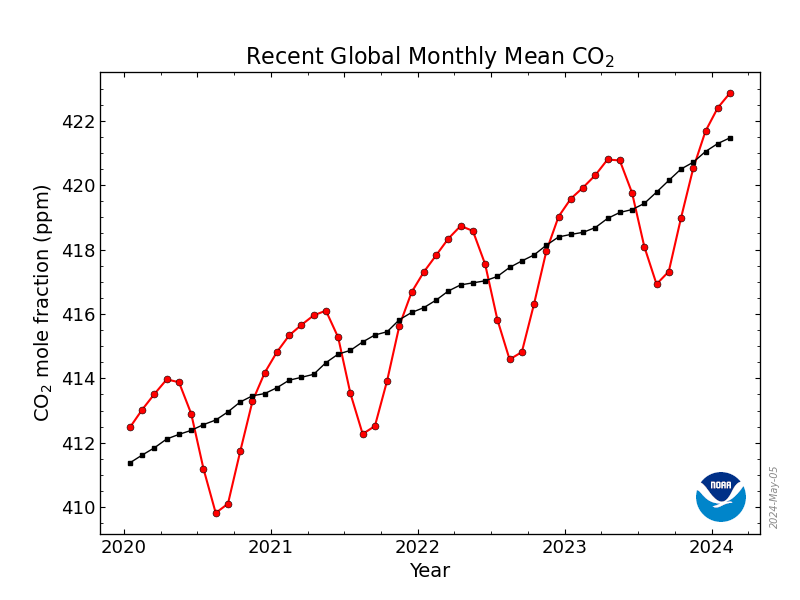
And corruption further drives our environmental destruction- government subsidies for oil companies to produce more oil to produce more global heating from CO2 now total more 7 trillion dollars in 2023. Why would politicans do that, knowing full well that global CO2 levels have already passed the 1.5C degree maximum the world agreed on only a few years ago? Follow the money…’There are no pockets in a shroud’ as my grandma used to say…

Critical thinking is clearly not a strong point for a Western ( or any other)politician . The amazing level of simple blind prejudice of Russia for instance allowed the analysts and leaders of the West to assume (contrary to the actual pre-existing evidence) that Russia would collapse under the West’s sanctions , that the ‘brutal dictator Putin’ would fall and be replaced by someone eager to please the West, while Russia would be defeated in Ukraine because NATO’s Western weapons were so much better than Russian ones and their Western military geniuses so much smarter than Russians!

So it was quite ok to fund train and support neonazis and other nationalist crazies in Kiev who believed they were descended from the Nordic master race, whilst the inferior ‘asiatic’ Russian hordes only had outside toilets and stole washing machine chips for their weapons!

Even now the West simply can’t seem to get it into their heads that they are on the wrong side of history and the wrong side of humanity. The Global South wants no more of the West’s brutal exploitation and colonialism and flat-out lies. And for some strange reason the Global South wants a liveable world!

The evidence is unequivocal, our so-called civilisational ‘progress’ has been made on the backs of environmental destruction and ecocide. Politicians across the globe have consistently refused to acknowledge the real costs of energy consumption and human ‘development’ on our planet and ourselves. The charade of the COP meetings fools no-one

Those devastating costs are only now being made manifest and will continue to do so at an accelerating rate for the next 1000 years or more.

But hey!- whose counting?

Postscript

Israel supposedly DID send a few Sparrow small air to ground missiles into Iran in response, and their terrorist proxies in Iran, the MEK, supposedly also sent a few toy quadrocopter drones of Isfahan– so I kind of got my analysis wrong- but not really!

As a sidenote: ‘In 2017, the year before John Bolton became President Trump’s National Security Adviser, Bolton addressed members of the MEK and said that they would celebrate in Tehran before 2019.’-wikipedia

Don’t Buy This Product We’re Advertising!

Girl in a Natural World

Have you ever seen that kind of email header in your inbox? -hmmm-maybe not!

(Note: this post has been reproduced with the kind permission of changethatmind.com )

Our ‘modern’ society puts enormous pressure on all of us to consume and buy more; whether it’s the ads you see pop up on your smartphone as you scan the web, your social media accounts, your local newspaper or your TV, the billboards on your way to work or on  the public transport you use-the exhortation to buy, buy, buy is constant and ever more insistent.

And our politicians extol the virtues of an ever bigger GDP, of ever more ‘progress’.

And we are all the victims of this propaganda war; we can’t escape, and we all succumb to one degree or another. We feel the need to have something more modern, something better something bigger, something more ostentatious, or even just keeping up with our friends, family or colleagues to have something at least as good as theirs. Why is that, do you think?

We’ve all heard that stuff about there’s only one Earth, but we all act like we don’t believe it and keep consuming enough for at least two! Maybe you’ve noticed how every year there’s a little less greenery, a little more concrete, or even how there’s far fewer bugs that splatter on your car windscreen, or that you don’t hear the birds you used to hear and see when you were younger.

Do you ever wonder why almost all the things we buy are inanimate things? -made of plastic, metal or dead plants?

So as our human population increases more and more, and every one of us wants more and more on this lonely little planet- what’s going to give?

And what can we do instead of consuming more and more?

‘Take the Jump’ has some great suggestions on how to decrease your footprint in the world…

Take The Jump

What if we all reduced our consumption back to the level of what was being consumed in the 1950s in the West? How hard would that be?

The ‘de-growth’ strategists give us a realist’s views of what we need to do to save our planet, and live a fulfilled, joyful and connected life.

Below is CNBC’s take on what degrowth means…

And then there other parallel strategies that can also help reduce our footprint like reducing the stuff or ‘clutter’ in your home.  ‘Homes & Gardens’ have some great ideas on reducing clutter. And there can be a certain pleasure in letting others get some enjoyment from the things you no longer need; whether it’s donating them to a charity or recycling agency, or selling them on Ebay or whatever your country’s equivalent online trader happens to be.

There’s no doubt our world is changing, and humans.  inevitably, will have to change along with those changes- whether we choose to, or whether nature chooses for us.

Our making the choice for ourselves now is so much the better choice!

To a more fulfilled life and better world!

Paul at ChangeThatMind.com

Note that ChangeThatMind is not an affiliate of ANY of the agencies noted in this post; and thence does NOT receive any payment on any of the products not sold through this website!)


Other Relevant Posts

Discover Hope for Humanity’s Future

https://www.the-trouble.com/content/2024/1/16/repair-the-rift-a-review-of-slow-down