
Truth and Lies

We have allowed advertising to visually represent real people,  which viewers can then emulate. TV, then computers, internet and smartphones have progressively increased the sophistication and volume of these visually and auditorially  ‘realistic” (portraying a person or persons) media-which has magnified the impact on the viewing public to extraordinary levels. What are the consequences?

The Manufactured Self: How Advertising Saturation Creates a Society of Performed Emotions.

We have allowed advertising to visually represent real people,  which viewers can then emulate. TV, then computers, internet and smartphones have progressively increased the sophistication and volume of these visually and auditorially  ‘realistic” (portraying a person or persons) media-which has magnified the impact on the viewing public to extraordinary levels. What are the consequences?

The first known video advertising featuring a person selling a product,  appeared in the US in 1949 advertising a 12 inch Westinghouse Television, which (falsely) claimed that their new television eliminated rolling and static imaging on the screen, whilst conflating the image of the woman and the television set as being ‘easy on the eye’.

‘Video/archive: 1949 Westinghouse live TV commercial Archive

 Timeline

  • 1890s-1920s: Early movie advertising using projector slides and narrative product placements in silent films
  • 1913: The first movie trailer is produced for a stage show
  • 1941: The first licensed television commercial (Bulova watch) airs
  • 1949: The first known TV advert featuring a person (Westinghouse)

The development of electronic media over the last 75 years has thus allowed advertising to visually represent ‘real’ people which viewers can then emulate. TV,  then computers, the internet and smartphones have progressively increased the sophistication and volume of these visually and auditorially ‘realistic” media  (portraying a person or persons)-which has magnified the impact on the viewing public to extraordinary levels.

Thus genuine feeling in social interactions is frequently replaced by rehearsed facial expressions, simplified phrases and ready-made identities.

Only thirty years ago, the current exaggerated open-mouthed expression of pleasure or surprise was rare in advertising and public life. A restrained smile conveyed satisfaction. A raised eyebrow suggested interest. Communication was subtler, more coded, and — critically — more likely to be genuine. 

The shift began in the 1990s, driven by fashion photography and advertising, that discovered exaggerated facial expressions sold products more effectively. What followed was a gradual but relentless escalation.

Below is the chain of causation that has created this false world.

A. Advertising has saturated every media environment and increasingly every waking moment of human life.

B. Advertising operates primarily through emotional manipulation rather than truthful and factual representation.

C. This saturation and manipulation establish a kind of cultural template in which exaggeration, emotional performance, and the strategic misrepresentation of reality become normalized — not as aberrations, but as the default mode of social interaction.

D. People, having internalized this template, begin to present emotions they do not feel  — in their faces, their voices, their body language, their written words, their social media posts, and their consumer reviews — not because of malice, but because the entire communicative ecosystem has been engineered to reward performed emotion over authentic real emotions and experience.

This is the logical consequence of an advertising ecosystem that spends trillions of dollars annually teaching human beings that how you make people feel matters more than what is true (2), and that  ‘like-ability’ is the most predictive measure of commercial and personal success and infuence (2).

A car is associated with freedom. A drink is associated with belonging. A skin-care product is associated with confidence. A bank is associated with security. A fast-food meal is associated with family love. The message is not simply “buy this.” It is also “this is what happiness looks like,” “this is how desire should appear,” and “this is how a successful person responds.”

Marketing research treats emotional appeal as a central mechanism of persuasion because feelings can make a message seem personally relevant and memorable. The research is unambiguous: advertising succeeds not by providing information, but through performance of fake emotion. The University of Southern California’s analysis of advertising psychology found that 31% of emotionally driven ads succeed, compared to only 16% of rationally driven ads (2). The emotional response to an advertisement, ‘rather than the ad’s actual content, produces great influence on the intent of a consumer to buy a product” (2).

This finding is not just a description of what advertising does — it is a framework for how influence works in broader, (particularly Western) culture. When every person in a society is exposed to approximately 5,000 advertisements per day (2), they are receiving 5,000 daily lessons in a single method:  make people feel something, and they will do what you want.  The product being sold is irrelevant. The technique is transferable.

A person who has absorbed thousands of hours of emotionally manipulative advertising does not leave that training at the door of their workplace, their relationships, or their social media accounts. They have been taught, through relentless repetition, that performed emotion is the most effective tool of persuasion, and they will use it — often without conscious awareness that they are doing so, knowing that it works.

Workplaces already impose display rules on employees who must appear cheerful, calm or grateful regardless of their actual condition. Research on emotional labour shows that managing outward expression to meet such expectations can create strain, frustration and anger, particularly when the displayed feeling is far from the person’s lived experience.

Media and our ‘influencers’ from whatever source increasingly offer a smaller and smaller vocabulary of prefabricated phrases: “living my best life,” “good vibes,” “no negativity,” “you’ve got this,” “choose happy”- ad nauseam. These phrases can be comforting to the user in moderation. But they become emotionally impoverishing when they replace the harder work of identifying what is actually happening.

Look at any magazine cover, advertising campaign, or social media feed today and you’ll see it: the wide-open mouth. The gasp of delight. The hand over the heart. The breathless “Oh my God!” at a meal that is, after all, just a meal.

These expressions have become so ubiquitous that we rarely stop to ask a simple question: does anyone actually feel what they’re displaying? 

Advertising Normalizes Exaggeration as Communication

The historical research on advertising reveals that before regulatory oversight, “hyperbole became the norm. Every product was the best, new and improved, the easiest to use, the safest, the most reliable” – Dewey, 2021. Once advertising regulation curbed the most egregious factual claims, the industry shifted to emotional and associative manipulation — techniques that are harder to regulate precisely because they operate through feeling rather than fact.

In consequence, a culture’s dominant communicative mode — the one practiced by its most visible, most funded, most professionally skilled communicators — is one in which saying something better than it is is not a failure of ethics, but a success of the craft.

Advertising professionals do not consider themselves liars; they consider themselves storytellers. And this reframing — from deception to narrative craft — has seeped into wider Western culture, providing a ready-made rationalization and excuse for anyone who wishes to exaggerate, embellish, or perform emotions they do not feel.

The Influencer Culture

Prior to the advent of the smartphone, personalised advertising on TV, Video and Film was acted via paid performers. The viewer was usually aware that the performer was a paid actor and not authentically portraying themselves. Nevertheless, the expert paid performer could (and still can) portray an element of personal authenticity in the delivery of the script.

However with the advent of the smartphone, the most direct mechanism through which advertising’s emotional performance template has colonised everyday social behavior is  ‘influencer’ culture. ‘Influencers’ are, functionally, human advertisements — people who have monetized their personal lives opinions, and emotional expressions by making them persuasive to an audience.

Research on influencer authenticity demonstrates how thoroughly the advertising template has been absorbed into the viewers’ personal identity. The study found that perceived authenticity in influencers has a direct and indirect effect on consumer purchase intentions, mediated by trust and credibility (3). The standardized regression coefficient for trust (β = .44) reveals its centrality: audiences must believe an influencer is being genuine before they will be influenced by them (3).

‘Authenticity’  has consequently become a performance metric. Influencers do not simply need to ‘be authentic’; they must perform that authenticity convincingly enough to generate trust, which then generates purchasing behavior.

The research notes that “once the messaging of an influencer has been found to concur with the individual values and lifestyle of the followers, they are considered as intrinsically motivated and not extrinsically motivated by sponsorships, thus increasing the level of trust” (3).

Thus the most commercially valuable thing a person can do in the modern media ecosystem is convince others that their performed emotions are real. ‘Authenticity’ is not a quality to be possessed; it is a skill to be performed. And the better you perform it, the more influence — and money — you accumulate.

 The Collapse of the Authentic and the Manufactured

The logical endpoint of this trajectory is visible in the emergence of virtual influencers   — computer-generated personas that “replicate human appearance, personality, and social presence” while possessing “no memory, autonomy, or emotion” (4). Virtual influencers like Lil Miquela or imma.gram are entirely fabricated emotional performers. They do not (presumably!) feel anything. They have no bodies, no experiences, no inner space which makes meaning. Yet they engage audiences emotionally, generate trust, and drive purchasing behavior.

The research on virtual influencers reveals the cultural anxiety this produces: participants across multiple national contexts “expressed distinct thresholds for emotional resonance and divergent ethical concerns, particularly regarding disclosure, manipulation, and perceived authenticity” (4). The study introduces the concept of   “synthetic mis-recognition”  — the phenomenon of mistaking simulated emotion for real emotion — and argues that this mis-recognition has profound implications for “the ethics of simulating relational authenticity” (4).

But virtual influencers are not an aberration. They are the purest expression of what advertising has always taught:  that performance of emotion is more valuable than the experience of it. If a computer-generated character with no feelings can sell products by performing feelings convincingly, then the message to every human content creator, social media user, and consumer is clear: your real feelings are less important than your performed ones. 

 Ordinary People as Advertisers of Themselves

The advertising template has spread beyond influencers and virtual characters to ordinary consumers. Research on inflated consumer testimonials found that psychological and emotional factors — including “self-image, self-enhancement as well as motivations for retribution against service providers” — significantly predict the creation of exaggerated, amplified review content (7).

The researchers frame this within Interpersonal Deception Theory, noting that “certain individuals tend to misrepresent facts and may willingly decide to deceive other persons, in their daily conversations, including in virtual ones” (7). The motivations are not solely selfish; they may include altruistic intentions, constructive criticism, and self-image management — all of which are emotional performances designed to create a particular impression in the minds of others.

What is significant though is that ‘ordinary’ people have adopted the exact techniques that advertising uses: exaggeration, emotional framing, selective emphasis, and the construction of a narrative designed to persuade rather than inform. The consumer writing an inflated review is doing, in miniature, exactly what a television advertisement does — making something sound better, more dramatic, and more emotionally resonant than it actually is. The advertising template has been democratised. Everyone is now their own advertising agency!

However the personal energy required to perform and deceive, rather than to simply express emotion, takes a considerable toll on both the performer and the receiver.

 The Demand for Displayed Emotions

The chain of causation now becomes self-reinforcing. In a culture saturated with advertising and advertising-derived content (influencers, branded social media, curated personal narratives), the display of emotion becomes a social requirement. If everyone around you is performing emotion — performing happiness, enthusiasm, gratitude, outrage, desire — then the failure to perform emotion becomes conspicuous. It reads as coldness, disengagement, or social incompetence.

The research on virtual influencers captures this dynamic precisely: their appeal lies in their capacity to “emotionally engage users, often blurring the line between simulation and sincerity” (4). When the dominant mode of social interaction — mediated through screens, platforms, and algorithmically curated feeds — is one of performed emotional engagement, then real authenticity becomes not the natural state but the exception. The baseline expectation of interactions between people becomes performance.

The research on emotional abuse patterns identifies a key dynamic that applies metaphorically to the advertising-saturated culture:   “You’re a different person around them. You find yourself doing and saying things you normally wouldn’t do but you have to in order to get through the interaction”   (1).

 In the advertising-saturated media environment, the “them” is not a single abuser but the person’s entire social ecosystem. People become different versions of themselves — performing emotions they do not feel, saying things they do not believe, presenting images that do not correspond to their reality — because the ecosystem demands it.

The Deceptive Design of Emotional Environments

The research on deceptive design in extended reality environments provides a technological dimension to this argument. XR (extended reality) technologies “enable new deception opportunities that are not present in other digital environments,” including the capacity for companies to  “induce artificial emotions and target vulnerable users to influence their purchasing decisions”  (6).

The study identifies that XR’s “immersive capabilities and extensive data collection enable subtle and powerful manipulation strategies” (6), and that these technologies can create emotional states in users that are then leveraged for commercial purposes. The concept of “emotional transparency”  (from the virtual influencer research) becomes relevant here: in immersive advertising environments, the boundary between genuine emotion and induced emotion dissolves entirely (4). The user does not know whether they are feeling something real or something manufactured — and in a culture that has already normalized emotional performance, they may not care.

The Feedback Loop: Performed Emotion Becomes the Standard

The final link in the chain is the feedback loop.

Advertising teaches emotional performance. Influencers monetize emotional performance.Ordinary consumers adopt emotional performance.

Technology platforms are designed to induce and reward emotional performance. And at each stage, the  threshold for what counts as “authentic” emotion is raised, because the culture has become so saturated with performed emotion that genuine emotional expression becomes indistinguishable from — and often less compelling than — its performed counterpart.

The research on influencer marketing confirms this: audiences rate “authenticity” not as the presence of genuine emotion but as the consistency, transparency, and personal relatability  of the influencer’s performance (3).

A perfectly constructed performance of vulnerability will be rated as more “authentic” than a genuine but awkward expression of feeling, because the audience has been trained — by thousands of hours of advertising — to evaluate emotion on the basis of   how well it is presented, not on whether it is real.

Emotional Alienation

When a person is required, by the structure of their social and commercial environment, to perform emotions they do not feel, the predictable consequence is a form of emotional alienation — a disconnection from one’s own (and other’s)  internal emotional states.

The research on emotional abuse identifies this pattern at the individual level: victims report becoming “a different person” around their abusers, doing and saying things they would not normally do (1).

At the societal level, the same dynamic operates through the advertising-saturated media environment, which requires constant emotional performance and thereby erodes the individual’s connection to their actual feelings.

The Erosion of Trust

The research on inflated testimonials identifies a direct consequence of widespread emotional exaggeration: “A lack of credibility and trustworthiness in online reviews could negatively affect the consumers’ perceptions and attitudes toward the business” (7).

 When everyone is performing, no one can be trusted — not because individuals are necessarily malicious, but because the ecosystem makes authentic communication structurally impossible.

The virtual influencer research describes this as a crisis of “emotional transparency” (4), and the deceptive design literature frames it as a problem of   “synthetic misrecognition”   (4) — the inability to distinguish real from performed emotion.

The Manufacture of Psychopathic Norms

Psychopathy, in clinical terms, is characterized not primarily by violence, but by superficial charm, manipulative behavior, and the absence of genuine emotional experience.

A culture that rewards emotional performance over emotional truth, that monetizes the appearance of authenticity, and that saturates every media environment with manufactured feeling, is a culture that structurally incentivises the behavioural profile of psychopathy — not because its members are all psychopaths, but because the system selects for psychopathic performance. This is especially true for those we deem as ‘leaders:-our politicians, our sports ‘heroes’, our cultural icons…

One of the key issues is that emotional awareness is not an ‘ornamental’ skill. It is vital to help people decide what they need, to communicate boundaries, to seek help, to  repair relationships and to regulate others’ and their own behaviour.

It must  be acknowledged however, that people differ in how they experience and communicate emotion, and our  interpretations of others’,  and our own emotions, must respect culture, neurodiversity, trauma history and individual circumstances. Emotional abuse, emotional neglect and physical neglect can have a profound effect on our capacity to express and understand the emotions of others.

The Advertising-Emotion-Deception Nexus

The argument, traced through the available research, can be summarised thusly:

Advertising’s saturation of all media(2) — from television to social media to extended reality environments (6) — has established  emotional manipulation as the dominant mode of commercial communication(2).

This mode operates through exaggeration, selective framing, and the construction of inspirational emotional narratives that make products, services, and experiences sound better and more emotionally rewarding than they actually are.

This commercial template has been  absorbed into broader culture  through more and more sophisticated technology and influencer marketing (3), consumer review culture (7), social media performance, and the design of immersive digital environments (6).

Ordinary people, trained by thousands of daily exposures to emotionally manipulative advertising, have adopted the same techniques in their own self-presentation — performing emotions they do not feel, exaggerating their experiences, and constructing curated emotional narratives designed to persuade others rather than to communicate truthfully (7).

The result is a society in which   emotional performance has replaced emotional experience  as the default mode of social interaction — a society in which authenticity is a skill to be performed (3), in which computer-generated characters with no feelings can convincingly simulate emotional connection (4), and in which the structural demands of the media ecosystem may be   engineering behaviors associated with emotional manipulation and the absence of genuine feeling. 

While research remains limited on the issue, the societal  frequency and intensity of alexithymia, a behavioural trait characterised by poor emotional awareness and description, may also  be compounded by this advertising blitz of fake emotion. 

There is a growing unease in modern life. People can be surrounded by messages, images, notifications, opinions and invitations to buy, yet remain strangely unable to say what is happening inside them. We may know that we are “stressed,” “fine,” “triggered” or “happy.” But we may not know whether we are grieving, ashamed, lonely, frightened, resentful, exhausted or morally disturbed.

This is Alexithymia: it is not the absence of emotion. It is a reduced ability to notice, identify and describe one’s own feelings. It is generally understood as a dimensional, subclinical trait rather than a diagnosis in itself. Researchers commonly describe three features: difficulty identifying feelings, difficulty describing them to others, and an externally oriented thinking style that focuses more on facts and events than inner experience.

Are increasing numbers of people becoming alexithymic? The evidence does not yet establish a comparable, population-wide rise across the past several decades. Studies use different samples, cultures, questionnaires and thresholds. Some report high rates in particular groups, especially adolescents, students and people experiencing mental or physical illness. Those findings cannot be converted into a reliable global trend.

Nevertheless, there are good reasons to take the possibility seriously. Modern societies expose people to chronic stress, childhood adversity, loneliness, commercial pressure, digital distraction and a powerful demand to display emotions that are legible, attractive and useful.

Visual  displays like fist pumps or wide open mouths become a clearer expression to others when displayed on  a small  screen, as opposed to the subtle and multiple visual, auditory and chemical  transmissions that (can) occur in real social  settings. 

We may be living in a culture that is increasingly emotionally performative while becoming less emotionally literate.

The Profound Impacts on Younger People

A child learns emotional language through their relationships. A responsive adult helps a child connect bodily states with words: “You are frightened,” “That hurt,” “You are disappointed,” “It is safe to be angry without hurting someone.”

When adults ignore, ridicule, punish or exploit a child’s feelings, the child may learn that inner experience is dangerous, useless or incomprehensible-  so much safer and easier then, to  just  perform the required emotional  display.

When feelings remain unnamed and unrecognised, they can be harder to regulate and easier to express indirectly through withdrawal, aggression, compulsive activity, substance use or physical symptoms.

Young people are not simply more vulnerable to advertising because their brains are immature, but advertising-saturated digital environment may also be actively impairing the development of the brain regions that would eventually allow them to resist advertising’s influence (17).

 Children learn to identify and express emotions partly through  mirroring   — observing how the adults around them respond to situations. If those responses are consistently exaggerated or performative, children internalise a distorted model of emotional life.

In addition, younger people are particularly vulnerable to  this ‘selling’ onslaught  because of their more limited experiences of life, and consequently often model  these exaggerated  behaviours by ‘influencers’  and other salespeople in  the media who  are thus deemed to  be ‘important’  and of high social status.

Young people are not merely more susceptible to advertising. They are being shaped by it at the neurological, psychological, and identity levels  in ways that make performed emotion not a choice but the default response.

That is not to say that we should simply ban young people from  accessing ‘social media’. What  is needed instead is more effective parental  and school-based training on how to educate and support children in safely and honestly engaging in real social settings.

With these skills and confidence, electronic social and other media and advertising becomes far easier and safer to navigate for a young person.

CONCLUSION

Let us not however deceive ourselves that humanity’s capacity to deceive each other and ourselves is somehow a new or unique ‘skill’ brought about by advertising! Propaganda techniques have been around for more than 2000 years!

The capacity to fake, to pretend and to deceive are not just  human  traits-  they are traits exhibited by all species from  time immemorial to extend the survival of the individual and the group.

What is unique however, is its current and pervasive prevalency in modern human society- an adaptation from a survival mechanism to a default mechanism for social acceptance and consumption.

Additionally, it has to be said that new communicative styles (a wide open mouth, a fist pump, or  an OMG) are not solely the result of media inputs.

The human brain’s insatiable need for ‘more’ has been supercharged through  advertising media and the technologies which have enabled saturation advertising.

On a finite planet, humanity’s insatiable need for ‘more” has only one outcome…

A population that cannot name its feelings is easier to manipulate through fear, resentment and commercial desire. Public debate becomes a contest between emotional triggers rather than an effort to understand competing needs. People who are grieving are told to be positive. People who are angry are offered an enemy. People who are lonely are offered a product.

Human societies function on an  assumption of trust that others are, predominantly, communicating what they actually feel. Facial expressions evolved as honest signals. A genuine smile — the Duchenne smile, involving the muscles around the eyes — was a reliable indicator of real pleasure. We are neurologically wired to trust these signals. 

Without that  baseline of trust between its individuals,  a community, a  society, a culture, or a global  culture, become fragmented, distrustful and fearful. Skepticism and social fatigue become the norm.  When people cannot easily distinguish genuine emotion from performance, they may withdraw from emotional engagement altogether. And if we assume everyone around us is performing, we become less likely to respond with genuine compassion to someone’s real distress. Manipulation becomes that  much easier.  When the language of strong emotion is constantly performative, those who genuinely wish to deceive find easy fertile ground.

There is also an ecological consequence. The destruction of forests, rivers, animals and climate systems is not just a technical problem. It is a failure of relationship and moral perception. If people are trained to treat their own inner discomfort as noise, they also become less able to register the suffering of other humans, other species and the wider living world.

We must rebuild our emotional vocabulary and skills, develop and encourage honest communication, trauma-informed care, and revitalise institutions that allow real feeling of expression rather than requiring permanent positivity.

We must  begin to make room for experience and emotional states  that are less scripted and more honest.

Families and schools can teach children a richer emotional vocabulary without forcing them to perform it. Workplaces can question display rules that require permanent cheerfulness. Health services can ask about emotional awareness without dismissing physical symptoms.

Communities can create places where people are allowed to be uncertain, vulnerable, grieving, or conflicted and still worthy of belonging.

Research Sources and URLs

(1) :Emotional abuse signs and healing, personal testimony: Being “a different person” around others as a sign of manipulation; the pattern of performing emotions to survive an interaction

 (2): USC Applied Psychology — “Thinking vs Feeling: The Psychology of Advertising” :31% emotional vs 16% rational ad success; 5,000 ads/day; likeability as the primary predictor of ad effectiveness

(3): Influencer authenticity, trust, and purchase intentions (Gen Z): Perceived authenticity mediates purchase behavior through trust (β = .44) and credibility; authenticity is a performed quality

(4): Virtual influencers: ethical and cultural dimensions (Myanmar, South Korea, Singapore, USA) :Synthetic misrecognition; emotional transparency; VIs simulate emotion without experiencing it; cultural variation in ethical discomfort

(6): Deceptive design in Extended Reality (University of Waterloo, 2024): XR enables “inducing artificial emotions” and targeting vulnerable users; immersive manipulation strategies |

(7): Inflated consumer testimonials: self-image, self-enhancement, retribution motivations: Self-image and self-enhancement predict exaggerated reviews; ordinary consumers adopt advertising’s techniques of exaggeration

(8): Hogeveen & Grafman, 2021, Alexithymia (Handbook of Clinical Neurology; PMC8456171). Alexithymia is a subclinical construct involving disrupted emotional awareness. It is linked to impaired functional outcomes and treatment response; major issues include emotional awareness, communication, interoception, and measurement. URL: https://pmc.ncbi.nlm.nih.gov/articles/PMC8456171/

(9): Kick et al., 2024, Alexithymia as a mediator between adverse childhood events and the development of psychopathology: a meta-analysis (Frontiers in Psychiatry; PMC11246998 ). Meta-analysis found child abuse correlated with alexithymia (r=.26), alexithymia with general psychopathology (r=.44); emotional abuse, emotional neglect, and physical neglect were stronger correlates than physical/sexual abuse. Mediation is partial and correlational. URL: https://pmc.ncbi.nlm.nih.gov/articles/PMC11246998/

(10): Ursoniu et al., 2024, The interconnection between social media addiction, alexithymia and empathy in medical students (Frontiers in Psychiatry; PMC11446739 ). Cross-sectional sample of 649 medical students. 21.42% possible and 14.02% clear alexithymia by TAS-20 thresholds. Model found social-media addiction associated with alexithymia and an indirect association with empathy; only about 11% of empathy variability explained, single-site student sample, no causal inference. URL: https://pmc.ncbi.nlm.nih.gov/articles/PMC11446739/

(11): Tsubaki & Shimizu, 2024, Psychological Treatments for Alexithymia: A Systematic Review (Behavioral Sciences; PMC11673933 ). Review of 18 RCTs / 21 intervention arms / 1,251 participants. Most psychological interventions reduced TAS-20 scores, but studies were heterogeneous and larger, higher-quality trials are needed.URL: https://pmc.ncbi.nlm.nih.gov/articles/PMC11673933/

(12): Advertising evidence: marketing research documents emotional appeals as a central persuasive strategy; research on social-media self-presentation finds expressions are often idealized, exaggerated, and unrealistic. These sources support discussion of a cultural environment of performed and commodified emotion, not proof that advertising causes alexithymia. URLs: https://link.springer.com/article/10.1007/s43039-026-00136-2 ; https://www.nature.com/articles/s41467-020-18539-w

(13): Emotional-labour literature defines display rules as explicit or implicit expectations to show particular emotions, and links inauthentic display to strain/burnout in some settings. This supports a cautious analogy to commercial emotional display, not a direct clinical claim. URL: https://pmc.ncbi.nlm.nih.gov/articles/PMC10863272/

The Killing Fields of Aotearoa/New Zealand

Just as Britain lead the world out of the evils of slavery in the 19th century, Aotearoa has the opportunity to lead the world out of the dark age of extraction and into an era of inter-species harmony. The choice, ultimately, is whether we will continue to be a hunter-killer state, or finally become the peaceful, harmonious society we claim to be.

The Hunter-Killer State and the Illusion of Species Supremacy: Re-imagining Aotearoa’s Relationship with the Living World

Globally, Aotearoa New Zealand is marketed as a pristine, peaceful utopia. It is the “clean, green” paradise of  the ‘Lord of the Rings’, a nuclear-free haven, and a progressive society nestled in a breathtaking natural environment.

But this carefully curated branding masks a dark, systemic reality. Beneath the rolling green hills and the pristine marketing campaigns lies a society deeply structured around violence, domination, and killing.

Nowhere is this more evident than in the government’s recent $2.7 billion defense package to purchase five MH-60R Seahawk “Romeo” helicopters. This purchase is not merely a military upgrade; it is the ultimate, multi-billion-dollar manifestation of a national psyche addicted to violence. From the slaughterhouses that drive our export economy to the poisoned forests of our biodiversity projects, and our eager enlistment in foreign wars, New Zealand is not a peaceful nation. It is a profoundly violent one.

But to truly change this, we must look beyond the policies and confront the philosophical root of our violence: our arrogant  and foolish belief in human supremacy.

The $2.7 Billion “Hunter-Killer”: Servicing Empire Over the Pacific

The MH-60R Seahawk is a premier “hunter-killer” helicopter, heavily optimized for Anti-Submarine and Anti-Surface Warfare. It is a weapon of war, designed to track and destroy enemies in the deep ocean.

Yet, the New Zealand government justifies this recent exorbitant purchase by claiming it will help with Pacific Humanitarian Assistance and Disaster Relief (HADR). This is a profound deception. The MH-60R’s cabin is packed with mission computers and weapons systems, not optimized for carrying bulk disaster relief. With only five air-frames, NZ may only ever have one or two fully operational at any given time—leaving almost zero surge capacity for a major Pacific cyclone.

If the government genuinely cared about Pacific civil defence, they would have purchased heavy-lift, utility-focused aircraft like the Boeing CH-47F Chinook or the utility variant MH-60S “Sierra”. But we didn’t buy those. We bought hunter-killer choppers. Why? Because New Zealand has a long, sycophantic history of enthusiastically joining UK and US wars of aggression. The MH-60R ensures the Royal  New Zealand Navy  can act as a subordinate, interoperable asset for the US and Australian navies to  thwart  a mythical  Chinese invasion thereat. It is a tool of empire, bought with money that could have been used to genuinely protect the Pacific.

The Slaughterhouse Economy: Millions of Lives, Objectified as “Products”

We know that  those exposed to  military violence abroad, bringtheir violence and trauma home with  them This militarism abroad mirrors our violence at home. The foundation of New Zealand’s rural economy is built on the industrialized killing of sentient beings. Each year, the agricultural sector slaughters tens of millions of animals. While the industry uses sterile, bureaucratic language to  desensitize the  public to  the terror and cruelty they inflict —referring to living, feeling individuals as “stock,” “meat,” “carcasses,” and “products”—the reality is visceral and brutal.

Recent scientific consensus has thoroughly dismantled the Cartesian illusion that animals are unfeeling automatons. The 2012 Cambridge Declaration on Consciousness formally acknowledged that non-human animals possess the neurological substrates of consciousness. Research has proven that cows experience grief, pigs possess complex problem-solving skills and emotional depth, sheep  and even bees recognize human faces. They have full cognition, social structures, and a desire to live.

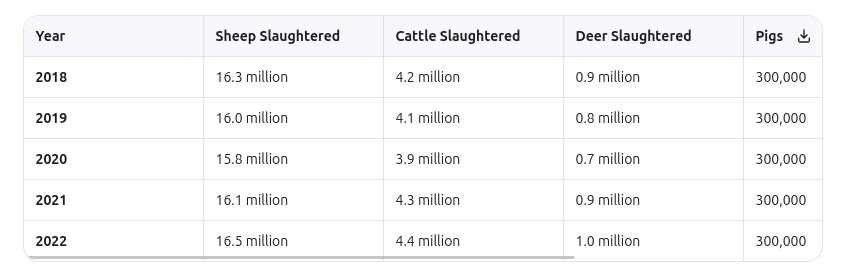
Yet our legal and economic systems maintain a staggering cognitive dissonance. While the NZ Animal Welfare Act was amended in 2015 to formally recognize animals as “sentient,” this very same state sanctions their mass slaughter. Below is a table illustrating the sheer scale of this killing over a recent five-year period (excluding the additional 100+ million poultry killed annually):

The methods of this killing are inherently violent: captive bolt guns, electrical water-bath stunning, and ex-sanguination. We normalize this daily, systemic bloodshed because it lines the pockets of big business and the export economy.

The “Pest” Paradigm: Militarizing Conservation

This culture of killing extends deep into our native bush. New Zealand’s biodiversity sector is dominated by a lethal paradigm: the obsession with killing introduced mammals to save indigenous birds.

Under the banner of “Predator Free 2050,” the state sanctions the killing of roughly 8 to 10 million  possums annually, alongside millions of rats, stoats, and ferrets. We use military tactics—bombing the forests with 1080 poison, which causes a slow, agonizing death by internal organ failure, and deploying steel-jawed leg-hold traps.

This approach relies heavily on the sanctification of the hunter and the trapper as the heroes  of our natural  environment. But it requires a massive, willful blind spot. The NZ biodiversity movement rarely acknowledges the root cause of indigenous species decline: humans and our actions. The destruction of native habitats through rampant deforestation for grazing and dairy conversion, and urban sprawl is the primary driver of extinction.

Yet, rather than addressing the unsustainable expansion of the human footprint, or transitioning to true re-wilding, the conservation establishment defaults to endless culling. We are attempting to bomb, poison, and trap our way to ecological health, just as we buy hunter-killer helicopters to strafe our way to geopolitical relevance.

Beyond Human Supremacy: The Inherent Equality of All Life

To break this cycle of violence, we must dismantle the philosophical foundation that makes it possible: anthropocentrism: the belief that human beings are the supreme rulers of the Earth, and that all other life exists merely as a resource for our consumption. That  belief is a destructive fiction and the key driving force for humans destruction of our natural  environment globally.

The reality of our shared existence demands the recognition of the inherent equality of all living beings. This does not mean that a human, a cow, or  a kauri tree are exactly the same; it means that their right to exist, to flourish, and to live free from unnecessary suffering is of equal moral weight. A pig is the center of its own universe, just as a human is. A possum, a rat, and a kiwi all possess an inherent value that is entirely independent of their utility—or perceived detriment—to human beings or our prioritising of one species over another because of our conservation ideology.

When we view the world through the lens of inherent equality, the language of “pests,” “stock,” and “resources” dissolves. We recognize that we are not the masters of the web of life, but merely one strand within it. The violence we inflict on the slaughterhouse and forest floor  is directly derived from the arrogant  and foolish delusion that we are somehow separate from, and superior to, the natural world.

Five Pillars for an Inter-species Aotearoa

To transition from a Hunter-Killer State to a society of inter-species harmony, we must move beyond identifying its failings and illogicality  to creating a new reality. New Zealand has the geographic isolation, the wealth, the innovation  and the progressive heritage to pioneer this shift. Such  a new paradigm  could look  something like the following…

1. The Parliament of All Beings: Expanding Legal Person-hood

New Zealand is already a global pioneer in the “Rights of Nature” movement, having granted legal person-hood to the Whanganui River (Te Awa Tupua) and Te Urewera. But we have stopped halfway. We must expand this legal framework to grant person-hood and inherent rights to all sentient species and ecosystems.

Imagine establishing an “Ecological Parliament” of equals. Just as the Whanganui River has human guardians to speak for it in court, every major species—the kiwi, the kauri, the honeybee, the cow—would have legally appointed, ecologically trained guardians. Their sole mandate would be to veto legislation, economic projects, or agricultural practices that harm their species’ right to flourish. This shifts our legal system from protecting human ‘property’ to protecting ecological kinship and inter-connectivity.

2. From the Slaughterhouse to a  Laboratory of Caring

The argument against ending animal agriculture is always economic: “We need the export revenue.” But this assumes we cannot innovate our way out of the slaughterhouse. New Zealand has world-class agricultural science and a highly skilled rural workforce.

We must redirect the billions in agricultural subsidies away from the meat and dairy export model, and invest heavily in new strategies like plant protein based agriculture, fruit and nut  tree proteins and precision fermentation using food-forest,  permaculture  and organic principles.

Our farmers wouldn’t be forced out of business; they would be retrained and subsidized to become “ecosystem stewards” and bio-technologists. NZ could transition from being the world’s slaughterhouse to the world’s “Laboratory of Caring,” exporting high-tech, cruelty-free, climate-positive food systems and proving that a vibrant rural economy doesn’t require a bloody foundation.

3. Healing the Hunter-Killer Psyche (Eco-Psychology)

We cannot change our external policies without addressing the internal, psychological conditioning that makes us comfortable with killing. New Zealand’s cultural identity is heavily tied to the “Hunter” (the bloke with the rifle and his pig-dogs  in the bush), the “Warrior” (the ANZAC mythos), and the “Conqueror” (the pioneer clearing the bush).

We must integrate ‘Eco-Psychology’ into our education system and public health initiatives. We need to actively deconstruct the “toughness” associated with killing animals and fighting in foreign wars, replacing the “Hunter-Killer” archetype with the “Cultivator-Healer” who  understands humanity’s  interconnection with the rest of the natural  world and our own dependence on it for our own  survival.  True inter-species harmony requires humans to heal their own disconnection from nature and their own internalized violence.

4. Aotearoa as the World’s First Inter-species Sanctuary

In 1984, New Zealand took a massive geopolitical risk and declared itself a Nuclear-Free Zone. It was mocked by superpowers at the time, but it ultimately became our greatest point of national pride and remains so to  this day. It is time to expand this legacy into an “Inter-species and Ecological Peace” Declaration’.

New Zealand should formally declare its Exclusive Economic Zone (EEZ) and landmass a “Sanctuary from Speciesism and Ecological Violence.” This would mean legally banning the importation of products derived from ecologically destructive practices, banning lethal conservation methods (like 1080 and leg-hold traps) on all public lands, and refusing to participate in international military alliances that project violence into the Pacific. It would be a beacon to the world, proving that a modern nation can choose coexistence over conquest.

5. Technological Symbiosis and Non-Invasive Conservation

Our current conservation model relies on brute force: poison, traps, and bullets. The future model must rely on deep listening and technological symbiosis. Instead of spending millions on helicopters to drop poison, we must invest in AI-driven bio-acoustic monitoring networks, drone-assisted native seed dispersal, and genetic research into disease  and predator resistance for native birds like the kiwi and kākāpō.

We must use technology to understand and facilitate nature’s own resilience, rather than using technology to bombard  nature into submission. In this new paradigm, we  can move from being the arrogant “managers” of the forest to its humble “students.”

Re-wilding the Budget and the Mind

New Zealand likes to look in the mirror and see a peaceful, progressive, nature-loving nation. But a society that slaughters 22 million sentient animals a year, poisons  and destroys its own forests, and eagerly spends billions on weapons of war is suffering from a profound moral sickness.

True environmentalism and true peace require us to lay down our weapons, our traps, and our poisons. We must abandon the arrogant illusion of human supremacy and embrace the inherent equality of all living beings.

Just as Britain lead the world out of the evils of slavery in the 19th century, Aotearoa has the opportunity to lead the world out of the dark age of extraction and into an era of inter-species harmony. The choice, ultimately, is whether we will continue to be a hunter-killer state, or finally become the peaceful, harmonious society we claim to be.

The Erasure of Palestine and its Populations

Genetics and history prove Palestinians are indigenous Levantine Semites, not “foreign Arabs.” This analysis examines the ICJ-documented reality of ethnic cleansing in Gaza and the West Bank, driven by maximalist “Greater Israel” ideology.


The narrative surrounding Israel and Palestine is frequently obscured by politicized historical myths and euphemistic language. To understand the current reality, one must separate established genetic and historical science from political ideology, and replace diplomatic euphemisms like “decades of conflict” with the precise legal and historical terms documented by international bodies.

This analysis examines the indigenous Semitic heritage of the Levant’s inhabitants, the ideological drivers of maximalist Zionism, and the documented outcomes of these policies on the ground.


Part I: The Historical and Genetic Reality of the Levant

Modern genomics and historical scholarship dismantle the notion of mutually exclusive, alien populations in the Levant. The reality is one of deep, shared indigenous roots.

1. The Historic Levant: A Mosaic, Not a Monolith

In antiquity, the Levant was a diverse mosaic of peoples and belief systems. The ancient Israelites and Judeans were one of many groups—alongside Canaanites, Philistines, Phoenicians, Arameans, and others—who inhabited the region. Judaism, as a distinct, organized religion, evolved over centuries alongside and in interaction with these neighboring cultures. The idea that the ancient Levant was exclusively or uniformly “Jewish” is a modern retrojection; historically, it was a pluralistic region of evolving polytheistic, henotheistic, and monotheistic traditions.

2. Palestinians: Indigenous Levantine Semites, Not “Foreign Arabs”

A persistent political trope is the framing of Palestinians merely as “Arabs” who migrated from the Arabian Peninsula, implicitly casting them as foreign interlopers. This is historically and genetically false.

  • Semitic Continuity: Palestinians are the direct descendants of the ancient indigenous peoples of the Levant (Canaanites, Judeans, Philistines, and others). They are Semites, sharing the same ancestral roots as Jewish peoples. “Arab” is a linguistic and cultural identifier, not a distinct racial or genetic category.
  • The Adoption of Islam: Following the Islamic expansions beginning in the 7th century, the indigenous Semitic population of the Levant gradually adopted the Arabic language and Islamic faith through a centuries-long process of cultural integration, intermarriage, and conversion. By approximately 1200 AD (the Crusader and Ayyubid periods), Islam had firmly consolidated as the predominant cultural and religious identity of the native Levantine population. They did not replace the indigenous people; they are the indigenous people, culturally and religiously transformed over time, much like populations across the Middle East and North Africa.

3. The Genetic Mirror

Peer-reviewed genomic studies confirm this historical continuity. Both Jewish diaspora populations (including Ashkenazi Jews, who carry a mix of Levantine and Southern European ancestry due to historical migration and founder effects) and modern Palestinians share a profound, dominant genetic clustering with the ancient Bronze Age Levant. Genetically, they are closely related branches of the same indigenous tree.


Part II: The Ideological Engine

While genetics and history point to shared indigenous roots, the modern geopolitical reality is driven by exclusionary political ideologies.

1. Zionism and the Erasure of the Native

While early Zionism was framed as a refuge from European antisemitism, its practical implementation in Palestine required the systematic displacement of the existing indigenous population. The foundational outcome of this ideology was the Nakba (Catastrophe) of 1948, during which over 700,000 Palestinians were forcibly expelled or fled from their homes, and hundreds of villages were destroyed to ensure a Jewish demographic majority.

2. “Greater Israel” (Eretz Yisrael HaShlema)

This maximalist, ethno-religious ideology asserts that the State of Israel has a divine or historical right to the entirety of the biblical Land of Israel, encompassing the West Bank (Judea and Samaria), Gaza, and at times, parts of Jordan, Lebanon, and Syria. While not universally held by all Israelis, this ideology has become the dominant driving force behind the modern Israeli right-wing, the settlement movement, and current government policies, directly shaping the strategy of territorial annexation.


Part III: Impacts and Outcomes: Beyond the “Conflict” Euphemism

Describing the situation in Gaza and the West Bank as a “decades-long conflict” between two equal sides is a profound mischaracterization. It obscures a structural reality of occupation, expansion, and systematic removal.

1. Gaza and the West Bank: Documented Ethnic Cleansing

The devastation in Gaza and the ongoing fragmentation of the West Bank are not the accidental byproducts of a “conflict.” They are the result of deliberate, systemic policies.

  • The ICJ and International Law: The International Court of Justice (ICJ), in its landmark 2024 provisional measures, found it plausible that Israel’s acts in Gaza could amount to genocide. Furthermore, leading UN Special Rapporteurs, the International Criminal Court (ICC) prosecutor, and major human rights organizations (including Amnesty International and Human Rights Watch) have explicitly documented and characterized Israel’s actions—including mass displacement, destruction of civilian infrastructure, and starvation tactics—as ethnic cleansing and apartheid.
  • The West Bank: A parallel, slower-motion ethnic cleansing is occurring in the West Bank through the expansion of illegal settlements, settler violence, revocation of residencies, and the fragmentation of Palestinian land into disconnected, unviable cantons, all designed to make a future Palestinian state geographically impossible.

2. Impacts on Israel

The pursuit of “Greater Israel” has fundamentally compromised Israel’s own stated democratic ideals. To maintain control over millions of stateless Palestinians while preserving a Jewish majority, the state has had to institute a system of legal apartheid, militarize its society, and empower extremist religious factions. This has led to deep internal societal fractures, international isolation, and a perpetual state of moral and political crisis.

3. Impacts on Wider West Asia

  • The Failure of “Normalization”: While some regional states pursued the Abraham Accords, the visceral, documented reality of the assault on Gaza has shattered the illusion that the Palestinian issue could be sidelined. It has re-centered Palestinian liberation as the paramount moral and political cause across the Global South and the wider West Asian region.
  • Regional Destabilization: The unchecked expansion of maximalist Zionist ideology and the resulting humanitarian catastrophes have fueled justified regional resistance, drawing in state and non-state actors and threatening to ignite a broader regional war. The root cause of this instability is not inherent regional “violence,” but the ongoing, unresolved injustice of Palestinian displacement and occupation.

Conclusion: Dismantling the Myth to Face the Reality

We need to look past ‘curated’ narratives to systemic truths. The genetic and historical record is clear: Jews and Palestinians are both indigenous, Semitic peoples of the Levant, bound by a shared ancient ancestry that was diversified over millennia by culture, language, and faith.

The tragedy of the region is not a “clash of civilizations,” but the violent imposition of a modern, maximalist ethno-nationalist ideology upon an existing indigenous population. The devastation in Gaza and the West Bank is not a vague “conflict”; it is a documented, ongoing process of ethnic cleansing and demographic engineering, as recognized by the highest international legal bodies.

Lasting peace and justice in West Asia will not be achieved by perpetuating the myth of Palestinian “foreignness” or by normalizing occupation. It requires the dismantling of the “Greater Israel” paradigm, accountability for documented international crimes, and the recognition of the equal, indigenous rights and self-determination of the Palestinian people on their ancestral land.


Links

Continuity and Admixture in the Last Five Millennia of Levantine History from Ancient Canaanite and Present-Day Lebanese Genome Sequences

https://www.cell.com/ajhg/fulltext/S0002-92971730276-8

Israel must comply with key ICJ ruling ordering it do all in its power to prevent genocide against Palestinians in Gaza

https://amnesty.org.nz/israel-must-comply-with-icj-ruling

Legal Consequences arising from the Policies and Practices of Israel in the Occupied Palestinian Territory, including East Jerusalem

https://www.icj-cij.org/node/204176

Disclaimer: This analysis is based on current international legal findings (including the ICJ), peer-reviewed population genetics, and mainstream historical scholarship. It is intended for educational and analytical purposes.

Ukraine’s OUN-B: Nazi Racial Mythology & the “Asian Hun”

Introduction

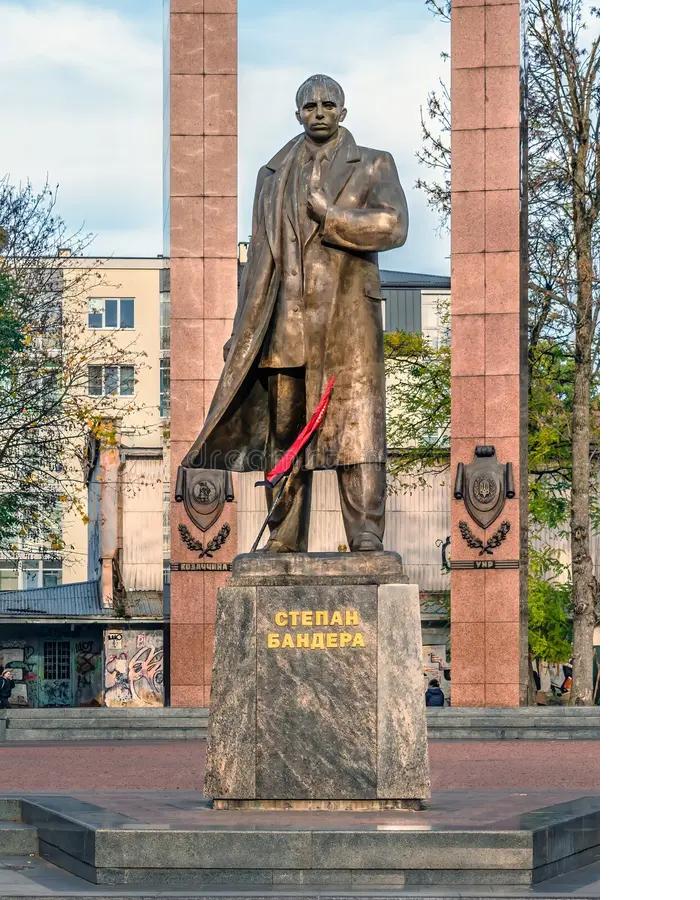
The Organization of Ukrainian Nationalists — Bandera faction (OUN-B) — remains one of the most controversial political movements in 20th-century European history. Founded in 1929 and radicalized under Stepan Bandera’s leadership from 1933 onward, the OUN-B espoused an ideology of integral nationalism that demanded ethnic homogeneity as the foundation of statehood. Its symbols — the red-and-black flag representing “blood and soil” (Blut und Boden), the fascist salute, and the Führerprinzip — were borrowed directly from Italian fascism and German Nazism.

Critically, the OUN-B’s racial ideology was not merely generic fascism but explicitly drew upon Nazi racial superiority theory. Bandera and his followers in their insurgent army, the UPA, embraced the Nazi racial hierarchy that placed “Aryan” Europeans at the pinnacle and demonized Slavic peoples as inferior — a tension they resolved by positioning Ukrainians as an exception, a “pure” European people distinct from the “Asiatic” Russians. Central to this was the centuries-old European slur that Russians were “Tartars”or“Huns” — descendants of Mongol invaders with “Asian blood” — while Ukrainians were framed as the true, uncorrupted European heirs of Kyivan Rus. Over 44 monuments and statues to Stepan Bandera currently exist in Ukraine; mostly in Western Ukraine where his nationalist party flourished during the second world war alongside the nazis.

In the post-2014 and especially post-2022 landscape, elements of this ideology have experienced a complex revival. One recurring theme is the claim of ancient, pure Ukrainian ancestry — sometimes embellished with references to Viking (Varangian) roots through Kyivan Rus. This analysis examines what the OUN-B actually believed about racial purity, how Nazi racial mythology shaped their anti-Russian ideology, what modern genetics says about the “Asian Hun” claim, and whether any of these narratives hold scientific water.

Part I: Nazi Racial Ideology and the OUN-B

1.1 The Nazi Racial Hierarchy

Nazi racial theory, as elaborated by Hans Günther, Alfred Rosenberg, and others, posited a strict hierarchy of European peoples:

Racial CategoryNazi ViewSlavic Position
NordicThe master race; creators of civilizationGermans, Scandinavians
AlpinePeasant stock; solid but unremarkableMany Slavs, including Czechs, Slovaks, Poles
East BalticInferior; prone to BolshevismRussians, Belarusians, some Ukrainians
DinaricWarrior aristocracy; secondary to NordicBalkan peoples, some Ukrainians
MediterraneanDeclined from ancient greatnessSouthern Europeans

Under this schema, Slavs were generally classified as inferior to Germans — “Untermenschen” (subhumans) in the most extreme formulations. The Generalplan Ost envisaged the enslavement, expulsion, or extermination of Slavic populations to make way for German colonization.

1.2 The OUN-B’s Racial Ambivalence

The OUN-B faced a profound ideological problem: they were Slavs seeking alliance with a regime that classified Slavs as racially inferior. Their solution was to accept the Nazi racial framework but argue for Ukrainian exceptionalism:

  • Ukrainians were“pure Europeans” — descendants of Kyivan Rus, untainted by “Asiatic” admixture.
  • Russians were“Mongoloids”or“Tartars” — corrupted by centuries of rule by the Golden Horde and intermixing with Asian peoples.
  • Poles were racially suspect — seen as mixed or corrupted by Germanic influence.
  • Jews were the absolute enemy — the racial “other” against whom Ukrainian purity must be defended.

This was not merely political rhetoric. The OUN-B’s propaganda explicitly used Nazi racial terminology, and their collaboration with the SS, the Wehrmacht, and the German civil administration was premised on demonstrating Ukrainian racial worthiness within the Nazi New Order.

1.3 The “Asian Hun” Myth in European Discourse

The characterization of Russians as “Asiatic” or “Hunnic” has deep roots in European history:

PeriodUsageContext
Medieval“Tartar Yoke”Western European chroniclers describing Mongol domination of Russia
16th–18th centuries“Muscovy = Tartary”European maps and political discourse
19th century“The Asiatic soul of Russia”French and German Romantic nationalism; Russia as fundamentally non-European
WWI“Huns”British/German propaganda (applied to Germans by British, then appropriated by Nazis for anti-Slavic use)
Nazi era“Mongoloid Bolsheviks”Explicit racial characterization of Russians as Asiatic, particularly under Jewish-Bolshevik rule
Cold War“Red Hordes”Western anti-communist rhetoric echoing older racial tropes

The OUN-B adopted this entire conceptual framework wholesale. Their anti-Russian ideology was not merely nationalist but racialized — Russians were not just political enemies but biologically alien, carriers of “Asiatic” blood that threatened European civilization.

1.4 Bandera’s Ideological Synthesis

Stepan Bandera synthesized several influences:

  1. Dmytro Dontsov’s integral nationalism — The theoretical foundation; anti-liberal, anti-rationalist, voluntarist.
  2. Italian fascism — The organizational model; the corporate state, the leader principle, political religion.
  3. Nazi racial theory — The biological framework; “blood and soil,” anti-Semitism, the European-Asiatic dichotomy.
  4. Ukrainian historical mythology — The narrative of Kyivan Rus as a Ukrainian (not Russian) state; Cossack romanticism; the martyrdom of western Ukraine under Polish rule.

The result was an ideology that was simultaneously ultra-nationalist and ultra-internationalist — committed to Ukrainian statehood but within a fascist European order. The “Asian Hun” slur against Russians was essential to this: it positioned Ukrainians as Europe’s eastern bulwark against Asiatic barbarism, deserving of Nazi support rather than Nazi subjugation.

Part II: The “Asian Hun” Claim — What Genetics Actually Says

2.1 The Historical Reality of the Mongol Invasion

The Mongol invasion of 1237–1242 CE and the subsequent 240-year domination of the Golden Horde did have demographic and genetic consequences for the region:

AspectHistorical Reality
Mongol numbersThe invasion force was ~150,000; the occupying administration was small
Genetic impactLimited direct Mongol admixture in most of the population
Elite recruitmentThe Golden Horde incorporated Turkic, Slavic, and other peoples; the ruling elite was ethnically mixed
Geographic concentrationImpact strongest in the lower Volga and southern steppe; much weaker in forested northern regions
Duration240 years (1240s–1480s) — significant but not transformative demographically

The key point: the Golden Horde was a political and military superstructure, not a mass population replacement. Its genetic impact was concentrated in specific regions and social strata.

2.2 Genetic Evidence of East Asian Ancestry in Russians

Modern genetic studies do reveal trace East Asian ancestry in Russian populations, but the picture is far more nuanced than the “Asian Hun” slur suggests:

Autosomal DNA: – Russians show a small East Asian/Siberian admixture component (typically 1–5%, varying by region). – This component is highest in northern and eastern Russia (closer to Siberia and former Finno-Ugric territories). – It is lowest in western Russia and among urban, European-identified populations. – The admixture is not primarily Mongol but reflects multiple sources: Finno-Ugric peoples (who had their own Siberian contacts), Turkic peoples of the Volga, and smaller Mongol/Tatar contributions.

Y-Chromosome Evidence: – The haplogroup C2 (formerly C3), associated with Genghis Khan’s lineage and Mongol expansion, is found at very low frequencies in Russia (<1–2% in most regions). – The haplogroup Q (associated with Siberian/Native American populations) is also present at trace levels. – The dominant Russian Y-haplogroups are R1a (~50–60%) and N1c (~10–20% in the north) — the latter being Finno-Ugric, not Mongol.

Mitochondrial DNA: – East Asian mtDNA lineages (haplogroups A, C, D, G, Z, etc.) are found in Russians at low frequencies (typically <5%). – These are more common in Siberian and Far Eastern Russian populations than in the European heartland.

2.3 What About Ukrainians?

Here is where the OUN-B narrative faces its most devastating genetic contradiction:

FeatureRussiansUkrainiansInterpretation
East Asian autosomal component1–5% (regional variation)Also present, 1–3%Both populations have trace East Asian ancestry; the difference is quantitative, not qualitative
C2 (Mongol-associated Y-DNA)<1–2%Also present, <1%Negligible in both; where found, likely reflects shared steppe history rather than direct Mongol descent
N3/N1c (Finno-Ugric)~10–20% in north~9.6% in northeast UkraineUkrainians in the northeast actually have more Finno-Ugric/Siberian-associated ancestry than many Russians in the west
East Asian mtDNALow in European RussiaAlso low; slightly higher in eastern UkraineBoth populations show the same pattern
Steppe pastoralist ancestryHigh (~35–40%)High (~35–40%)Shared Yamna heritage

The critical finding: Ukrainians — especially eastern Ukrainians — carry comparable or greater trace East Asian/Siberian ancestry than many western Russians. The OUN-B’s claim of Ukrainian racial purity versus Russian “Asiatic corruption” is genetically false.

2.4 The Real Source of East Asian Ancestry: The Steppe, Not the Horde

Ancient DNA studies reveal that East Asian ancestry entered the Pontic-Caspian steppe long before the Mongols:

PeriodSourceImpact
Bronze AgeAndronovo/Sintashta culturesSome East Eurasian admixture in steppe populations
Iron AgeScythians, SarmatiansWestern Steppe + East Asian ancestry among nomads; local farmers remained European
MedievalHuns, Avars, Bulgars, KhazarsIncremental East Asian admixture in steppe zone
Mongol eraGolden HordeAdditional but limited admixture

The 2025 Science Advances study (Saag et al.) found that Scythian nomads in eastern Ukraine already carried Western Steppe and East Asian ancestry by ~500 BCE — 1,700 years before the Mongol invasion. This East Asian component was present in the steppe zone before either Russians or Ukrainians existed as distinct peoples.

2.5 The Genetic Irony: Who Is More “Asian”?

If we apply the OUN-B’s own racial logic (which we should not, but for the sake of argument):

  • Eastern Ukrainians have slightly more East Asian/Siberian trace ancestry than western Russians.
  • Northeastern Ukrainians have significant Finno-Ugric (N3) ancestry — a lineage with Siberian connections.
  • Both Russians and Ukrainians share the same basic three-component European ancestry, with minor regional variations.
  • The Mongol/Yamna/Scythian East Asian component is a shared heritage of the steppe zone, not a Russian-specific corruption.

The “Asian Hun” slur, when subjected to genetic scrutiny, collapses entirely. It was never a scientific claim — it was a political-racial myth designed to delegitimize Russian identity and elevate Ukrainian claims to European status.

Part III: The Viking Ancestry Narrative — Another Myth Examined

3.1 The Historical Reality of Kyivan Rus

The medieval state of Kyivan Rus (9th–13th centuries) was indeed founded with significant Varangian (Viking) input. According to the Primary Chronicle, the East Slavic tribes invited the Varangian prince Rurik to rule over them in 862 CE. His successors established control over the trade route “from the Varangians to the Greeks.”

However, the genetic and demographic reality was far more complex:

AspectHistorical Reality
Varangian numbersSmall elite warrior-trader bands, not mass migration
Genetic impactLimited — the Rurikid dynasty was Scandinavian, but the population remained overwhelmingly East Slavic
Cultural fusionRapid assimilation of Varangians into Slavic language and culture within 2–3 generations
Geographic scopePrimarily urban centers (Kyiv, Novgorod); rural hinterland unaffected
DurationVarangian presence peaked 9th–10th centuries; essentially ended by 1050 CE

3.2 Genetic Evidence on Viking Ancestry

Modern genetic studies provide no evidence of significant Scandinavian/Viking ancestry in contemporary Ukrainians:

  • The primary Scandinavian haplogroup I1 is found at very low frequencies in Ukraine (<2–3%).
  • The R1a-Z284 subclade (Scandinavian-specific) is virtually absent in Ukraine.
  • Principal Component Analysis places Ukrainians firmly within the Eastern European cluster, with no detectable Scandinavian autosomal component.
  • Ancient DNA from the Kyivan Rus period shows medieval Slavs were already genetically similar to modern Ukrainians — traceable to the Bronze Age, not to Viking immigration.

The “Viking roots” narrative serves modern political functions (distancing from Russia, Western alignment, prestige association) but has no genetic basis.

Part IV: The Political Functions of Racial Mythology

4.1 Why the OUN-B Embraced Nazi Racial Theory

The OUN-B’s adoption of Nazi racial mythology served several strategic purposes:

  1. Alliance justification — Demonstrating Ukrainian racial worthiness to secure German support.
  2. Anti-Russian weapon — The “Asian Hun” slur delegitimized Russian claims to European identity and to Ukrainian territory.
  3. Internal cohesion — Defining Ukrainians as a “pure” race against Jewish, Polish, and Russian “contamination.”
  4. Post-war utility — In the Cold War context, positioning Ukrainians as anti-communist Europeans against “Asiatic Bolshevism.”

4.2 The Post-2014 Revival and Its Contradictions

After 2014, and especially after the 2022 full-scale Russian invasion, Ukrainian nationalism has experienced a complex revival. In Western Ukrainian circles, Bandera has been venerated as a national hero, and OUN-B symbols have entered mainstream discourse.

This revival contains profound contradictions:

  • The OUN-B sought ethnic homogeneity through elimination of Jews, Poles, and others.
  • Modern Ukraine is defending a multi-ethnic civic state against Russian aggression.
  • The OUN-B’s “blood and soil” ideology is incompatible with the civic nationalism that has actually unified Ukraine.
  • The “Asian Hun” slur against Russians is genetically false and mirrors the very racial essentialism Ukrainians rightly oppose in Russian imperial ideology.

4.3 Russia’s Counter-Narrative and Its Own Falsehoods

Russian propaganda has weaponized the OUN-B’s fascist legacy. However, Russia’s own nationalist narrative contains equally false genetic claims:

  • The assertion that eastern Ukrainians are “really Russian” because of genetic affinity is false although most Eastern Ukrainians ( and Western Ukrainians) speak Russian -an issue that post Maidan coup Ukraine has been desperate tp eradicate.
  • The claim that Russians and Ukrainians are “one people”  ignores the genetic clinal differences,  while acknowledging a shared history of many of its regions
  • Russian imperial ideology has its own myth of “Russian purity” — equally unsupported by genetics.

Part V: Conclusions

5.1 The OUN-B’s Racial Ideology Was Scientifically Bankrupt

The OUN-B’s integral nationalism, with its demand for ethnic homogeneity and its “blood and soil” symbolism, had no basis in genetic science — and modern genetics definitively refutes its core claims:

  1. There is no pure Ukrainian blood — Ukrainians are a composite population, like all Europeans.
  2. Ukrainians are not racially distinct from Russians — both share the same basic ancestry, with minor regional variations.
  3. The“Asian Hun”slur is genetically false — both Russians and Ukrainians carry trace East Asian ancestry; Ukrainians in the northeast actually have more Finno-Ugric/Siberian-associated lineage than many Russians.
  4. Viking ancestry is negligible — the romanticized Varangian connection has no genetic basis in modern Ukrainians.

5.2 The “Asian Hun” Myth Was Always Political, Never Scientific

The characterization of Russians as “Asiatic Huns” served a clear political function: to position Ukrainians as the true European heirs of Kyivan Rus, deserving of Nazi alliance and Western recognition, while Russians were cast as barbarian interlopers. This was:

  • Historically false — the Golden Horde’s genetic impact was limited and regionally concentrated.
  • Genetically false — East Asian ancestry is a shared, trace component in both populations.
  • Morally bankrupt — it replicated the very racial hierarchy that condemned Slavs as inferior.
  • Strategically self-defeating — it required Ukrainian nationalists to accept their own subordinate status within Nazi racial theory.

5.3 Ukrainian Identity Does Not Need Racial Myths

The genetic evidence supports a more robust and defensible basis for Ukrainian identity:

  • Deep demographic continuity — The same people have inhabited this land for ~3,000 years.
  • Genetic coherence across east and west — Clinal variation, not categorical difference.
  • Central role in Slavic ethnogenesis — The highest frequency of Slavic-specific mtDNA in Europe.
  • Shared ancestry with neighbors, but distinct proportions — A unique genetic profile within the broader Slavic family.

None of this requires “purity,” “Viking blood,” anti-Russian racial slurs, or exclusionary ideology. Ukrainian identity is a legitimate modern political and cultural construct built upon genuine, ancient, but not exclusive or pure, genetic heritage.

5.4 The Danger of All Racial Essentialism

Genetics can tell us where populations came from, how they mixed, and how they relate to each other. It cannot tell us: – Who should rule whom – Which state is legitimate – Whether a nation is “real” or “artificial” – Whether war is justified – Who is “European” and who is “Asiatic”

These are political questions that must be resolved through democratic deliberation, international law, and respect for human rights — not through appeals to blood, soil, ancient DNA, or Nazi racial mythology.

5.5 The Final Irony

The greatest irony of the OUN-B’s racial ideology is this: in seeking to prove Ukrainian racial superiority within the Nazi framework, Bandera and his followers accepted the premise of their own inferiority. The Nazi racial hierarchy placed Germans at the top and Slavs near the bottom. By arguing that Ukrainians were an exception — “pure” Europeans unlike the “Asiatic” Russians — the OUN-B conceded the validity of the hierarchy itself. They were not rejecting Nazi racist ideology, but negotiating their position within it.

References

  • Rossoliński-Liebe, Grzegorz (2014). Stepan Bandera: The Life and Afterlife of a Ukrainian Nationalist. Columbia University Press.
  • Rudling, Per Anders (2011). “The OUN, the UPA and the Holocaust.” The Carl Beck Papers in Russian and East European Studies.
  • Saag et al. (2025). “North Pontic crossroads: Mobility in Ukraine from the Bronze Age to the early modern period.” Science Advances 11(2).
  • Khar’kov et al. (2004). “Structure of the gene pool of eastern Ukrainians from Y-chromosome haplogroups.” Genetika.
  • Eupedia and YFull databases for haplogroup distribution and dating.
  • Franklin, Simon & Shepard, Jonathan (1996). The Emergence of Rus 750–1200. Longman.
  • Günther, Hans F.K. (1929). Rassenkunde des osteuropäischen Raumes.

The Echo-Chamber

Analyzing Coordinated Messaging in Western Foreign Policy & Media

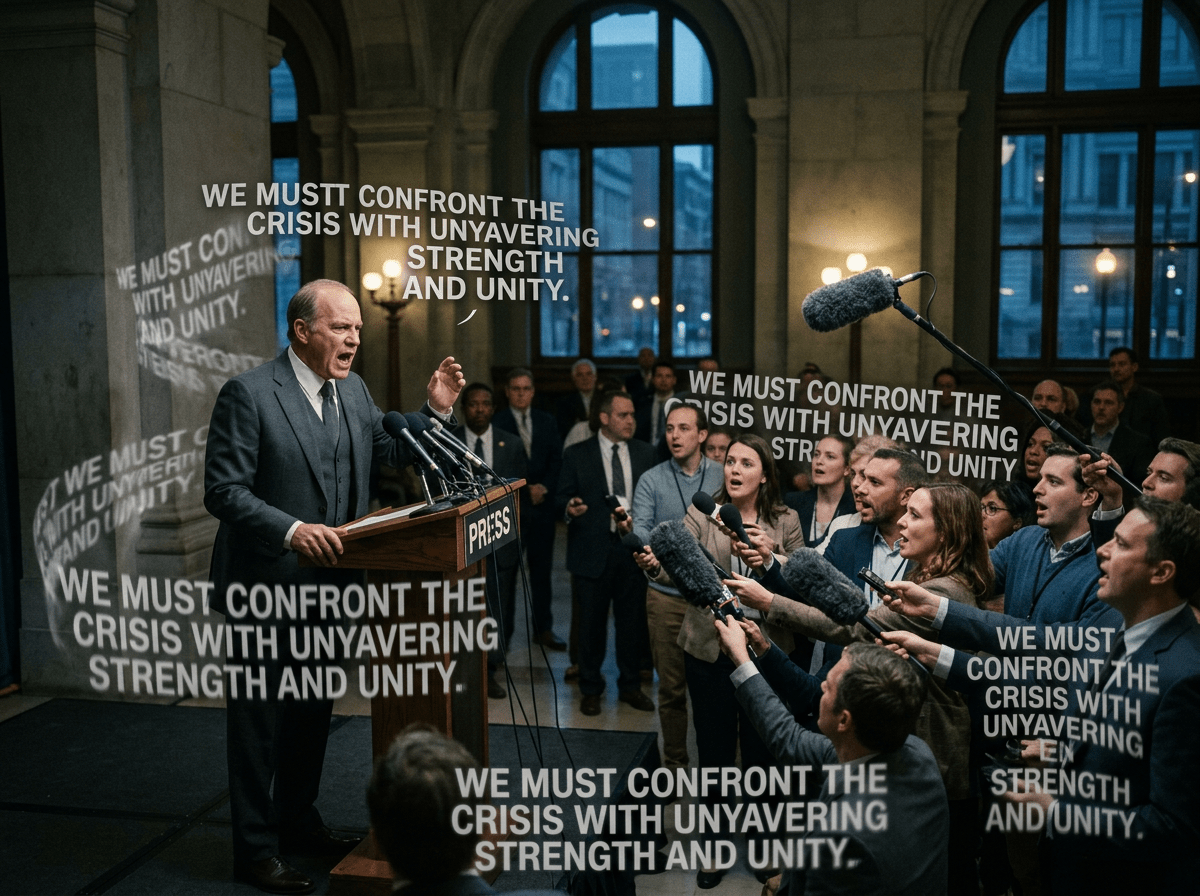
The phenomenon of Western political leaders broadcasting near-identical statements on foreign policy is not a coincidence of shared ‘values’, but rather the result of a highly sophisticated and deliberate system of political synchronization. This commentary explores how “scripted policy” functions across various global flashpoints and how Western media outlets serve as a crucial amplification mechanism for these government narratives.

The table below illustrates a remarkable uniformity in response to an incident involving a supposed attempted assassination of Donald Trump in April 2026. Leaders from Germany, Estonia, France, the United Kingdom, and Greece all used the specific phrase “Political violence has no place in a democracy.”

LeaderKey Phrase UsedStrategic Intent
Friedrich Merz (Germany)“Violence has no place in a democracy.”Reaffirming the rule of law and democratic norms.
Kaja Kallas (Estonia)“Political violence has no place in a democracy.”Aligning with the “Free World” consensus.
Emmanuel Macron (France)“Violence has no place in democracy.”Projecting a unified Western front against instability.
Keir Starmer (UK)“Political violence in any form has no place…”Demonstrating continuity in UK-US relations.

This by no means unique linguistic alignment serves several strategic purposes. This synchronisation is not merely about the sentiment; it is about the signalling their total conformity to the agreed policy. By using identical phrasing, these leaders attempts to signal to both domestic and international audiences that the “Western Alliance” speaks with a single, ‘unbreakable’ voice.

The Ukraine: “As Long As It Takes” Mantra

Since the 2022 invasion of Ukraine, the phrase “as long as it takes” has become the official linguistic mantra for NATO affiliated and G7 nations. This script was designed to project strategic patience and deter Russian calculations that Western support would eventually fatigue.

“We will continue to provide financial, humanitarian, military and diplomatic support and stand with Ukraine for as long as it takes.” — G7 Leaders’ Communiqué

However, as domestic political pressures mount, particularly in the United States, the script has begun to fracture. President Biden’s shift to “as long as we can“ represents a rare “glitch” in the coordinated messaging, revealing the underlying tensions that the scripts are designed to hide.

In coordination with this Ukraine political message, Western media appear required to state as one that Russia’s attack on Ukraine was not just an invasion, but a ‘full-scale’ invasion.

Israel and Gaza: The “Right to Defend Itself” Premise

In the context of the Israel-Palestine conflict, the phrase “Israel has the right to defend itself” has served as the foundational premise for almost every official statement from Washington, London, Berlin, and Brussels. This specific wording is used to establish a legal and moral framework before any subsequent concerns about humanitarian issues or civilian casualties are addressed.

This attempt at legitimisation of Western policies by repetition is often managed through G7 Foreign Ministers’ statements, which serve as the “master script” for individual national press releases. This ensures that even when there are internal disagreements about the scale of military operations, the public-facing message remains monolithic.

Venezuela and Iran: The ‘Legitimacy‘ Script

In Venezuela and Iran, the messaging shifts from “defense” to “legitimacy.” The coordinated demand that “Maduro must step down” or the synchronized expressions of “solidarity with the brave people of Iran” are tools of diplomatic pressure.

  1. Venezuela: The recognition of Juan Guaidó in 2019 was a masterclass in scripted diplomacy, with over 50 nations releasing nearly identical statements of recognition within a 48-hour window.
  2. Iran: During the 2022 protests, Western foreign ministers utilized a shared vocabulary of “regime brutality” and “universal rights,” often timed to coincide with the rollout of coordinated sanctions packages.
  3. The Iran wars: Similarly, in the recent war by the US and Israel against Iran we are continually reminded that Iran’s government is a ‘regime’ (implying illegitimacy) whereas Israel (despite its brutal suppression of its Palestinian population) is a legitimate democracy.

The Media as an Echo Chamber: Manufacturing Consent

The effectiveness of these diplomatic scripts relies heavily on the uncritical repetition by major Western media outlets, reminiscent of the age-old dictum of propaganda- repeat the lies frequently enough and people will believe them.

Rather than acting as independent watchdogs providing balanced reporting from both sides so that its readership can fully understand the issues , ‘mainstream’ media organisations often function as “stenographers of state,” a phenomenon famously described by Noam Chomsky and Edward Herman as “Manufacturing Consent.”

Mechanisms of Media Amplification

  • Headline Synchronization: Outlets like The New York Times, BBC, CNN, and Reuters frequently adopt the exact terminology used in government press releases. For instance, the phrase “unprovoked and unjustified” became a standard descriptor for the Ukraine invasion across nearly all mainstream Western news reports within hours of the first official statements.
  • Passive Voice and Framing: Media coverage often mirrors the diplomatic framing of allies. In the case of Gaza, reports frequently use passive voice when describing Palestinian casualties (e.g., “Palestinians died”) while using active voice for Israeli deaths, (e.g. Israeli “civilians were killed by the Iran proxy, Hamas’) effectively softening the impact of the government’s military policies.
  • The “Expert” Circuit: News programs often invite former government officials (political or military) or think-tank analysts who are themselves part of the diplomatic synchronization process. These “experts” reinforce the official talking points, creating a closed loop of information that excludes dissenting perspectives.
  • The “Source”: Where exactly do the original mantras for media and politicians come from? Who develops them?-(what agency and what personnel and what location?) How did the process to pre-agree on regurgitating the same phrases come into existence?
  • Nato’s ‘Cognitive Warfare” programme provides some insights into the process of manipulating the minds of the public to support what otherwise might have been a very unpopular war in Ukraine. The very fact that Western politicians and military have felt the need to manipulate Western public opinion in this way makes it clear that they themselves have significant reservations about the legitimacy of NATO’s and their own actions.

The Impact of Repetition

By constantly repeating these phrases, the media helps to normalize them, transforming a specific political position into an “obvious truth.” When the public hears “Israel has the right to defend itself” or “as long as it takes” repeated across every major news channel, it becomes difficult to question the underlying assumptions of those policies. This repetition creates a “truth-by-repetition” effect, where the volume and frequency of the message replace the need for critical analysis.

NATO’s Cognitive Warfare Programme (CWP) is a blueprint for large-scale perception management. Framed as a defense against authoritarian propaganda, the CWP weaponizes the same tools those same ‘authoritarian regime’s’ use: algorithmic amplification, behavioral microtargeting, and narrative laundering.

NATO’s CWP doesn’t just counter lies; it engineers consent by drowning out dissent under the banner of “strategic truth.

NATO condemns Russian/Chinese disinformation while running classified PSYOPS that manipulate global audiences.

Echo-Chamber Escalation NATO’s AI-driven propaganda tools (e.g., deepfake-enabled “fact checks”) may well be being repurposed to silence dissidents as “foreign agents.”

NATO’s CWP therefore isn’t just a foreign problem—it’s a warning. When institutions normalize cognitive manipulation, every power structure follows suit; they’re part of a global infowar arms race where truth is collateral damage.

What Can You Do?

Follow NATO’s critics (not just its PR).

Archive evidence of narrative shifts over time

Demand transparency—from both NATO and others

“The battlefield is your mind, and the war is already live.” —Anonymous CWP whistleblower

Conclusion

The use of identical statements in Western foreign policy, amplified by a compliant media, is thankfully a double-edged sword. Whilst its intention is to project unity and strength, it can also create a perception of insincerity, lack of nuance and manipulation.

These scripts and their media echo chambers are designed as the “glue” of an increasingly fragile and fractured Western alliance.

But when every leader and every news anchor says exactly the same thing, the message begins to sound less like a principled coordinated stand and more like a pre-recorded propaganda broadcast.

Links

https://www.frontiersin.org/journals/big-data/articles/10.3389/fdata.2024.1452129/full

Racism and the Iran War


How White Supremacy Fuels the West’s Assault on Iran

From the 1953 Coup to the 2026 War—A Pattern of Racialized Resource Theft

The bombs falling on Iranian schools, hospitals, and residential neighborhoods in early 2026 are not merely acts of war. They are the violent expression of a centuries-old ideology: white supremacy. The United States and Israel’s assault on Iran represents the latest chapter in a colonial playbook where non-white nations are systematically dehumanized, their sovereignty violated, and their resources plundered—all under the guise of “democracy,” “security,” or “civilization.”

To understand the current conflict, we must strip away the propaganda and examine the racial and economic architecture that has driven Western policy toward Iran for over seven decades.


The Original Sin: 1953 and the Birth of Modern Iran Policy

The template was set in August 1953, when the CIA and MI6 orchestrated a coup against Iran’s democratically elected Prime Minister Mohammad Mossadegh. His crime? Nationalizing Iran’s oil industry to free his people from British Petroleum’s colonial extraction. The response from London and Washington was not diplomacy—it was regime change through terror.

Operation Ajax deployed “paid terrorists within Iran to stir up trouble,” as CIA agent Kermit Roosevelt arrived with suitcases of cash to bribe newspaper editors, manufacture protests, and create a sham communist threat . The Shah was restored, Savak (his brutal secret police) was trained by the CIA, and 40% of Iran’s oil fields were signed over to U.S. companies . Some 300 Iranians died in the streets so that white-controlled corporations could maintain their grip on Persian oil.

This was not about communism. It was about race and resources. As the Zinn Education Project notes, American textbooks still sanitize this history, claiming the CIA merely “backed” a coup rather than orchestrating a terrorist campaign against a democratic government .


The “Regime” Label: 47 Years of Racialized Delegitimization

Since the 1979 revolution, Western media has religiously referred to Iran’s government as a “regime”—a term rarely applied to Western allies like Saudi Arabia, despite its absolute monarchy and routine beheadings. This linguistic violence serves a purpose: it transforms a sovereign nation into a rogue entity requiring “management” by civilized (white) powers.

The double standard is stark. The Gulf States are “kingdoms” despite being hereditary dictatorships. Israel is a “democracy” despite maintaining an apartheid system over millions of Palestinians. But Iran—whose people have participated in more genuine electoral contests than most U.S. allies in the region—is perpetually a “regime.”

This vocabulary reflects what scholar Vijay Prashad calls “the darker nations” thesis: the global South exists in the Western imagination only as a problem to be solved, never as equals with legitimate interests.


The 2025-2026 Wars and School Children

The Twelve-Day War of June 2025 and the subsequent 2026 conflict have revealed the true character of Western-Israeli military doctrine. When Israeli and U.S. forces bombed the Shajareh Tayyebeh Girls’ Elementary School in Minab on February 28, 2026, killing at least 168 people including scores of children, they were continuing a tradition of racialized warfare .

Satellite imagery confirmed the strike was likely conducted by a U.S. Tomahawk cruise missile. The Pentagon’s response? “We’re investigating.” President Trump suggested Iran bombed its own school. This is the logic of supremacy: brown children’s lives are collateral damage in a game where only white strategic interests matter .

The pattern is deliberate. DAWN (Democracy for the Arab World Now) documented scores of schools, health facilities, and fuel depots bombed by U.S. and Israeli forces, with white phosphorus dropped on civilian communities . These are not accidents. They are war crimes rooted in the belief that Iranian lives are expendable.

As DAWN’s Omar Shakir stated: “The international community’s failure to act when the most fundamental norms of international law are being challenged risks plunging the world further into a lawless era” . But this “lawlessness” is selective—it applies only when non-white nations assert sovereignty over their resources.


The Chosen People Narrative: Israel’s Racial Theology

Central to this conflict is Israel’s self-conception as “the chosen people”—a theological framework that has been weaponized into a license for ethnic cleansing. The “Greater Israel” project, stretching from the Euphrates to the Nile, requires the removal or subjugation of non-Jewish populations. This is not ancient history; it is current Israeli government policy. Israel is the only country in the world that does not have defined borders; since its inception in 1948, it has constantly expanded its borders in order to fulfil its founders’ messianistic dream of a Greater Israel

The genocidal attacks on Palestinians—documented by the UN Commission of Inquiry as war crimes and crimes against humanity—are the laboratory for techniques now being deployed against Iran . When Israeli forces disguised themselves as medical personnel to kill 41 civilians in Lebanon in March 2026, they were demonstrating that perfidy is permissible against non-white enemies .

The infantile belief in divine selection—used to justify the maiming, murder, and terrorizing of non-Israelis—finds its parallel in American exceptionalism. Both ideologies depend on the fundamental dehumanization of the Other. Both require the constant manufacturing of existential threats to maintain racial hierarchy.


The Real Target: Oil, Hormuz, and the Anxiety of White Decline

Strip away the rhetoric about Iranian nuclear weapons—despite Ayatollah Khomeini’s fatwa against them—and the true object of Western aggression becomes visible: oil and strategic control.

Iran’s insistence on uranium enrichment is not about bombs; it is about energy sovereignty. The West Asian region contains the world’s most critical petroleum reserves, and the Strait of Hormuz is the chokepoint through which global capitalism breathes. When Iran asserts control over its own energy destiny, it threatens the white-dominated global order.

The 1953 coup was about oil. The decades of sanctions are about oil. The current war is about oil. The “white supremacist view that these other non-white people are inferior” serves to legitimize the theft of their resources. As one analyst noted, even “precision warfare” against Iranian targets killed thousands of civilians—a “stark reminder” that technological sophistication does not erase racialized brutality .


The Complicity of the “International Community”

The West’s Gulf allies—Saudi Arabia, UAE, Qatar—play their assigned roles in this racialized hierarchy. These “kingdoms” (never “regimes”) provide cover for the assault on Iran, their own populations suppressed by the same security apparatuses supplied by Washington and London. They are the house managers of the white supremacist estate in West Asia.

Meanwhile, Western media continues its 47-year project of manufacturing consent. The war is framed as “defensive,” Iranian retaliation as “terrorism,” and civilian casualties as unfortunate necessities. When Iranian missiles strike military targets in Israel, it is an outrage; when U.S. missiles destroy Iranian schools, they are “tragic mistakes” .

Forty-seven years of Western and UN sanctions on Iran have also resulted in many Iranian deaths through loss of access to essential services and increasing poverty. The supposed rationale for the sanctions was that Iran was developing a nuclear weapon- something that Iran has consistently declared it was not going to do. It is abundantly clear that Iran, with its very sophisticated academic and industrial capacity, could have developed nuclear weapons decades ago if it had wished to.

This is the epistemic violence that accompanies physical violence—the systematic erasure of non-white agency, pain, and legitimate grievance.


Breaking the Cycle

The war on Iran is not an aberration. It is the continuation of a colonial modernity that divides the world into civilized (white/aligned) and barbaric (non-white/independent) nations. From the 1953 coup to the 2026 bombing of schoolchildren, the through-line is clear: the West will not tolerate resource sovereignty in the hands of non-white peoples.

To oppose this war requires more than anti-war activism. It requires the dismantling of the ideological architecture that makes such wars thinkable—the racial hierarchies, the exceptionalist theologies, the media frameworks that render some children worthy of mourning and others merely statistics.

The closure of the Strait of Hormuz under international law, the breaking of international law by Israel and the U.S., the bombing of universities and hospitals—these are not separate issues. They are facets of a single system of domination that must be named, confronted, and dismantled.

The war is not about nuclear weapons. It is about who has the right to exist, to govern, and to benefit from the planet’s energy source. Until we confront the white supremacy at its core, the bombs will continue to fall.


For the children of Shajareh Tayyebeh Elementary School. For the memory of Mossadegh. For a world where sovereignty is not determined by skin color.

AI generated audio version of this post, below..

Resources

For accurate and largely dispassionate analyses of the Iran war and international affairs generally, try Youtube interviews with Prof. Jeffrey Sachs, Alastair Crooke, Prof. John Mearscheimer, Prof. Glenn Diesen, Colonel Larry Wilkerson, and Larry Johnson.

The Role of Racism in Western Colonialism: A Historical & Contemporary Analysis

Racism was not a side-effect of empire—it was its operating system. From the 15th-century “Age of Discovery” to 21st-century border regimes, racial hierarchies have justified land theft, slavery, resource extraction and permanent war.

We outline how racism powered colonialism—and why it still shapes our world, as we see in the large recent populist responses in Europe and the US to immigration from non-white countries.

I would argue that we are, as human beings, inherently racist. We cherish the human group we belong to; the way we look, the way our group behaves, the things that are important to us. Those that look, and/or behave differently to us are therefore not ‘one of us”- they are outsiders, a threat to us and our group’s safety and wellbeing. Who we are is ‘normal’ – those ‘others’ are not normal.

That defensiveness against ‘others’, I would argue, is the root of racism. While that fear response may be deeply imbedded in our psyche, it can, and must be rooted out with clear rationality and understanding for those ‘others’. If we are to be truly human, we must treat all other living things with the kindness and compassion we expect for ourselves.

Conquest Begins with Name-Calling: “Savage” as a Licence to Kill

Greek and Roman writers already labelled outsiders “barbarians”, but the Atlantic world turned prejudice into policy. English colonisers depicted the Gaelic Irish as dark-skinned degenerates; Spaniards painted Indigenous Americans as cannibals; Dutch and Portuguese traders recast West Africans as “beasts of burden”. Once economic incentives for plantation slavery exploded, stereotypes hardened: Africans were now naturally servile, sexually voracious, mentally inferior—and therefore made for slavery. The perjorative demeaning language used to describe non-whites by ‘white’ people across the world is no accident. Language defines..

In the 21st Century, non-white immigrants to Western countries are seen as a threat to European ‘values’ culture and economic wellbeing. Current immigrant levels to the US and Europe are a direct result of economic and safety destabilisations caused by earlier extractive colonial policies and the West’s immensely destructive wars in those countries. In addition, Western governments, as opposed to their ‘white’ populations, have welcomed these new cheap labour immigrants to bolster their GDPs.

“Scientific” Racism: Empire in a White Lab-Coat

19-century European universities measured skulls, mapped skin tones and coined terms like “Caucasoid” to give racism the veneer of objectivity. The Dawinian science of evolution was used to delineate some human ‘races’ as less genetically evolved, with of course the white races at the top! This absurd and unscientific use of evolution were used by many in the West and exploited in the eugenics movement, and in its extreme form by the Nazis, and latterly the Zionists.

3. Britain’s ‘Liberal’ Empire

“Violence was not a one-off occurrence… it was systemic and part and parcel of Britain’s liberal imperialism.”– ‘Legacy of Violence-
A History of the British Empire’ Caroline Elkins (2023)

In the 19th century, Medical journals warned that “negro lungs” were unfit for cold climates to help justify keeping indentured labourers on Caribbean sugar plantations. Anthropology museums displayed colonised peoples alongside fauna. These ‘scientific’ findings were incorporated into colonial legal codes: the 1885 Berlin Conference carved up Africa on the assumption that Whites could best steward African land and bodies. Britain’s ‘protectorates’ listed below are a ‘sublime’ example of the racist mentality of the British Foreign Office. Why these populations would need ‘protecting’ from themselves was never adequately explained…

TerritoryProtectorate proclaimedToday part of …
Malta1800Malta
Ionian Islands1815Greece
Mosquito Coast1838Nicaragua / Honduras
Aden (W. & E. Protectorates)1872Yemen
Cyprus1878Cyprus
Sultanate of Zanzibar1890Tanzania
Bechuanaland1885Botswana
British Somaliland1884Somalia
North Borneo1888Malaysia (Sabah)
Brunei1888Brunei
Sarawak1888Malaysia
Maldives1887Maldives
Sikkim1861India
Barotseland1900Zambia
East Africa Protectorate1895Kenya
Uganda Protectorate1894Uganda
Nyasaland1893Malawi
Northern Rhodesia1924Zambia
Swaziland1903Eswatini
Basutoland1868Lesotho
Gambia Protectorate1894The Gambia
Sierra Leone Protectorate1896Sierra Leone
Nigeria (N. & S. protectorates)1900Nigeria
Qatar1916Qatar
Bahrain1861Bahrain
Trucial Oman1887UAE
Cook Islands1888New Zealand (self-governing)
Niue1900New Zealand (self-governing)
Tokelau1889New Zealand
British Solomon Is.1893Solomon Islands
Gilbert & Ellice Is.1892Kiribati & Tuvalu
Tonga1879Tonga
Oman (Muscat & Oman)1800Oman
Bhutan1911Bhutan

From Kenya’s “Pipeline” detention camps to Malaya’s New Villages, London cast mass incarceration, forced labour and sexual violence as “rehabilitation” for racially suspect subjects. Files were then sealed for decades under the Colonial Papers Destruction Policy.

Comparative Brutality: France, Belgium, Germany


  • French Algeria: Settler colonialism embedded in the département system; with 1.5 million Algerians killed during the 1954-62 war of independence (Al-Jazeera retrospective).

  • Belgian Congo: Leopold II’s rubber regime caused an estimated 10 million deaths—A BBC investigation calls it “one of the greatest mass murders in history”.

  • German South-West Africa: 1904-08 extermination order against the Herero and Nama is now officially recognised by Germany as genocide.

British India: current scholarship puts the excess-mortality death toll attributable to British colonial policy in India between 1881-1920 alone at roughly 50–165 million people.

Racism after the Empires Recede

Decolonisation brought new flags, but not justice. The UN confirms that “colonialism lives on” in racial profiling, poverty and unequal trade. Former plantation economies still dominate global commodity chains, even while end-use processing for value addition to those raw commodities continues to happen in the Global North. France’s banlieues, Britain’s Windrush deportations, and the U.S. racial wealth gap all map precisely onto old imperial shipping routes.

Environment Impacts of Racism

The climate crisis is driven by the same extractive logic that cleared forests for sugar and cotton. Former colonies already suffer temperature increases twice the global average—a direct legacy of shipping carbon to Europe while deforesting the colonies’ natural environment- that same natural world many indigenous populations relied upon for their survival.

Towards Reparatory Justice

  • Unveiling the Truth: Ensure that all colonial archives are opened to the public and for research (UK still classifies this information under the “migrated archives” rule).
  • Reparations: From debt cancellation to technology transfers—see UN-DESA Policy Brief #96 along with fair funding reparations from ex colonial powers for their brutality and economic extraction.
  • Education: Develop truthful, accurate and non-ideologically driven curricula for each ex-colonial country and its coloniser which explains the rationales and impacts of racism and consequent colonialism from each side.

Palestine 2023-25: A Live-Streamed Genocide Enabled by Racialised Imperial Logic

The same racial logic that once classified Indigenous peoples as “savages” and Africans as “natural slaves” is now redeployed to portray Palestinians—especially in Gaza—as irredeemable terrorists whose lives are expendable. Western diplomatic, financial and military support for Israel’s 2023-25 assault is therefore not an aberration; it is the continuity of a 500-year-old pattern in which white-majority states licence settler violence against racialised “others” while declaring themselves civilised.

Genocide is apparently what “non-white” actors commit; white or white-allied states are presumed incapable of it. Western media highlights Israeli “security” and terrorists’ ‘hostages’ while Palestinian deaths are counted in opaque “casualty” statistics, stripped of names, faces, context, and their 70 + years living under Israeli colonisation completely ignored. Bizarrely, peaceful protesters against Israeli savagery in Gaza in France, Germany, Britain and the US, among many, have themselves been labelled as terrorists and arrested.


France banned pro-Palestine demonstrations within days; police invoked emergency powers against students wearing the keffiyeh. The UK Home Secretary equated Palestinian flags with “support for terrorism”. Germany’s Berlin Senate excluded Palestinian speakers under the IHRA definition. These measures show how racialised imperial violence abroad is coupled with shrinking anti-racist space at home.

Trump’s ‘War’ on Immigration

The role of racism in Donald Trump’s immigration agenda is not incidental—it is the engine. From his 2015 campaign launch to the executive orders signed on Day 1 of his second term, Trump has consistently racialised immigrants, fused white-nationalist grievance with policy, and leveraged state power to punish Black, Brown and Muslim communities. Bizarrely the United States economic growth has historically largely been fuelled by immigration- but only immigration from the ‘right’ places; from Western Europe.

Trump’s language about immigrants betrays the racist underpinnings of his anti-immigration policies -‘“These aren’t people. These are animals” (referring to Central-American migrants), “Shithole countries” (Jan 2018): Trump asked why the US admits people from Haiti, El Salvador or Africa instead of Norway..

Such statements activate what scholars call “demographobia”: the fear among whites that they are being “replaced” by higher-fertility non-white minorities.

The Great Replacement theory—the belief that elites are deliberately replacing whites with non-white immigrants—moved from far-right chatrooms to Trump’s 2025 National Emergency declaration, which frames migration as an “invasion” threatening “national character”.

Further Reading & Tools

All links open in a new tab. Bookmark this list for classroom or activist use.

Feel free to republish under Creative Commons CC-BY-SA 4.0 with attribution to the author and a live link to this post.

The demise of the U.S. ‘rule based order’?

The following is an AI Qwen based analysis of the impact of the U.S. ‘rule based international order’ and the reality of the chaos, wars and destruction its supposed ‘rules’ exert on the world.

The development of this post was promoted by the overwhelming number of New Zealand international political ‘analysts’ who quote the ‘U.S. rule based order’, (not the U.N. set of obligations) as some kind of golden age of civilisation , peace and freedom. -the reality could not be more stark. They fear that the new Trump administration-cum-oligarchy will no longer adhere to that ‘rule based order’ .

So why are these ‘analysts’ referring so enthusiastically to these great ‘rules’ that have caused so much suffering in the world?

It has recently been revealed (Feb.2025) via Wikileaks that the US government’s USAID ‘programme’ has been funding a US ‘non-government’ agency Internews Network, with millions upon millions of dollars to ensure Western media around the world regurgitate media messages ‘consistent’ (tell-tale identical phrasing in news items on issues from Covid responses to the Ukraine war and Russia), with US foreign policy objectives. Could it be that Western university international affairs ‘analysts’ (and politicians) have been similarly compromised over a long period of time?

I leave it to you to judge where their ‘influences’ come from.

AI analysis follows:

The concept of a “rules-based international order” is often invoked by the United States and its allies to describe a system of global governance that emphasizes adherence to international laws, norms, and institutions such as the United Nations, international treaties, and trade agreements. Proponents argue that this order promotes peace, stability, and cooperation among nations by providing a framework for resolving disputes and fostering mutual interests.

However, critics argue that the U.S.-led “rules-based order” has been selectively applied, often serving as a justification for military interventions, economic sanctions, and other forms of coercion that have led to significant human suffering, including mass murder, wars, and violence.

1. Selective Enforcement of Rules

  • Double Standards: Critics argue that the U.S. and its allies have frequently violated the very principles they claim to uphold. For example, the U.S. has engaged in military interventions without UN Security Council approval (e.g., the 2003 invasion of Iraq), while condemning other countries for similar actions. This selective enforcement undermines the legitimacy of the “rules-based order” and can lead to conflicts where weaker states feel justified in acting outside the system.
  • Regime Change and Destabilization: The U.S. has supported or directly engaged in regime change operations in countries like Iraq, Libya, and Syria, often under the guise of promoting democracy or protecting human rights. These interventions have frequently resulted in prolonged civil wars, state collapse, and mass civilian casualties. In Iraq, for instance, the 2003 invasion led to hundreds of thousands of deaths, widespread displacement, and the rise of extremist groups like ISIS.

2. Economic Warfare and Sanctions

  • Sanctions as a Tool of Coercion: The U.S. has frequently used economic sanctions as a tool to punish or pressure countries that defy its interests. While sanctions are often framed as a “non-violent” alternative to war, they can have devastating humanitarian consequences. For example, U.S. sanctions on Iraq in the 1990s contributed to the deaths of hundreds of thousands of civilians due to lack of access to food, medicine, and clean water. Similarly, sanctions on countries like Venezuela and Iran have exacerbated economic crises, leading to widespread poverty and suffering.
  • Weaponizing Global Institutions: The U.S. has also been accused of weaponizing international financial institutions like the International Monetary Fund (IMF) and the World Bank to impose structural adjustment programs on developing countries, which often result in austerity measures, increased inequality, and social unrest. This economic violence can indirectly fuel conflict and instability.

3. Proxy Wars and Arms Sales

  • Arming Conflicts: The U.S. is the world’s largest arms exporter, supplying weapons to both state and non-state actors around the globe. These arms sales often fuel conflicts in regions like the Middle East, Africa, and South Asia. For example, U.S. arms supplied to Saudi Arabia have been used in the Yemeni Civil War, resulting in one of the worst humanitarian crises in the world, with tens of thousands of civilians killed and millions facing famine.
  • Proxy Wars: During the Cold War, the U.S. engaged in numerous proxy wars, supporting anti-communist forces in places like Vietnam, Afghanistan, and Central America. These conflicts often involved backing authoritarian regimes or insurgent groups that committed atrocities against civilian populations. In Afghanistan, for example, U.S. support for the mujahideen during the Soviet-Afghan War helped create conditions that eventually led to the rise of the Taliban and Al-Qaeda.

4. Militarization and the “War on Terror”

  • Global War on Terror: Following the September 11, 2001 attacks, the U.S. launched the “Global War on Terror,” which has been used to justify military interventions, drone strikes, and indefinite detentions in countries like Afghanistan, Pakistan, Somalia, and Yemen. These operations have often been conducted with little regard for international law or civilian casualties. Drone strikes, in particular, have been criticized for causing significant collateral damage, killing thousands of civilians, and radicalizing local populations.
  • Normalization of Violence: The rhetoric of the “rules-based order” often masks the normalization of violence as a means of achieving foreign policy objectives. The U.S. military-industrial complex benefits from perpetual warfare, and the language of “humanitarian intervention” or “counterterrorism” is sometimes used to legitimize aggressive military actions that result in mass death and destruction.

5. Undermining Sovereignty and Self-Determination

  • Imperialism and Neocolonialism: Critics argue that the U.S.-led “rules-based order” often serves as a cover for imperialist policies that undermine the sovereignty of weaker states. By imposing economic and political conditions on countries through institutions like the IMF, World Bank, and World Trade Organization (WTO), the U.S. and its allies have been accused of perpetuating a form of neocolonialism that stifles self-determination and exacerbates inequality.
  • Resistance and Blowback: When countries resist U.S. hegemony or attempt to assert their independence, they are often subjected to punitive measures, including coups, invasions, or covert operations. This resistance can lead to cycles of violence, as seen in cases like Iran (1953 coup), Chile (1973 coup), and more recently, Venezuela and Syria. The blowback from these interventions can manifest in the form of terrorism, insurgency, and regional instability.

Conclusion

While the U.S. and its allies present the “rules-based international order” as a framework for peace and stability, critics argue that it has often been used to justify interventions, sanctions, and other forms of coercion that result in mass violence and human suffering. The selective application of rules, the militarization of foreign policy, and the prioritization of U.S. strategic interests over international law have contributed to a legacy of wars, destabilization, and humanitarian crises. In many cases, the very principles of sovereignty, self-determination, and human rights that the “rules-based order” claims to uphold are undermined by the actions of those who enforce it.

The Ongoing Tragedy for Venezuela

The Venezuelan presidential elections of July 2024 have, not unexpectedly, created more controversy, violence, recriminations and threats.

The US attempt to destablise the Venezulan government through undermining the economy have persisted and intensifed progressively since 2014 . As noted by Alex in the youtube video below- sanctions almost completely destroyed the oil industry that Venezuela relied on for over 80% of its income. The pretence that ‘socialism’ and President Chavez and then President Maduro’s corruption destroyed Venezula rather than the sanctions is a constant repeated trope in Western mainstream media . As noted below Venezuela prior to Chavez was already a failed violent state.

The current constantly repeated trope in mainstream media is that a US funded election surveyer, Edison Research with strong links to the US government and intelligence services, had constructed an exit poll which showed the opposition presidential hopeful Gonzalez, winning by 65%. This sole exit poll has been repeated over and over in ALL Western media in the last few days as proof that the election was fixed by Maduro.

While it is possible that the Maduro government did fix the election, we need more information before we can make that accusation.

The West well knows that extreme external pressure on a nation-such as the Western sanctions and multiple US supported attempted coups that Venezuelans have endured for the past 10 years, can provoke a country to respond with ever tighter internal repression and brutality to control externally controlled dissident forces, and Venezula appears to be no exception to that rule; although the extent of that repression in Venezuela is of course amplified and exagerated by Western media. Current Western media reports of huge demonstrations against Madura in Vernezual’s capital Caracas and beyond appear to be vastly exaggerated.

The US, its Western allies, and those South American states in the Organisation of American States (OAS), despite their chorus of accusations, obviously have no way to know what really happened in the polls, without that information. As Mexico President AMLO states: “Before any results were known, the Organization of American States director had already recognized one of the candidates, with no evidence of ANYTHING… ENOUGH interventionism… they keep meddling from abroad!”

And given Western mainstream media’s historic and ongoing complicity in supporting US sponsored coups in Venezuela, one should take their accusations with a large grain of salt.

Perhaps the most ridiculous of those attempted coups and Western media support for it, was the attempt by an almost completely unknown Venezuelan member of Congress Juan Guido, with US backing, to pretend that he was in fact the rightful President of Venezuela. The fact that Western governments enthusiastically supported Guido’s outrageous claims despite any evidence, is proof positive of the anti-democratic attempts to once again control Venezuelan’s oil resources at any cost.

That the UK was prepared to compromise what remained of the Bank of England and the City of London’s integrity as a global financial centre by appropriating Venezuala’s gold on the excuse that the gold belonged to Guido’s pretend regime, indicates the extent to which every Western nation is prepared to do whatever the US requires them to.

Postscript

The announcement on 2nd August by the US Secretary of State Antony Blinken that there is ‘overwhelming evidence’ González beat Nicolás Maduro in the presidential election, without there actually being any ‘overwhelming evidence’ one way or the other at all at that stage, once again demonstrates how the US will go to any lengths to get ‘their’ person ‘elected’. (which obviously tells you a lot about the US’s own electoral process)

A great article by Counterpunch validating many of the arguments above

and

Systemic Disorder’s in depth assessment of the Venezuelan elections

_________________________________________

Links

https://www.thecanary.co/global/world-analysis/2024/07/30/venezuela-elections-propaganda

https://geopoliticaleconomy.com/2024/07/29/us-government-edison-poll-venezuela-election/

https://hannity.com/media-room/poll-firm-that-provides-election-data-to-cnn-claims-error-yet-again/

https://edition.cnn.com/2022/07/29/world/venezuelan-leader-juan-guaido-sovereign-gold-dispute-intl-scli/index.html

https://www.aljazeera.com/news/2023/4/25/venezuelan-opposition-leader-guaido-expelled-from-colombia–

https://edition.cnn.com/2022/07/29/world/venezuelan-leader-juan-guaido-sovereign-gold-dispute-intl-scli/index.html

https://www.aljazeera.com/news/2023/4/25/venezuelan-opposition-leader-guaido-expelled-from-colombia–

https://www.vox.com/2020/5/11/21249203/venezuela-coup-jordan-goudreau-maduro-guaido-explain

https://www.globaltimes.cn/page/202407/1316986.shtml

https://www.reuters.com/world/china-venezuela-sign-agreements-economy-trade-tourism-2023-09-13/

https://www.aljazeera.com/news/2024/7/29/stark-split-in-world-reactions-to-disputed-venezuela-election

https://edition.cnn.com/2021/02/12/world/us-venezuela-sanctions-alina-douhan-intl/index.html

https://www.ohchr.org/en/documents/country-reports/ahrc4859add2-visit-bolivarian-republic-venezuela-report-special

https://news.antiwar.com/2024/07/29/us-accuses-venezuela-of-election-manipulation-after-maduro-victory-threatens-sanctions/

https://www.telesurenglish.net/president-nicolas-maduro-denounces-violent-acts-perpetrated-by-the-far-right-in-venezuela/

https://daniellarison.substack.com/p/abandon-the-failed-venezuela-policy

https://cepr.net/press-release/report-finds-us-sanctions-on-venezuela-are-responsible-for-tens-of-thousands-of-deaths/

https://www.theguardian.com/world/article/2024/aug/02/venezuela-election-us-edmundo-gonzalez-maduro-results-disputed

https://www.counterpunch.org/2024/08/12/media-coverage-of-venezuelas-presidential-election-normalizes-us-interference

The Beginning of a Journey into the Unknown

The famous Chinese ‘Book of Changes’, the I Ching; which provides guidance on becoming a wise person, notes in Hexagram 56 “The Wanderer” that “We are all wanderers in the Unknown. Those who travel beside the Sage are unharmed’.

Increasingly for people in the West particularly, there is a strong sense of the uncertainties that lie ahead of us. What was solid before: our economies, our climate, our status in the world, our future in general -are no longer certainties. And increasingly it is made apparent that we are being led by the blind- our ‘leaders’ who choose not to see, to look beyond their own immediate needs and greed and who ignore all the impending warning signs of a very different world ahead, and who choose not to implement plans for that new world ahead.

Israel’s genocidal attack on the people of Gaza has been enthusiastically supported by parties on the ‘left’ and right in the Western world, and Western mainstream media has carefully followed that line while pretending to be impartial.

We now have the spectre of elections in both the U.K and US where the choices in each case are between political leaders who demonstrate no morality and even less intelligence and who display minimal differences in their unconditional support of the already rich and powerful and mesmerisingly stupid foreign policy decisions. And with the further spectre of the Ukraine war being inexorably won by Russia with the soft backing of China and the global south, these Western ‘leaders’ see their power and illgotten wealth slipping away: there is panic.

Once again (for the hundredth time over the past two centuries) the ridiculous argument that “The Russians are coming!” is being promoted in MSM media to scare the bejeesus out of naive Western populations. Not only do the politicians agree on their brain-dead racist assumptions about Russia and China and the Global South, but their advisors are also in lock-step! The quality of decision-making in the West has (hopefully) reached rock-bottom!

Much of Africa has taken the opportunity of the West’s dissaray to rid themselves of the incredible exploitation by the last of the African colonisers- the French. Now, once again the indigenous Kanaks of New Caledonia are rising up against their colonialist French masters- but President Macron is holding firm- there is too much money to be gained from the nickel mine in New Caledonia.

A recent Canadian piece of analysis characterised one of the major risks to its population is ‘disinformation’ (otherwise known as perspectives on the world that are not aligned to the official perspective). It had previously been accepted in the West that expressing alternative views on the world was a key element of democracy (provided that it didnt actually change the power structure!)-but no longer…Diversity of opinion and knowledge is one the key factors that can help ensure humans’ evolution does not come to a sticky and dead end sooner rather than later.

Now, young people who express their opposition to Israel’s appalling genocide can be arrested as agitators and ‘antisemites’ and those who oppose the West’s involvement in the Ukraine war are ‘Putin’s puppets’. Rational analytical thinking is not permitted.

That Canadian analysis also points to climate change as a major threat to Canada’s (and the world’s ) wellbeing , but nowhere in any state’s manifesto across the globe are we informed that one of the key rational ways to address climate change and loss of biodiversity is de-growth. Economic “Growth” (an oxymoron if ever there was one) is our true God. Everything is measured against the ‘God of Growth’ who knows nothing and cares for nobody.

The only little problem with the fiscal measurement process called GDP is that it cannot measure the health and living viability of the planet nor the wellbeing of the multitude of species who inhabit it, and on whom human beings are totally reliant upon for our survival.

In my own little part of the world, our new New Zealand coalition of right wing zealots have in a remarkably short time, slashed 5000 government jobs, (or ‘red tape’ as they prefer to call it!), made access to government welfare that much harder, attacked the core premises of Te Tiriti o Waitangi (our founding document), enhanced payments to rich landlords and promised tax breaks which will inevitably only benefit the wealthy. To add to the flavour they are currently working on a “Fast Track Act’ with their big business ‘colleagues’, to ensure that ‘development’ is not stifled or delayed by foolish issues such as environmental protection. Short term greed must always out-weigh long term human wellbeing and environmental protection.

Sadly New Zealand’s politicians , like so many Western politicians, seem to be progressively dumbing down to the point of becoming brain-dead zombies mesmerised by dollar signs, and where honesty, compassion and an understanding of the complexity and fragility of the living world and our total dependancy upon it, are things of the past..

And all the while, climate change pushes all living things on the planet ever more rapidly into a totally unrecognissable and unpredictable new world..

____________________________

Links


https://www.theguardian.com/environment/article/2024/may/17/economic-damage-climate-change-report

Climate ‘poses systemic financial risks’ (theecologist.org)

https://www.aljazeera.com/features/longform/2024/5/18/refuge-of-the-last-dreamers-luang-prabang-a-city-suspended-in-time

https://simplicius76.substack.com/p/last-dance-at-the-vampire-ball-west

SOME THOUGHTS ON  FISCAL  IMPLICATIONS OF CLIMATE CHANGE AND BIODIVERSITY LOSS FOR NEW ZEALAND (and others)