
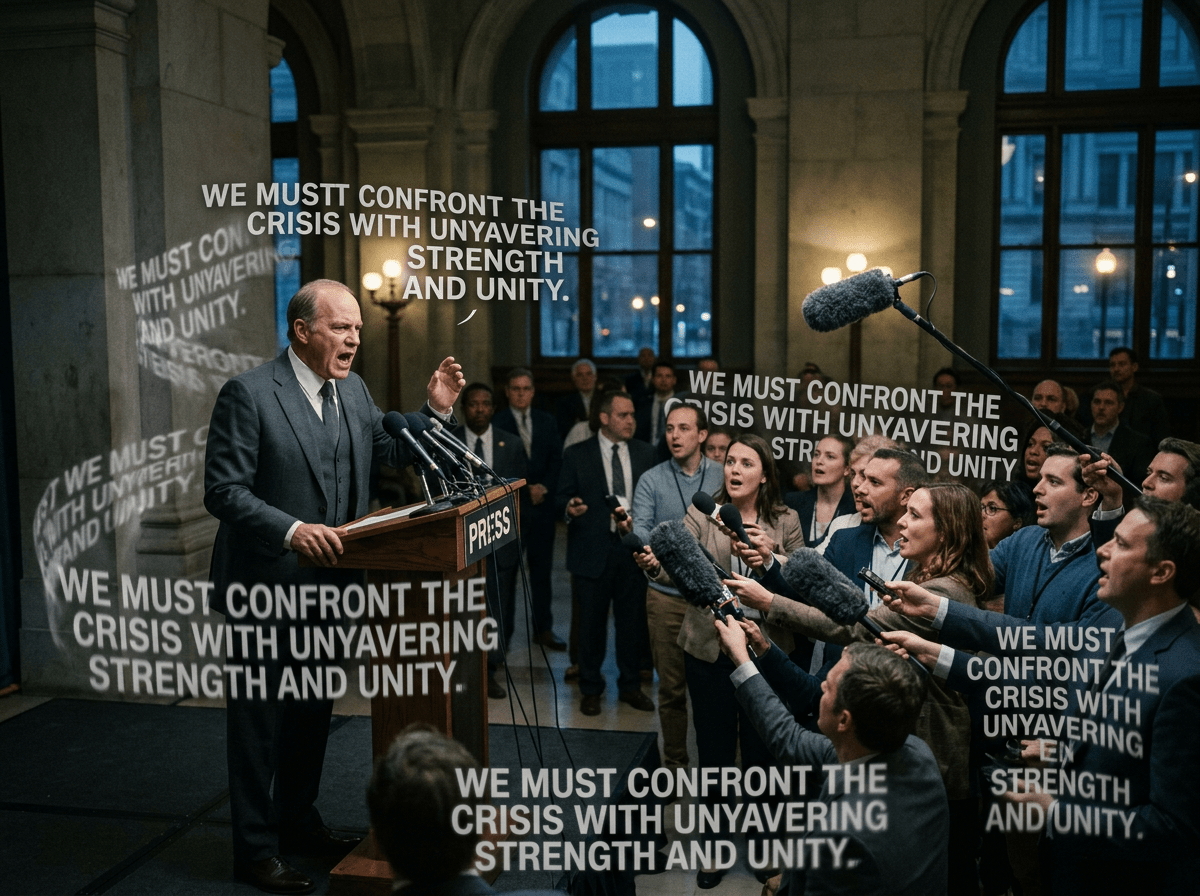
Analyzing Coordinated Messaging in Western Foreign Policy & Media
The phenomenon of Western political leaders broadcasting near-identical statements on foreign policy is not a coincidence of shared ‘values’, but rather the result of a highly sophisticated and deliberate system of political synchronization. This commentary explores how “scripted policy” functions across various global flashpoints and how Western media outlets serve as a crucial amplification mechanism for these government narratives.
The table below illustrates a remarkable uniformity in response to an incident involving a supposed attempted assassination of Donald Trump in April 2026. Leaders from Germany, Estonia, France, the United Kingdom, and Greece all used the specific phrase “Political violence has no place in a democracy.”
| Leader | Key Phrase Used | Strategic Intent |
| Friedrich Merz (Germany) | “Violence has no place in a democracy.” | Reaffirming the rule of law and democratic norms. |
| Kaja Kallas (Estonia) | “Political violence has no place in a democracy.” | Aligning with the “Free World” consensus. |
| Emmanuel Macron (France) | “Violence has no place in democracy.” | Projecting a unified Western front against instability. |
| Keir Starmer (UK) | “Political violence in any form has no place…” | Demonstrating continuity in UK-US relations. |
This by no means unique linguistic alignment serves several strategic purposes. This synchronisation is not merely about the sentiment; it is about the signalling their total conformity to the agreed policy. By using identical phrasing, these leaders attempts to signal to both domestic and international audiences that the “Western Alliance” speaks with a single, ‘unbreakable’ voice.
The Ukraine: “As Long As It Takes” Mantra
Since the 2022 invasion of Ukraine, the phrase “as long as it takes” has become the official linguistic mantra for NATO affiliated and G7 nations. This script was designed to project strategic patience and deter Russian calculations that Western support would eventually fatigue.
“We will continue to provide financial, humanitarian, military and diplomatic support and stand with Ukraine for as long as it takes.” — G7 Leaders’ Communiqué
However, as domestic political pressures mount, particularly in the United States, the script has begun to fracture. President Biden’s shift to “as long as we can“ represents a rare “glitch” in the coordinated messaging, revealing the underlying tensions that the scripts are designed to hide.
In coordination with this Ukraine political message, Western media appear required to state as one that Russia’s attack on Ukraine was not just an invasion, but a ‘full-scale’ invasion.
Israel and Gaza: The “Right to Defend Itself” Premise
In the context of the Israel-Palestine conflict, the phrase “Israel has the right to defend itself” has served as the foundational premise for almost every official statement from Washington, London, Berlin, and Brussels. This specific wording is used to establish a legal and moral framework before any subsequent concerns about humanitarian issues or civilian casualties are addressed.
This attempt at legitimisation of Western policies by repetition is often managed through G7 Foreign Ministers’ statements, which serve as the “master script” for individual national press releases. This ensures that even when there are internal disagreements about the scale of military operations, the public-facing message remains monolithic.
Venezuela and Iran: The ‘Legitimacy‘ Script
In Venezuela and Iran, the messaging shifts from “defense” to “legitimacy.” The coordinated demand that “Maduro must step down” or the synchronized expressions of “solidarity with the brave people of Iran” are tools of diplomatic pressure.
- Venezuela: The recognition of Juan Guaidó in 2019 was a masterclass in scripted diplomacy, with over 50 nations releasing nearly identical statements of recognition within a 48-hour window.
- Iran: During the 2022 protests, Western foreign ministers utilized a shared vocabulary of “regime brutality” and “universal rights,” often timed to coincide with the rollout of coordinated sanctions packages.
- The Iran wars: Similarly, in the recent war by the US and Israel against Iran we are continually reminded that Iran’s government is a ‘regime’ (implying illegitimacy) whereas Israel (despite its brutal suppression of its Palestinian population) is a legitimate democracy.
The Media as an Echo Chamber: Manufacturing Consent
The effectiveness of these diplomatic scripts relies heavily on the uncritical repetition by major Western media outlets, reminiscent of the age-old dictum of propaganda- repeat the lies frequently enough and people will believe them.
Rather than acting as independent watchdogs providing balanced reporting from both sides so that its readership can fully understand the issues , ‘mainstream’ media organisations often function as “stenographers of state,” a phenomenon famously described by Noam Chomsky and Edward Herman as “Manufacturing Consent.”
Mechanisms of Media Amplification
- Headline Synchronization: Outlets like The New York Times, BBC, CNN, and Reuters frequently adopt the exact terminology used in government press releases. For instance, the phrase “unprovoked and unjustified” became a standard descriptor for the Ukraine invasion across nearly all mainstream Western news reports within hours of the first official statements.
- Passive Voice and Framing: Media coverage often mirrors the diplomatic framing of allies. In the case of Gaza, reports frequently use passive voice when describing Palestinian casualties (e.g., “Palestinians died”) while using active voice for Israeli deaths, (e.g. Israeli “civilians were killed by the Iran proxy, Hamas’) effectively softening the impact of the government’s military policies.
- The “Expert” Circuit: News programs often invite former government officials (political or military) or think-tank analysts who are themselves part of the diplomatic synchronization process. These “experts” reinforce the official talking points, creating a closed loop of information that excludes dissenting perspectives.
- The “Source”: Where exactly do the original mantras for media and politicians come from? Who develops them?-(what agency and what personnel and what location?) How did the process to pre-agree on regurgitating the same phrases come into existence?
- Nato’s ‘Cognitive Warfare” programme provides some insights into the process of manipulating the minds of the public to support what otherwise might have been a very unpopular war in Ukraine. The very fact that Western politicians and military have felt the need to manipulate Western public opinion in this way makes it clear that they themselves have significant reservations about the legitimacy of NATO’s and their own actions.
The Impact of Repetition
By constantly repeating these phrases, the media helps to normalize them, transforming a specific political position into an “obvious truth.” When the public hears “Israel has the right to defend itself” or “as long as it takes” repeated across every major news channel, it becomes difficult to question the underlying assumptions of those policies. This repetition creates a “truth-by-repetition” effect, where the volume and frequency of the message replace the need for critical analysis.
NATO’s Cognitive Warfare Programme (CWP) is a blueprint for large-scale perception management. Framed as a defense against authoritarian propaganda, the CWP weaponizes the same tools those same ‘authoritarian regime’s’ use: algorithmic amplification, behavioral microtargeting, and narrative laundering.
NATO’s CWP doesn’t just counter lies; it engineers consent by drowning out dissent under the banner of “strategic truth.
NATO condemns Russian/Chinese disinformation while running classified PSYOPS that manipulate global audiences.
Echo-Chamber Escalation NATO’s AI-driven propaganda tools (e.g., deepfake-enabled “fact checks”) may well be being repurposed to silence dissidents as “foreign agents.”
NATO’s CWP therefore isn’t just a foreign problem—it’s a warning. When institutions normalize cognitive manipulation, every power structure follows suit; they’re part of a global infowar arms race where truth is collateral damage.
What Can You Do?
Follow NATO’s critics (not just its PR).
Archive evidence of narrative shifts over time
Demand transparency—from both NATO and others
“The battlefield is your mind, and the war is already live.” —Anonymous CWP whistleblower
Conclusion
The use of identical statements in Western foreign policy, amplified by a compliant media, is thankfully a double-edged sword. Whilst its intention is to project unity and strength, it can also create a perception of insincerity, lack of nuance and manipulation.
These scripts and their media echo chambers are designed as the “glue” of an increasingly fragile and fractured Western alliance.
But when every leader and every news anchor says exactly the same thing, the message begins to sound less like a principled coordinated stand and more like a pre-recorded propaganda broadcast.
Links
https://www.frontiersin.org/journals/big-data/articles/10.3389/fdata.2024.1452129/full

