The Yemen Tragedy

Now that Trump ( as of May 2025) has made the decision not to continue U.S. air attacks on targets in Yemen (for now), the following semi-legal analysis of the strikes below is perhaps somewhat moot. However it does provide a glimpse into the legalities of the multiple aggressions by Western countries in the past 75 years since World War 2.

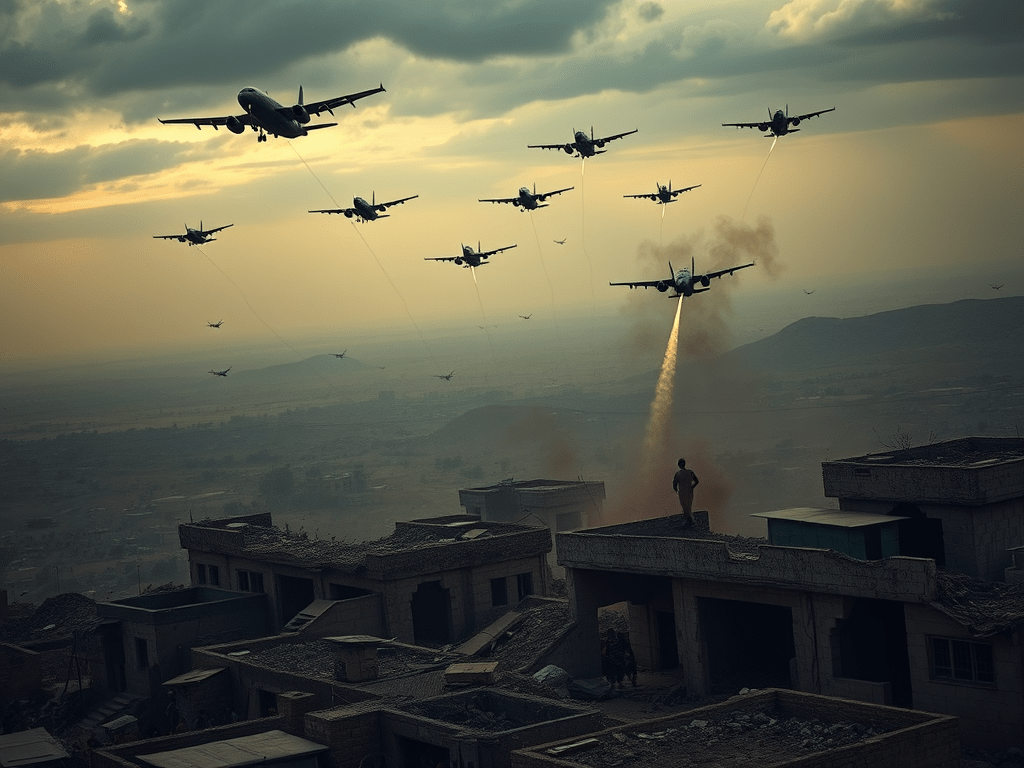
After an almost shootdown of an ‘invisible’ US F35 aircraft, and the loss of 2 (possibly 3) F18s (valued at $70 million each) that had ‘fallen off’ US aircraft carriers in the Gulf, along with about 10, 30 million dollar MQ9 drones shot down by Ansar-allah (what the West MSM as one voice like to call “Iran backed rebel Houthis”-all in one breath), it must have been clearly apparent, even to Trump, that the billion dollar US bombing campaign against Yemen was going nowhere.

Additionally, because the US had (and has) very little accurate information on where Ansarallah weapons and military was on the ground they were in fact predominantly (and accidentally?) hitting civilians. In addition the long-standing U.K air support for the Americans on the Arabian peninsula was entirely without targeting or strategy, but largely an attempt to try and demonstrate that Britain was still a force to be reckoned with in the Gulf.

One cannot however be so charitable about Israeli bombings of civilian Yemen targets-(civilian ports and airports), who used their traditional methods of terror and brutality to try and intimidate Ansarallah.

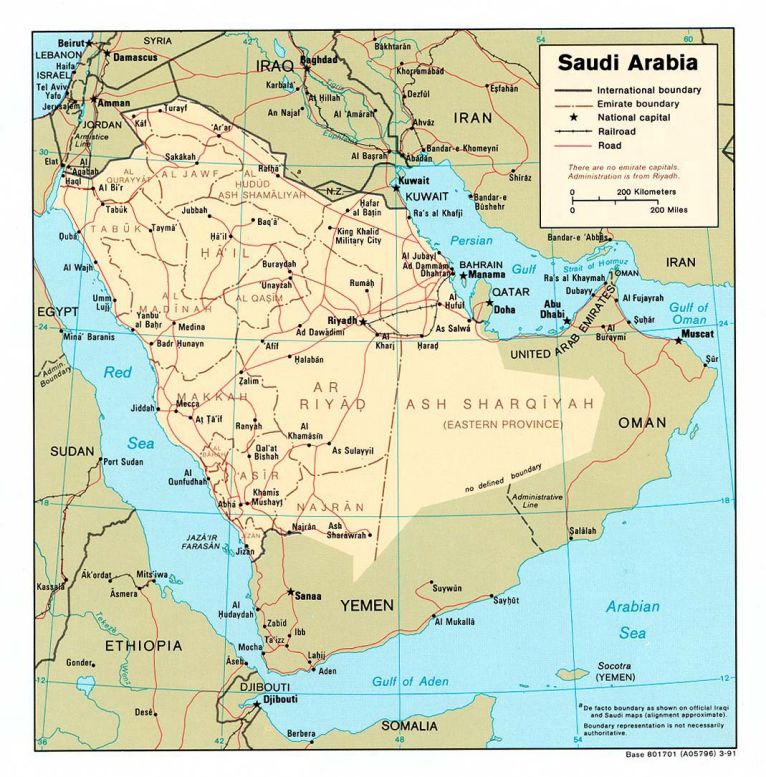
What follows is an analysis of the legalities of this bombing campaign, supposedly initiated by first Biden and then Trump, to stop Ansarallah closing the Gulf of Aden and Red Sea to shipping bound for the Israeli Red Sea port of Eilat (top right hand section of map)
Legal Analysis of US/UK Strikes in Yemen and Potential Violations of International Humanitarian Law (IHL)

The US and UK military interventions in Yemen, particularly against Houthi targets, raise significant legal questions under international humanitarian law (IHL)—also known as the laws of war. Below is a deeper examination of their compliance with key legal principles.


Analysis of the Legal Framework Governing US Strikes against Yemen

A. Applicable Law

  • Geneva Conventions (1949) & Additional Protocol I (1977): Govern the conduct of hostilities, including distinction, proportionality, and precautions in attack.
  • UN Charter (Article 2(4) & Article 51): Prohibits the use of force except in self-defense or with UN Security Council authorization.
  • Customary IHL: Binding on all parties, including non-state actors like the Houthis.

B. Justifications for US/UK Strikes

  • Self-Defense Argument (Article 51, UN Charter): The US and UK argue strikes are necessary to protect maritime security (Houthi attacks on Red Sea shipping).
  • Legal Debate: Some scholars argue this stretches self-defense doctrine, as Houthi attacks may not constitute an “armed attack” justifying unilateral force.
  • Collective Self-Defense (Supporting Saudi Arabia & UAE): Previously invoked, but less relevant post-2022 since the Saudi-Houthi truce.

2. Key IHL Principles & Potential Violations

A. Principle of Distinction (Civilian vs. Military Targets)

  • Rule: Attacks must only target military objectives, not civilians or civilian infrastructure.
  • Concerns in Yemen:
  • Urban Warfare: Houthis embed military assets in densely populated areas, increasing civilian risk.
  • Reports of Civilian Harm: NGOs (e.g., Mwatana, Amnesty) allege US/UK strikes hit homes, farms, and markets, suggesting possible indiscriminate targeting.

B. Principle of Proportionality

  • Rule: Civilian harm must not be excessive relative to the concrete and direct military advantage anticipated.
  • Challenges:
  • “Double-Tap” Strikes: Some reports suggest follow-up strikes hit first responders, which could be a war crime if deliberate.
  • High Civilian Toll in Past Strikes: Even if targets are legitimate, large-scale civilian casualties (e.g., 2022 Saada prison strike by Saudi coalition) raise proportionality concerns.

C. Precautions in Attack

  • Rule: Parties must take all feasible measures to verify targets and minimize civilian harm.
  • US/UK Practices:
  • Use of precision-guided munitions (reduces but does not eliminate risk).
  • Lack of Transparency: Few public investigations into alleged civilian harm, unlike in Iraq/Syria.

3. Accountability & Legal Consequences

A. Mechanisms for Accountability

  1. Domestic Investigations (US/UK):
  • The US has a Civilian Harm Mitigation and Response Action Plan (CHMR-AP) but rarely discloses Yemen investigations.
  • The UK has no independent Yemen strike review body, unlike its Iraq/Syria oversight.
  1. International Criminal Court (ICC):
  • Yemen is not an ICC member, but if nationals of member states commit crimes on Yemeni soil, the ICC could theoretically investigate.
  1. Universal Jurisdiction:
  • Third countries could prosecute war crimes under universal jurisdiction (e.g., Germany’s case against Syrian officials).

B. State Responsibility & Reparations

  • Under IHL, states must provide reparations for unlawful strikes, but neither the US nor UK has a compensation program for Yemeni victims.
  • Contrast with US payments for civilian harm in Afghanistan/Iraq.

4. Broader Implications & Legal Precedents

  • Escalation Risks: If strikes are seen as disproportionate, they could fuel further Houthi attacks, creating a cycle of violence.
  • Erosion of IHL Norms: Repeated civilian harm without accountability weakens global adherence to laws of war.
  • Potential for Future Cases: If evidence of systematic violations emerges, legal challenges could arise in international courts or via sanctions.

Conclusion: Are US/UK Strikes Lawful?

  • Legally Defensible? The US/UK can argue self-defense and military necessity, but civilian harm incidents raise serious IHL concerns.
  • Accountability Gap: Lack of transparent investigations and reparations undermines claims of compliance.
  • Future Risks: If civilian casualties continue unchecked, legal challenges (e.g., ICC petitions, universal jurisdiction cases) could follow.
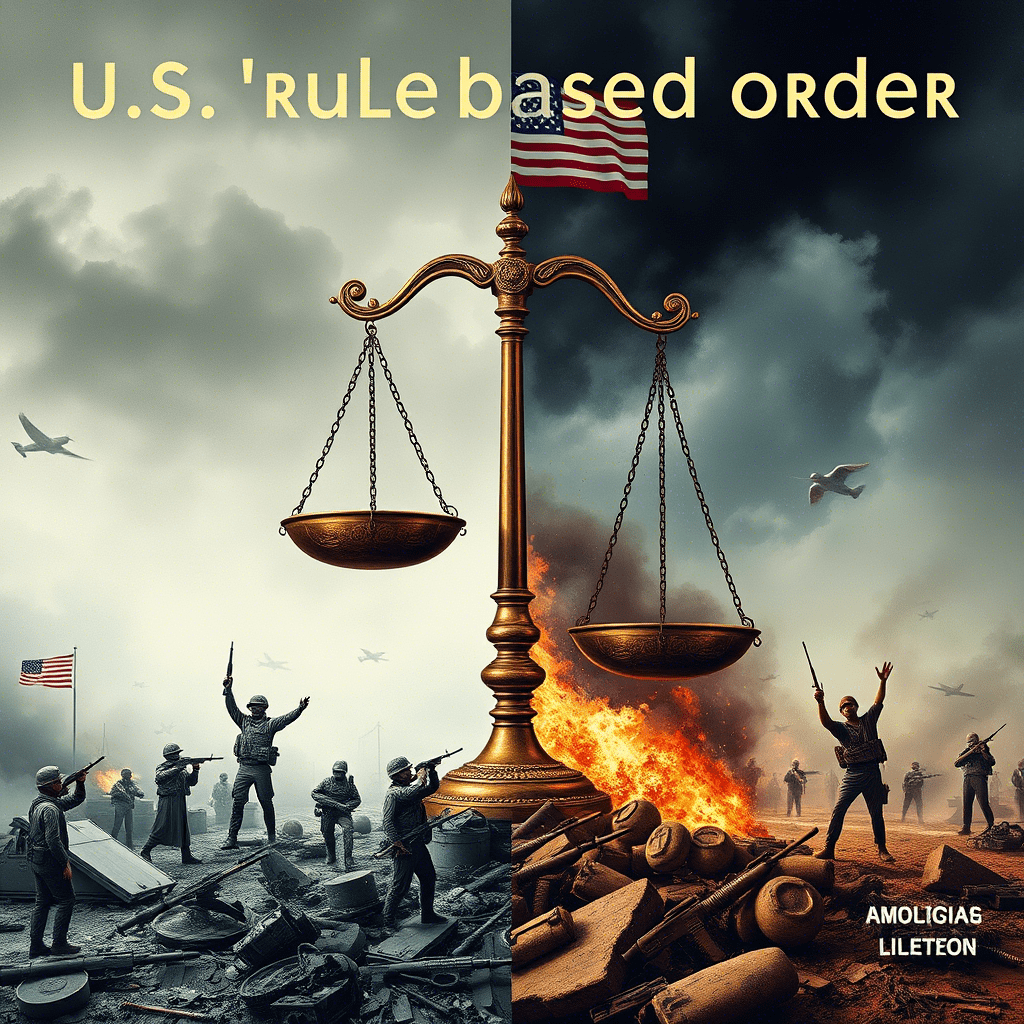
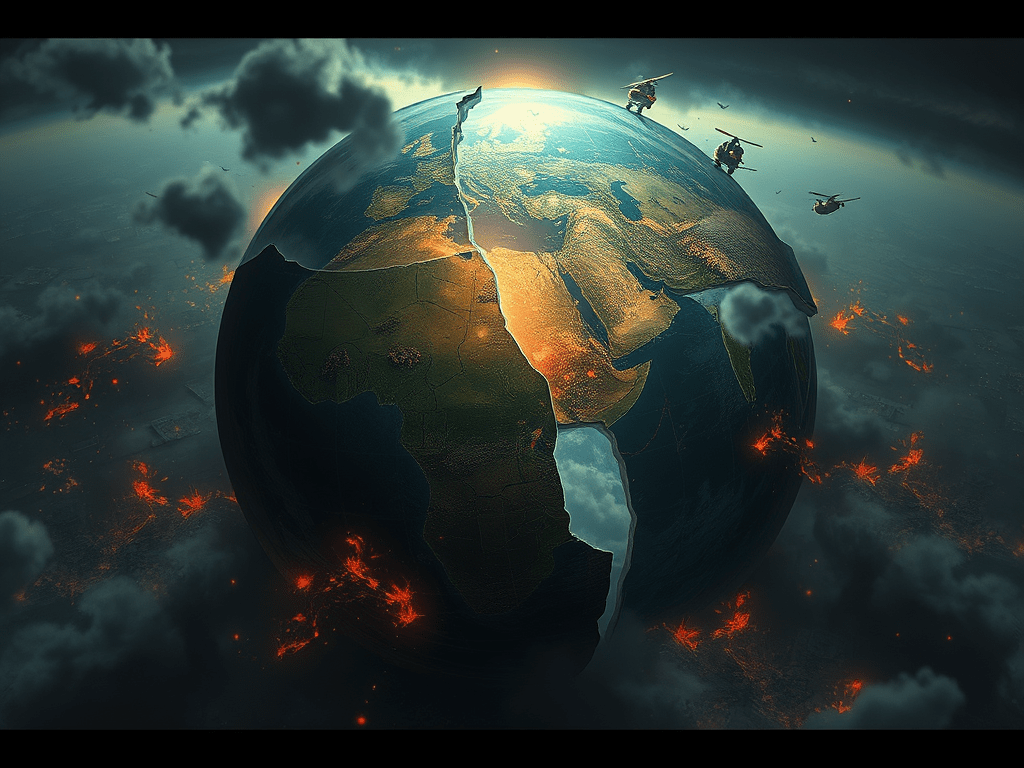
The demise of the U.S. ‘rule based order’?

The following is an AI Qwen based analysis of the impact of the U.S. ‘rule based international order’ and the reality of the chaos, wars and destruction its supposed ‘rules’ exert on the world.

The development of this post was promoted by the overwhelming number of New Zealand international political ‘analysts’ who quote the ‘U.S. rule based order’, (not the U.N. set of obligations) as some kind of golden age of civilisation , peace and freedom. -the reality could not be more stark. They fear that the new Trump administration-cum-oligarchy will no longer adhere to that ‘rule based order’ .

So why are these ‘analysts’ referring so enthusiastically to these great ‘rules’ that have caused so much suffering in the world?

It has recently been revealed (Feb.2025) via Wikileaks that the US government’s USAID ‘programme’ has been funding a US ‘non-government’ agency Internews Network, with millions upon millions of dollars to ensure Western media around the world regurgitate media messages ‘consistent’ (tell-tale identical phrasing in news items on issues from Covid responses to the Ukraine war and Russia), with US foreign policy objectives. Could it be that Western university international affairs ‘analysts’ (and politicians) have been similarly compromised over a long period of time?

I leave it to you to judge where their ‘influences’ come from.

AI analysis follows:

The concept of a “rules-based international order” is often invoked by the United States and its allies to describe a system of global governance that emphasizes adherence to international laws, norms, and institutions such as the United Nations, international treaties, and trade agreements. Proponents argue that this order promotes peace, stability, and cooperation among nations by providing a framework for resolving disputes and fostering mutual interests.

However, critics argue that the U.S.-led “rules-based order” has been selectively applied, often serving as a justification for military interventions, economic sanctions, and other forms of coercion that have led to significant human suffering, including mass murder, wars, and violence.

1. Selective Enforcement of Rules

  • Double Standards: Critics argue that the U.S. and its allies have frequently violated the very principles they claim to uphold. For example, the U.S. has engaged in military interventions without UN Security Council approval (e.g., the 2003 invasion of Iraq), while condemning other countries for similar actions. This selective enforcement undermines the legitimacy of the “rules-based order” and can lead to conflicts where weaker states feel justified in acting outside the system.
  • Regime Change and Destabilization: The U.S. has supported or directly engaged in regime change operations in countries like Iraq, Libya, and Syria, often under the guise of promoting democracy or protecting human rights. These interventions have frequently resulted in prolonged civil wars, state collapse, and mass civilian casualties. In Iraq, for instance, the 2003 invasion led to hundreds of thousands of deaths, widespread displacement, and the rise of extremist groups like ISIS.

2. Economic Warfare and Sanctions

  • Sanctions as a Tool of Coercion: The U.S. has frequently used economic sanctions as a tool to punish or pressure countries that defy its interests. While sanctions are often framed as a “non-violent” alternative to war, they can have devastating humanitarian consequences. For example, U.S. sanctions on Iraq in the 1990s contributed to the deaths of hundreds of thousands of civilians due to lack of access to food, medicine, and clean water. Similarly, sanctions on countries like Venezuela and Iran have exacerbated economic crises, leading to widespread poverty and suffering.
  • Weaponizing Global Institutions: The U.S. has also been accused of weaponizing international financial institutions like the International Monetary Fund (IMF) and the World Bank to impose structural adjustment programs on developing countries, which often result in austerity measures, increased inequality, and social unrest. This economic violence can indirectly fuel conflict and instability.

3. Proxy Wars and Arms Sales

  • Arming Conflicts: The U.S. is the world’s largest arms exporter, supplying weapons to both state and non-state actors around the globe. These arms sales often fuel conflicts in regions like the Middle East, Africa, and South Asia. For example, U.S. arms supplied to Saudi Arabia have been used in the Yemeni Civil War, resulting in one of the worst humanitarian crises in the world, with tens of thousands of civilians killed and millions facing famine.
  • Proxy Wars: During the Cold War, the U.S. engaged in numerous proxy wars, supporting anti-communist forces in places like Vietnam, Afghanistan, and Central America. These conflicts often involved backing authoritarian regimes or insurgent groups that committed atrocities against civilian populations. In Afghanistan, for example, U.S. support for the mujahideen during the Soviet-Afghan War helped create conditions that eventually led to the rise of the Taliban and Al-Qaeda.

4. Militarization and the “War on Terror”

  • Global War on Terror: Following the September 11, 2001 attacks, the U.S. launched the “Global War on Terror,” which has been used to justify military interventions, drone strikes, and indefinite detentions in countries like Afghanistan, Pakistan, Somalia, and Yemen. These operations have often been conducted with little regard for international law or civilian casualties. Drone strikes, in particular, have been criticized for causing significant collateral damage, killing thousands of civilians, and radicalizing local populations.
  • Normalization of Violence: The rhetoric of the “rules-based order” often masks the normalization of violence as a means of achieving foreign policy objectives. The U.S. military-industrial complex benefits from perpetual warfare, and the language of “humanitarian intervention” or “counterterrorism” is sometimes used to legitimize aggressive military actions that result in mass death and destruction.

5. Undermining Sovereignty and Self-Determination

  • Imperialism and Neocolonialism: Critics argue that the U.S.-led “rules-based order” often serves as a cover for imperialist policies that undermine the sovereignty of weaker states. By imposing economic and political conditions on countries through institutions like the IMF, World Bank, and World Trade Organization (WTO), the U.S. and its allies have been accused of perpetuating a form of neocolonialism that stifles self-determination and exacerbates inequality.
  • Resistance and Blowback: When countries resist U.S. hegemony or attempt to assert their independence, they are often subjected to punitive measures, including coups, invasions, or covert operations. This resistance can lead to cycles of violence, as seen in cases like Iran (1953 coup), Chile (1973 coup), and more recently, Venezuela and Syria. The blowback from these interventions can manifest in the form of terrorism, insurgency, and regional instability.

Conclusion

While the U.S. and its allies present the “rules-based international order” as a framework for peace and stability, critics argue that it has often been used to justify interventions, sanctions, and other forms of coercion that result in mass violence and human suffering. The selective application of rules, the militarization of foreign policy, and the prioritization of U.S. strategic interests over international law have contributed to a legacy of wars, destabilization, and humanitarian crises. In many cases, the very principles of sovereignty, self-determination, and human rights that the “rules-based order” claims to uphold are undermined by the actions of those who enforce it.

‘Cant Find My Way Home’

The heading for this post comes from one of the great compositions by Stevie Winwood and the UK band ‘Blind Faith’ in 1969.

It perhaps symbolises in 2024, the journey this human world is travelling and its likely future…

A world where pointless and savage wars in West Asia, Ukraine and Africa are spurred on by the quest for power and profit and where infantile ideologies predominate.

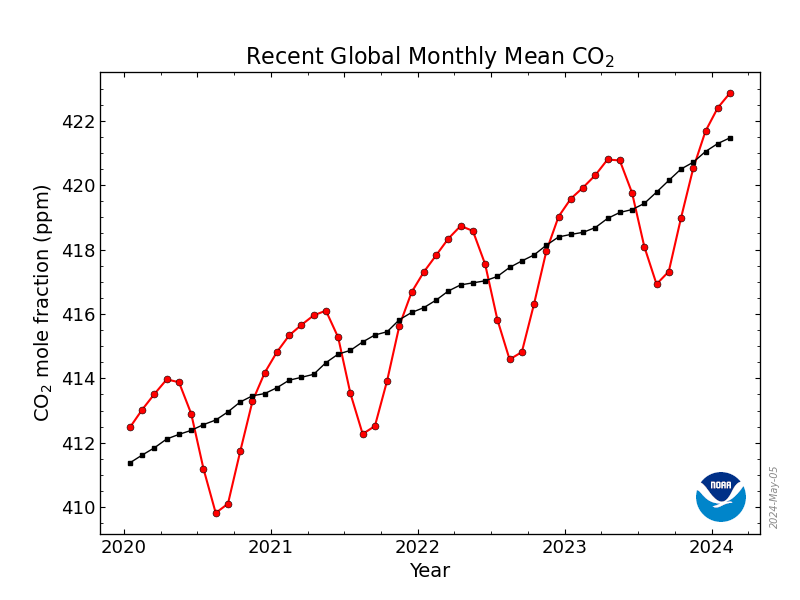
And a world where climate change continues its seemingly inexorable march towards a planet destroyed through the pure blind stupidity and ignorance of our ‘world leaders’.

Never before have we all been able to witness the savage brutality of a war of genocide in technicolour- never before have we seen Western media and politicians proselytising so blatantly for that inhumanity. An oh so stark reminder of the difference between Western weasel words about ‘freedom and democracy’ and their support of mass-murder when it profits them.

A reminder too that this has been the Western theme for 500 years of colonial exploitation of more vulnerable populations- that these centuries of exploitation are, in the immortal words in 2022 of EU’s blatantly racist and furiously stupid foreign policy chief Josep Borrell,  the reason why Europe and the West is a garden and the rest of the world (in his view), a jungle.

To support this meme, our Western mainstream media continues to idolise the fiction of Western supremacy in all things. As the evidence that this is no longer the case continues to pile up, Western media have resorted to ever greater contortions and lies to support that meme. The recent violence in Amsterdam between Israeli and Dutch football fans – characterised as ‘antisemitism’ is just one of many examples.

Time and time again we have seen European (and U.S. ) political leaders make decisions based on an outdated and irrelevant ideology which ignores all rationality and the reality of the situation.

The most telling, and likely deadly, example of this, is their farcical contortions to prove to their electorates that they doing something about climate change when they are in fact doing worse than nothing. There are no reductions in CO2 emissions, and the hype about the electrification of energy and transport is just that- electrification is not substituting for coal or oil, it comes as an addition to the continuing use of high rates of coal and oil burning.

Our ‘civilisation;’ is locked into endless ‘growth’ (an awful word given that economic ‘growth’ is the total opposite of true organic living growth) – a paradigm that is destroying the planet, but from which we apparently have no wish to escape from.

While climate and environmental scientists have long been steadily ratcheting up their estimations of the devastating impacts of global warming and biodiversity to the living fabric of our world, it is only now that economists from the ‘Network for Greening the Financial System’ are beginning to estimate the true fiscal costs to climate warming- something that could and should have been done 50 years ago, as it would have provided some leverage for real change in this money obsessed world. In the latest estimates economists estimate that global GDP will contract by 33% by 2100 from a 3C rise in global average surface temperatures. That 33% reduction in global GDP is almost certainly a huge underestimation of the real fiscal costs of global warming.

That ‘canary in the coalmine’ early warning system for economies, the cost of insurance, is already rising rapidly as a result of the rapidly increasing unpredictability of our climate systems.

We still do not know for certain what is going to happen to global sea currents and sea level rise as a result of ice melt , but early indications are that there will be a complete collapse of the Atlantic Meridional Overturning Circulation (AMOC) within a few decades. When that collapse occurs, not only will much of the Northern Hemisphere become much colder, but the Southern Hemisphere will warm much much faster.

If that’s not enough, the 1972 bestseller Limits to Growth (LtG) authors (70 years ago) concluded that, if global society kept pursuing economic growth, it would experience a decline in food production, industrial output, and ultimately population, within this century. Recent remodelling of that study indicate ‘a halt in welfare, food, and industrial production over the next decade or so, which puts into question the suitability of continuous economic growth as humanity’s goal in the twenty-first century.’

And then we can go to the annual farce of the COP global conferences: the pretence that global leaders are in fact doing something about climate change, when in fact they are doing less than nothing- actively promoting more oil and gas exploration and consumption because endless ‘growth’ on a finite planet is a logical and sensible thing to do -isn’t it?

To hold everything together, so that we don’t lose our trajectory and deviate from accelerating over the climate change cliff, our mainstream and social media incessantly promotes consumption and the vital importance of the constant expansion of each country’s mythical GDP.

Have we completely forgotten our way home?

_______________________________________

References

https://www.theguardian.com/business/2024/nov/08/climate-breakdown-will-hit-global-growth-by-a-third-say-central-banks

https://www.nature.com/articles/s41467-023-39810-w

https://onlinelibrary.wiley.com/doi/abs/10.1111/jiec.13084

https://www.independent.ie/opinion/editorial/editorial-cop29-climate-summit-is-indeed-like-a-dark-joke-given-the-lack-of-buy-in-from-world-leaders/a131893267.html