
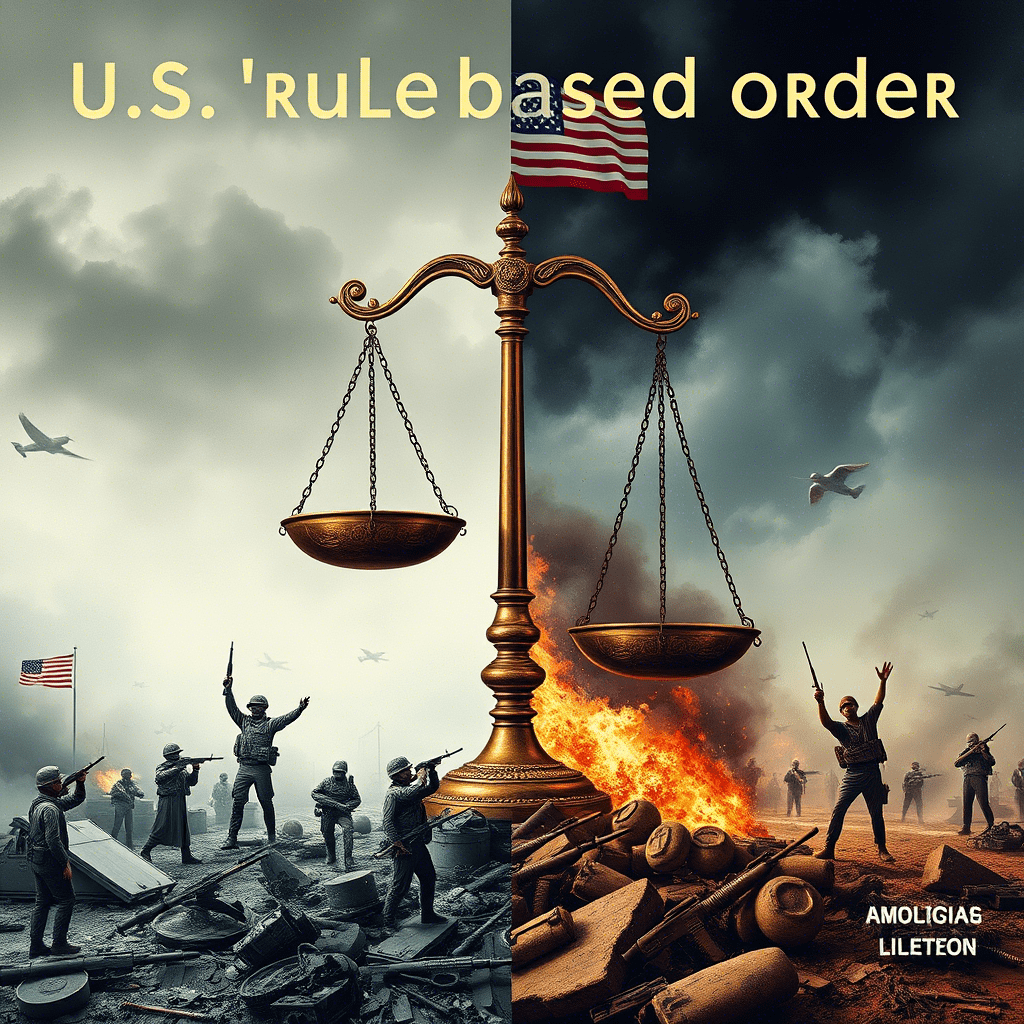
The following is an AI Qwen based analysis of the impact of the U.S. ‘rule based international order’ and the reality of the chaos, wars and destruction its supposed ‘rules’ exert on the world.
The development of this post was promoted by the overwhelming number of New Zealand international political ‘analysts’ who quote the ‘U.S. rule based order’, (not the U.N. set of obligations) as some kind of golden age of civilisation , peace and freedom. -the reality could not be more stark. They fear that the new Trump administration-cum-oligarchy will no longer adhere to that ‘rule based order’ .
So why are these ‘analysts’ referring so enthusiastically to these great ‘rules’ that have caused so much suffering in the world?
It has recently been revealed (Feb.2025) via Wikileaks that the US government’s USAID ‘programme’ has been funding a US ‘non-government’ agency Internews Network, with millions upon millions of dollars to ensure Western media around the world regurgitate media messages ‘consistent’ (tell-tale identical phrasing in news items on issues from Covid responses to the Ukraine war and Russia), with US foreign policy objectives. Could it be that Western university international affairs ‘analysts’ (and politicians) have been similarly compromised over a long period of time?
I leave it to you to judge where their ‘influences’ come from.
AI analysis follows:
The concept of a “rules-based international order” is often invoked by the United States and its allies to describe a system of global governance that emphasizes adherence to international laws, norms, and institutions such as the United Nations, international treaties, and trade agreements. Proponents argue that this order promotes peace, stability, and cooperation among nations by providing a framework for resolving disputes and fostering mutual interests.
However, critics argue that the U.S.-led “rules-based order” has been selectively applied, often serving as a justification for military interventions, economic sanctions, and other forms of coercion that have led to significant human suffering, including mass murder, wars, and violence.
1. Selective Enforcement of Rules
- Double Standards: Critics argue that the U.S. and its allies have frequently violated the very principles they claim to uphold. For example, the U.S. has engaged in military interventions without UN Security Council approval (e.g., the 2003 invasion of Iraq), while condemning other countries for similar actions. This selective enforcement undermines the legitimacy of the “rules-based order” and can lead to conflicts where weaker states feel justified in acting outside the system.
- Regime Change and Destabilization: The U.S. has supported or directly engaged in regime change operations in countries like Iraq, Libya, and Syria, often under the guise of promoting democracy or protecting human rights. These interventions have frequently resulted in prolonged civil wars, state collapse, and mass civilian casualties. In Iraq, for instance, the 2003 invasion led to hundreds of thousands of deaths, widespread displacement, and the rise of extremist groups like ISIS.
2. Economic Warfare and Sanctions
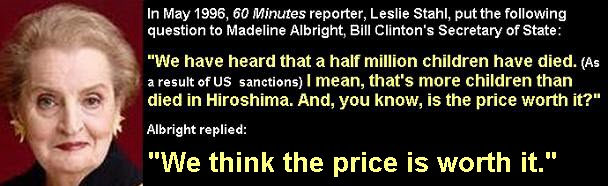
- Sanctions as a Tool of Coercion: The U.S. has frequently used economic sanctions as a tool to punish or pressure countries that defy its interests. While sanctions are often framed as a “non-violent” alternative to war, they can have devastating humanitarian consequences. For example, U.S. sanctions on Iraq in the 1990s contributed to the deaths of hundreds of thousands of civilians due to lack of access to food, medicine, and clean water. Similarly, sanctions on countries like Venezuela and Iran have exacerbated economic crises, leading to widespread poverty and suffering.
- Weaponizing Global Institutions: The U.S. has also been accused of weaponizing international financial institutions like the International Monetary Fund (IMF) and the World Bank to impose structural adjustment programs on developing countries, which often result in austerity measures, increased inequality, and social unrest. This economic violence can indirectly fuel conflict and instability.
3. Proxy Wars and Arms Sales
- Arming Conflicts: The U.S. is the world’s largest arms exporter, supplying weapons to both state and non-state actors around the globe. These arms sales often fuel conflicts in regions like the Middle East, Africa, and South Asia. For example, U.S. arms supplied to Saudi Arabia have been used in the Yemeni Civil War, resulting in one of the worst humanitarian crises in the world, with tens of thousands of civilians killed and millions facing famine.
- Proxy Wars: During the Cold War, the U.S. engaged in numerous proxy wars, supporting anti-communist forces in places like Vietnam, Afghanistan, and Central America. These conflicts often involved backing authoritarian regimes or insurgent groups that committed atrocities against civilian populations. In Afghanistan, for example, U.S. support for the mujahideen during the Soviet-Afghan War helped create conditions that eventually led to the rise of the Taliban and Al-Qaeda.
4. Militarization and the “War on Terror”
- Global War on Terror: Following the September 11, 2001 attacks, the U.S. launched the “Global War on Terror,” which has been used to justify military interventions, drone strikes, and indefinite detentions in countries like Afghanistan, Pakistan, Somalia, and Yemen. These operations have often been conducted with little regard for international law or civilian casualties. Drone strikes, in particular, have been criticized for causing significant collateral damage, killing thousands of civilians, and radicalizing local populations.
- Normalization of Violence: The rhetoric of the “rules-based order” often masks the normalization of violence as a means of achieving foreign policy objectives. The U.S. military-industrial complex benefits from perpetual warfare, and the language of “humanitarian intervention” or “counterterrorism” is sometimes used to legitimize aggressive military actions that result in mass death and destruction.
5. Undermining Sovereignty and Self-Determination
- Imperialism and Neocolonialism: Critics argue that the U.S.-led “rules-based order” often serves as a cover for imperialist policies that undermine the sovereignty of weaker states. By imposing economic and political conditions on countries through institutions like the IMF, World Bank, and World Trade Organization (WTO), the U.S. and its allies have been accused of perpetuating a form of neocolonialism that stifles self-determination and exacerbates inequality.
- Resistance and Blowback: When countries resist U.S. hegemony or attempt to assert their independence, they are often subjected to punitive measures, including coups, invasions, or covert operations. This resistance can lead to cycles of violence, as seen in cases like Iran (1953 coup), Chile (1973 coup), and more recently, Venezuela and Syria. The blowback from these interventions can manifest in the form of terrorism, insurgency, and regional instability.
Conclusion
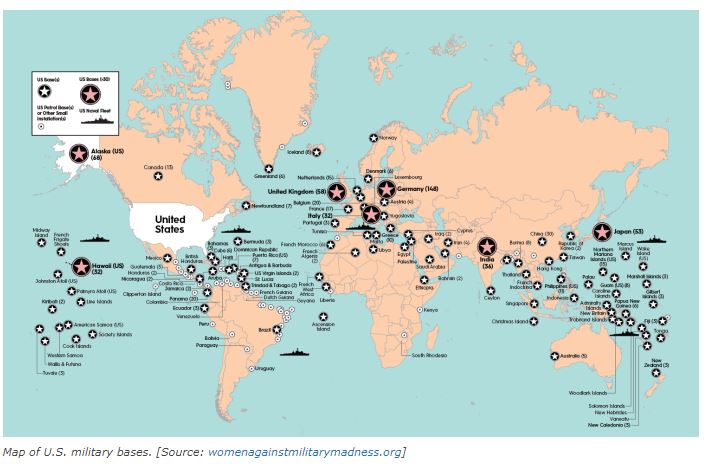
While the U.S. and its allies present the “rules-based international order” as a framework for peace and stability, critics argue that it has often been used to justify interventions, sanctions, and other forms of coercion that result in mass violence and human suffering. The selective application of rules, the militarization of foreign policy, and the prioritization of U.S. strategic interests over international law have contributed to a legacy of wars, destabilization, and humanitarian crises. In many cases, the very principles of sovereignty, self-determination, and human rights that the “rules-based order” claims to uphold are undermined by the actions of those who enforce it.






 New Antarctica