The Hunter-Killer State and the Illusion of Species Supremacy: Re-imagining Aotearoa’s Relationship with the Living World
Globally, Aotearoa New Zealand is marketed as a pristine, peaceful utopia. It is the “clean, green” paradise of the ‘Lord of the Rings’, a nuclear-free haven, and a progressive society nestled in a breathtaking natural environment.
But this carefully curated branding masks a dark, systemic reality. Beneath the rolling green hills and the pristine marketing campaigns lies a society deeply structured around violence, domination, and killing.
Nowhere is this more evident than in the government’s recent $2.7 billion defense package to purchase five MH-60R Seahawk “Romeo” helicopters. This purchase is not merely a military upgrade; it is the ultimate, multi-billion-dollar manifestation of a national psyche addicted to violence. From the slaughterhouses that drive our export economy to the poisoned forests of our biodiversity projects, and our eager enlistment in foreign wars, New Zealand is not a peaceful nation. It is a profoundly violent one.
But to truly change this, we must look beyond the policies and confront the philosophical root of our violence: our arrogant and foolish belief in human supremacy.
The $2.7 Billion “Hunter-Killer”: Servicing Empire Over the Pacific
The MH-60R Seahawk is a premier “hunter-killer” helicopter, heavily optimized for Anti-Submarine and Anti-Surface Warfare. It is a weapon of war, designed to track and destroy enemies in the deep ocean.
Yet, the New Zealand government justifies this recent exorbitant purchase by claiming it will help with Pacific Humanitarian Assistance and Disaster Relief (HADR). This is a profound deception. The MH-60R’s cabin is packed with mission computers and weapons systems, not optimized for carrying bulk disaster relief. With only five air-frames, NZ may only ever have one or two fully operational at any given time—leaving almost zero surge capacity for a major Pacific cyclone.
If the government genuinely cared about Pacific civil defence, they would have purchased heavy-lift, utility-focused aircraft like the Boeing CH-47F Chinook or the utility variant MH-60S “Sierra”. But we didn’t buy those. We bought hunter-killer choppers. Why? Because New Zealand has a long, sycophantic history of enthusiastically joining UK and US wars of aggression. The MH-60R ensures the Royal New Zealand Navy can act as a subordinate, interoperable asset for the US and Australian navies to thwart a mythical Chinese invasion thereat. It is a tool of empire, bought with money that could have been used to genuinely protect the Pacific.
The Slaughterhouse Economy: Millions of Lives, Objectified as “Products”
We know that those exposed to military violence abroad, bringtheir violence and trauma home with them This militarism abroad mirrors our violence at home. The foundation of New Zealand’s rural economy is built on the industrialized killing of sentient beings. Each year, the agricultural sector slaughters tens of millions of animals. While the industry uses sterile, bureaucratic language to desensitize the public to the terror and cruelty they inflict —referring to living, feeling individuals as “stock,” “meat,” “carcasses,” and “products”—the reality is visceral and brutal.
Recent scientific consensus has thoroughly dismantled the Cartesian illusion that animals are unfeeling automatons. The 2012 Cambridge Declaration on Consciousness formally acknowledged that non-human animals possess the neurological substrates of consciousness. Research has proven that cows experience grief, pigs possess complex problem-solving skills and emotional depth, sheep and even bees recognize human faces. They have full cognition, social structures, and a desire to live.
Yet our legal and economic systems maintain a staggering cognitive dissonance. While the NZ Animal Welfare Act was amended in 2015 to formally recognize animals as “sentient,” this very same state sanctions their mass slaughter. Below is a table illustrating the sheer scale of this killing over a recent five-year period (excluding the additional 100+ million poultry killed annually):
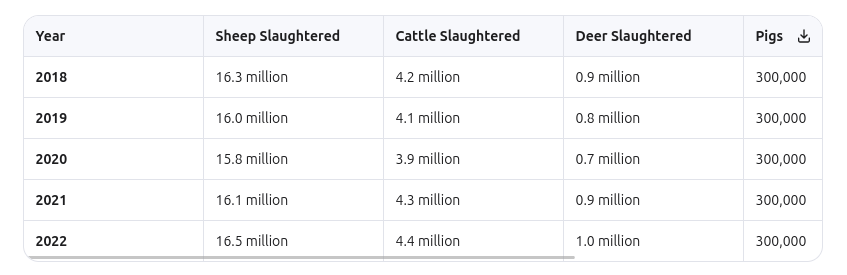
The methods of this killing are inherently violent: captive bolt guns, electrical water-bath stunning, and ex-sanguination. We normalize this daily, systemic bloodshed because it lines the pockets of big business and the export economy.
The “Pest” Paradigm: Militarizing Conservation
This culture of killing extends deep into our native bush. New Zealand’s biodiversity sector is dominated by a lethal paradigm: the obsession with killing introduced mammals to save indigenous birds.
Under the banner of “Predator Free 2050,” the state sanctions the killing of roughly 8 to 10 million possums annually, alongside millions of rats, stoats, and ferrets. We use military tactics—bombing the forests with 1080 poison, which causes a slow, agonizing death by internal organ failure, and deploying steel-jawed leg-hold traps.
This approach relies heavily on the sanctification of the hunter and the trapper as the heroes of our natural environment. But it requires a massive, willful blind spot. The NZ biodiversity movement rarely acknowledges the root cause of indigenous species decline: humans and our actions. The destruction of native habitats through rampant deforestation for grazing and dairy conversion, and urban sprawl is the primary driver of extinction.
Yet, rather than addressing the unsustainable expansion of the human footprint, or transitioning to true re-wilding, the conservation establishment defaults to endless culling. We are attempting to bomb, poison, and trap our way to ecological health, just as we buy hunter-killer helicopters to strafe our way to geopolitical relevance.
Beyond Human Supremacy: The Inherent Equality of All Life
To break this cycle of violence, we must dismantle the philosophical foundation that makes it possible: anthropocentrism: the belief that human beings are the supreme rulers of the Earth, and that all other life exists merely as a resource for our consumption. That belief is a destructive fiction and the key driving force for humans destruction of our natural environment globally.
The reality of our shared existence demands the recognition of the inherent equality of all living beings. This does not mean that a human, a cow, or a kauri tree are exactly the same; it means that their right to exist, to flourish, and to live free from unnecessary suffering is of equal moral weight. A pig is the center of its own universe, just as a human is. A possum, a rat, and a kiwi all possess an inherent value that is entirely independent of their utility—or perceived detriment—to human beings or our prioritising of one species over another because of our conservation ideology.
When we view the world through the lens of inherent equality, the language of “pests,” “stock,” and “resources” dissolves. We recognize that we are not the masters of the web of life, but merely one strand within it. The violence we inflict on the slaughterhouse and forest floor is directly derived from the arrogant and foolish delusion that we are somehow separate from, and superior to, the natural world.
Five Pillars for an Inter-species Aotearoa
To transition from a Hunter-Killer State to a society of inter-species harmony, we must move beyond identifying its failings and illogicality to creating a new reality. New Zealand has the geographic isolation, the wealth, the innovation and the progressive heritage to pioneer this shift. Such a new paradigm could look something like the following…
1. The Parliament of All Beings: Expanding Legal Person-hood
New Zealand is already a global pioneer in the “Rights of Nature” movement, having granted legal person-hood to the Whanganui River (Te Awa Tupua) and Te Urewera. But we have stopped halfway. We must expand this legal framework to grant person-hood and inherent rights to all sentient species and ecosystems.
Imagine establishing an “Ecological Parliament” of equals. Just as the Whanganui River has human guardians to speak for it in court, every major species—the kiwi, the kauri, the honeybee, the cow—would have legally appointed, ecologically trained guardians. Their sole mandate would be to veto legislation, economic projects, or agricultural practices that harm their species’ right to flourish. This shifts our legal system from protecting human ‘property’ to protecting ecological kinship and inter-connectivity.
2. From the Slaughterhouse to a Laboratory of Caring
The argument against ending animal agriculture is always economic: “We need the export revenue.” But this assumes we cannot innovate our way out of the slaughterhouse. New Zealand has world-class agricultural science and a highly skilled rural workforce.
We must redirect the billions in agricultural subsidies away from the meat and dairy export model, and invest heavily in new strategies like plant protein based agriculture, fruit and nut tree proteins and precision fermentation using food-forest, permaculture and organic principles.
Our farmers wouldn’t be forced out of business; they would be retrained and subsidized to become “ecosystem stewards” and bio-technologists. NZ could transition from being the world’s slaughterhouse to the world’s “Laboratory of Caring,” exporting high-tech, cruelty-free, climate-positive food systems and proving that a vibrant rural economy doesn’t require a bloody foundation.
3. Healing the Hunter-Killer Psyche (Eco-Psychology)
We cannot change our external policies without addressing the internal, psychological conditioning that makes us comfortable with killing. New Zealand’s cultural identity is heavily tied to the “Hunter” (the bloke with the rifle and his pig-dogs in the bush), the “Warrior” (the ANZAC mythos), and the “Conqueror” (the pioneer clearing the bush).
We must integrate ‘Eco-Psychology’ into our education system and public health initiatives. We need to actively deconstruct the “toughness” associated with killing animals and fighting in foreign wars, replacing the “Hunter-Killer” archetype with the “Cultivator-Healer” who understands humanity’s interconnection with the rest of the natural world and our own dependence on it for our own survival. True inter-species harmony requires humans to heal their own disconnection from nature and their own internalized violence.
4. Aotearoa as the World’s First Inter-species Sanctuary
In 1984, New Zealand took a massive geopolitical risk and declared itself a Nuclear-Free Zone. It was mocked by superpowers at the time, but it ultimately became our greatest point of national pride and remains so to this day. It is time to expand this legacy into an “Inter-species and Ecological Peace” Declaration’.
New Zealand should formally declare its Exclusive Economic Zone (EEZ) and landmass a “Sanctuary from Speciesism and Ecological Violence.” This would mean legally banning the importation of products derived from ecologically destructive practices, banning lethal conservation methods (like 1080 and leg-hold traps) on all public lands, and refusing to participate in international military alliances that project violence into the Pacific. It would be a beacon to the world, proving that a modern nation can choose coexistence over conquest.
5. Technological Symbiosis and Non-Invasive Conservation
Our current conservation model relies on brute force: poison, traps, and bullets. The future model must rely on deep listening and technological symbiosis. Instead of spending millions on helicopters to drop poison, we must invest in AI-driven bio-acoustic monitoring networks, drone-assisted native seed dispersal, and genetic research into disease and predator resistance for native birds like the kiwi and kākāpō.
We must use technology to understand and facilitate nature’s own resilience, rather than using technology to bombard nature into submission. In this new paradigm, we can move from being the arrogant “managers” of the forest to its humble “students.”
Re-wilding the Budget and the Mind
New Zealand likes to look in the mirror and see a peaceful, progressive, nature-loving nation. But a society that slaughters 22 million sentient animals a year, poisons and destroys its own forests, and eagerly spends billions on weapons of war is suffering from a profound moral sickness.
True environmentalism and true peace require us to lay down our weapons, our traps, and our poisons. We must abandon the arrogant illusion of human supremacy and embrace the inherent equality of all living beings.
Just as Britain lead the world out of the evils of slavery in the 19th century, Aotearoa has the opportunity to lead the world out of the dark age of extraction and into an era of inter-species harmony. The choice, ultimately, is whether we will continue to be a hunter-killer state, or finally become the peaceful, harmonious society we claim to be.

