
Introduction
The Organization of Ukrainian Nationalists — Bandera faction (OUN-B) — remains one of the most controversial political movements in 20th-century European history. Founded in 1929 and radicalized under Stepan Bandera’s leadership from 1933 onward, the OUN-B espoused an ideology of integral nationalism that demanded ethnic homogeneity as the foundation of statehood. Its symbols — the red-and-black flag representing “blood and soil” (Blut und Boden), the fascist salute, and the Führerprinzip — were borrowed directly from Italian fascism and German Nazism.
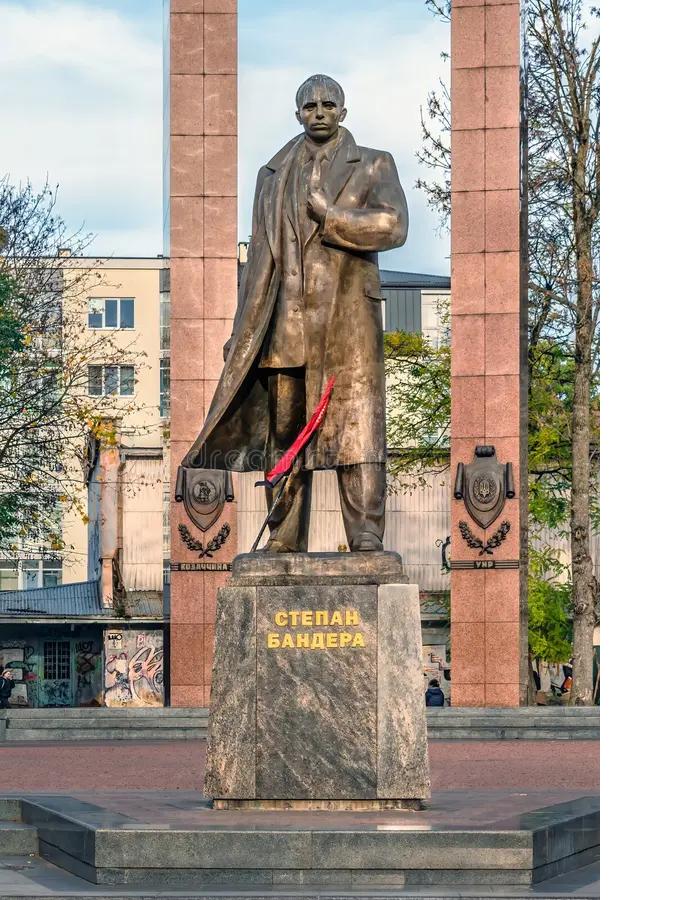
Critically, the OUN-B’s racial ideology was not merely generic fascism but explicitly drew upon Nazi racial superiority theory. Bandera and his followers in their insurgent army, the UPA, embraced the Nazi racial hierarchy that placed “Aryan” Europeans at the pinnacle and demonized Slavic peoples as inferior — a tension they resolved by positioning Ukrainians as an exception, a “pure” European people distinct from the “Asiatic” Russians. Central to this was the centuries-old European slur that Russians were “Tartars”or“Huns” — descendants of Mongol invaders with “Asian blood” — while Ukrainians were framed as the true, uncorrupted European heirs of Kyivan Rus. Over 44 monuments and statues to Stepan Bandera currently exist in Ukraine; mostly in Western Ukraine where his nationalist party flourished during the second world war alongside the nazis.
In the post-2014 and especially post-2022 landscape, elements of this ideology have experienced a complex revival. One recurring theme is the claim of ancient, pure Ukrainian ancestry — sometimes embellished with references to Viking (Varangian) roots through Kyivan Rus. This analysis examines what the OUN-B actually believed about racial purity, how Nazi racial mythology shaped their anti-Russian ideology, what modern genetics says about the “Asian Hun” claim, and whether any of these narratives hold scientific water.

Part I: Nazi Racial Ideology and the OUN-B
1.1 The Nazi Racial Hierarchy
Nazi racial theory, as elaborated by Hans Günther, Alfred Rosenberg, and others, posited a strict hierarchy of European peoples:
| Racial Category | Nazi View | Slavic Position |
| Nordic | The master race; creators of civilization | Germans, Scandinavians |
| Alpine | Peasant stock; solid but unremarkable | Many Slavs, including Czechs, Slovaks, Poles |
| East Baltic | Inferior; prone to Bolshevism | Russians, Belarusians, some Ukrainians |
| Dinaric | Warrior aristocracy; secondary to Nordic | Balkan peoples, some Ukrainians |
| Mediterranean | Declined from ancient greatness | Southern Europeans |
Under this schema, Slavs were generally classified as inferior to Germans — “Untermenschen” (subhumans) in the most extreme formulations. The Generalplan Ost envisaged the enslavement, expulsion, or extermination of Slavic populations to make way for German colonization.
1.2 The OUN-B’s Racial Ambivalence
The OUN-B faced a profound ideological problem: they were Slavs seeking alliance with a regime that classified Slavs as racially inferior. Their solution was to accept the Nazi racial framework but argue for Ukrainian exceptionalism:
- Ukrainians were“pure Europeans” — descendants of Kyivan Rus, untainted by “Asiatic” admixture.
- Russians were“Mongoloids”or“Tartars” — corrupted by centuries of rule by the Golden Horde and intermixing with Asian peoples.
- Poles were racially suspect — seen as mixed or corrupted by Germanic influence.
- Jews were the absolute enemy — the racial “other” against whom Ukrainian purity must be defended.
This was not merely political rhetoric. The OUN-B’s propaganda explicitly used Nazi racial terminology, and their collaboration with the SS, the Wehrmacht, and the German civil administration was premised on demonstrating Ukrainian racial worthiness within the Nazi New Order.
1.3 The “Asian Hun” Myth in European Discourse
The characterization of Russians as “Asiatic” or “Hunnic” has deep roots in European history:
| Period | Usage | Context |
| Medieval | “Tartar Yoke” | Western European chroniclers describing Mongol domination of Russia |
| 16th–18th centuries | “Muscovy = Tartary” | European maps and political discourse |
| 19th century | “The Asiatic soul of Russia” | French and German Romantic nationalism; Russia as fundamentally non-European |
| WWI | “Huns” | British/German propaganda (applied to Germans by British, then appropriated by Nazis for anti-Slavic use) |
| Nazi era | “Mongoloid Bolsheviks” | Explicit racial characterization of Russians as Asiatic, particularly under Jewish-Bolshevik rule |
| Cold War | “Red Hordes” | Western anti-communist rhetoric echoing older racial tropes |
The OUN-B adopted this entire conceptual framework wholesale. Their anti-Russian ideology was not merely nationalist but racialized — Russians were not just political enemies but biologically alien, carriers of “Asiatic” blood that threatened European civilization.
1.4 Bandera’s Ideological Synthesis
Stepan Bandera synthesized several influences:
- Dmytro Dontsov’s integral nationalism — The theoretical foundation; anti-liberal, anti-rationalist, voluntarist.
- Italian fascism — The organizational model; the corporate state, the leader principle, political religion.
- Nazi racial theory — The biological framework; “blood and soil,” anti-Semitism, the European-Asiatic dichotomy.
- Ukrainian historical mythology — The narrative of Kyivan Rus as a Ukrainian (not Russian) state; Cossack romanticism; the martyrdom of western Ukraine under Polish rule.
The result was an ideology that was simultaneously ultra-nationalist and ultra-internationalist — committed to Ukrainian statehood but within a fascist European order. The “Asian Hun” slur against Russians was essential to this: it positioned Ukrainians as Europe’s eastern bulwark against Asiatic barbarism, deserving of Nazi support rather than Nazi subjugation.

Part II: The “Asian Hun” Claim — What Genetics Actually Says
2.1 The Historical Reality of the Mongol Invasion
The Mongol invasion of 1237–1242 CE and the subsequent 240-year domination of the Golden Horde did have demographic and genetic consequences for the region:
| Aspect | Historical Reality |
| Mongol numbers | The invasion force was ~150,000; the occupying administration was small |
| Genetic impact | Limited direct Mongol admixture in most of the population |
| Elite recruitment | The Golden Horde incorporated Turkic, Slavic, and other peoples; the ruling elite was ethnically mixed |
| Geographic concentration | Impact strongest in the lower Volga and southern steppe; much weaker in forested northern regions |
| Duration | 240 years (1240s–1480s) — significant but not transformative demographically |
The key point: the Golden Horde was a political and military superstructure, not a mass population replacement. Its genetic impact was concentrated in specific regions and social strata.
2.2 Genetic Evidence of East Asian Ancestry in Russians
Modern genetic studies do reveal trace East Asian ancestry in Russian populations, but the picture is far more nuanced than the “Asian Hun” slur suggests:
Autosomal DNA: – Russians show a small East Asian/Siberian admixture component (typically 1–5%, varying by region). – This component is highest in northern and eastern Russia (closer to Siberia and former Finno-Ugric territories). – It is lowest in western Russia and among urban, European-identified populations. – The admixture is not primarily Mongol but reflects multiple sources: Finno-Ugric peoples (who had their own Siberian contacts), Turkic peoples of the Volga, and smaller Mongol/Tatar contributions.
Y-Chromosome Evidence: – The haplogroup C2 (formerly C3), associated with Genghis Khan’s lineage and Mongol expansion, is found at very low frequencies in Russia (<1–2% in most regions). – The haplogroup Q (associated with Siberian/Native American populations) is also present at trace levels. – The dominant Russian Y-haplogroups are R1a (~50–60%) and N1c (~10–20% in the north) — the latter being Finno-Ugric, not Mongol.
Mitochondrial DNA: – East Asian mtDNA lineages (haplogroups A, C, D, G, Z, etc.) are found in Russians at low frequencies (typically <5%). – These are more common in Siberian and Far Eastern Russian populations than in the European heartland.
2.3 What About Ukrainians?
Here is where the OUN-B narrative faces its most devastating genetic contradiction:
| Feature | Russians | Ukrainians | Interpretation |
| East Asian autosomal component | 1–5% (regional variation) | Also present, 1–3% | Both populations have trace East Asian ancestry; the difference is quantitative, not qualitative |
| C2 (Mongol-associated Y-DNA) | <1–2% | Also present, <1% | Negligible in both; where found, likely reflects shared steppe history rather than direct Mongol descent |
| N3/N1c (Finno-Ugric) | ~10–20% in north | ~9.6% in northeast Ukraine | Ukrainians in the northeast actually have more Finno-Ugric/Siberian-associated ancestry than many Russians in the west |
| East Asian mtDNA | Low in European Russia | Also low; slightly higher in eastern Ukraine | Both populations show the same pattern |
| Steppe pastoralist ancestry | High (~35–40%) | High (~35–40%) | Shared Yamna heritage |
The critical finding: Ukrainians — especially eastern Ukrainians — carry comparable or greater trace East Asian/Siberian ancestry than many western Russians. The OUN-B’s claim of Ukrainian racial purity versus Russian “Asiatic corruption” is genetically false.
2.4 The Real Source of East Asian Ancestry: The Steppe, Not the Horde
Ancient DNA studies reveal that East Asian ancestry entered the Pontic-Caspian steppe long before the Mongols:
| Period | Source | Impact |
| Bronze Age | Andronovo/Sintashta cultures | Some East Eurasian admixture in steppe populations |
| Iron Age | Scythians, Sarmatians | Western Steppe + East Asian ancestry among nomads; local farmers remained European |
| Medieval | Huns, Avars, Bulgars, Khazars | Incremental East Asian admixture in steppe zone |
| Mongol era | Golden Horde | Additional but limited admixture |
The 2025 Science Advances study (Saag et al.) found that Scythian nomads in eastern Ukraine already carried Western Steppe and East Asian ancestry by ~500 BCE — 1,700 years before the Mongol invasion. This East Asian component was present in the steppe zone before either Russians or Ukrainians existed as distinct peoples.
2.5 The Genetic Irony: Who Is More “Asian”?
If we apply the OUN-B’s own racial logic (which we should not, but for the sake of argument):
- Eastern Ukrainians have slightly more East Asian/Siberian trace ancestry than western Russians.
- Northeastern Ukrainians have significant Finno-Ugric (N3) ancestry — a lineage with Siberian connections.
- Both Russians and Ukrainians share the same basic three-component European ancestry, with minor regional variations.
- The Mongol/Yamna/Scythian East Asian component is a shared heritage of the steppe zone, not a Russian-specific corruption.
The “Asian Hun” slur, when subjected to genetic scrutiny, collapses entirely. It was never a scientific claim — it was a political-racial myth designed to delegitimize Russian identity and elevate Ukrainian claims to European status.

Part III: The Viking Ancestry Narrative — Another Myth Examined
3.1 The Historical Reality of Kyivan Rus
The medieval state of Kyivan Rus (9th–13th centuries) was indeed founded with significant Varangian (Viking) input. According to the Primary Chronicle, the East Slavic tribes invited the Varangian prince Rurik to rule over them in 862 CE. His successors established control over the trade route “from the Varangians to the Greeks.”
However, the genetic and demographic reality was far more complex:
| Aspect | Historical Reality |
| Varangian numbers | Small elite warrior-trader bands, not mass migration |
| Genetic impact | Limited — the Rurikid dynasty was Scandinavian, but the population remained overwhelmingly East Slavic |
| Cultural fusion | Rapid assimilation of Varangians into Slavic language and culture within 2–3 generations |
| Geographic scope | Primarily urban centers (Kyiv, Novgorod); rural hinterland unaffected |
| Duration | Varangian presence peaked 9th–10th centuries; essentially ended by 1050 CE |
3.2 Genetic Evidence on Viking Ancestry
Modern genetic studies provide no evidence of significant Scandinavian/Viking ancestry in contemporary Ukrainians:
- The primary Scandinavian haplogroup I1 is found at very low frequencies in Ukraine (<2–3%).
- The R1a-Z284 subclade (Scandinavian-specific) is virtually absent in Ukraine.
- Principal Component Analysis places Ukrainians firmly within the Eastern European cluster, with no detectable Scandinavian autosomal component.
- Ancient DNA from the Kyivan Rus period shows medieval Slavs were already genetically similar to modern Ukrainians — traceable to the Bronze Age, not to Viking immigration.
The “Viking roots” narrative serves modern political functions (distancing from Russia, Western alignment, prestige association) but has no genetic basis.

Part IV: The Political Functions of Racial Mythology
4.1 Why the OUN-B Embraced Nazi Racial Theory
The OUN-B’s adoption of Nazi racial mythology served several strategic purposes:
- Alliance justification — Demonstrating Ukrainian racial worthiness to secure German support.
- Anti-Russian weapon — The “Asian Hun” slur delegitimized Russian claims to European identity and to Ukrainian territory.
- Internal cohesion — Defining Ukrainians as a “pure” race against Jewish, Polish, and Russian “contamination.”
- Post-war utility — In the Cold War context, positioning Ukrainians as anti-communist Europeans against “Asiatic Bolshevism.”
4.2 The Post-2014 Revival and Its Contradictions
After 2014, and especially after the 2022 full-scale Russian invasion, Ukrainian nationalism has experienced a complex revival. In Western Ukrainian circles, Bandera has been venerated as a national hero, and OUN-B symbols have entered mainstream discourse.
This revival contains profound contradictions:
- The OUN-B sought ethnic homogeneity through elimination of Jews, Poles, and others.
- Modern Ukraine is defending a multi-ethnic civic state against Russian aggression.
- The OUN-B’s “blood and soil” ideology is incompatible with the civic nationalism that has actually unified Ukraine.
- The “Asian Hun” slur against Russians is genetically false and mirrors the very racial essentialism Ukrainians rightly oppose in Russian imperial ideology.
4.3 Russia’s Counter-Narrative and Its Own Falsehoods
Russian propaganda has weaponized the OUN-B’s fascist legacy. However, Russia’s own nationalist narrative contains equally false genetic claims:
- The assertion that eastern Ukrainians are “really Russian” because of genetic affinity is false although most Eastern Ukrainians ( and Western Ukrainians) speak Russian -an issue that post Maidan coup Ukraine has been desperate tp eradicate.
- The claim that Russians and Ukrainians are “one people” ignores the genetic clinal differences, while acknowledging a shared history of many of its regions
- Russian imperial ideology has its own myth of “Russian purity” — equally unsupported by genetics.

Part V: Conclusions
5.1 The OUN-B’s Racial Ideology Was Scientifically Bankrupt
The OUN-B’s integral nationalism, with its demand for ethnic homogeneity and its “blood and soil” symbolism, had no basis in genetic science — and modern genetics definitively refutes its core claims:
- There is no pure Ukrainian blood — Ukrainians are a composite population, like all Europeans.
- Ukrainians are not racially distinct from Russians — both share the same basic ancestry, with minor regional variations.
- The“Asian Hun”slur is genetically false — both Russians and Ukrainians carry trace East Asian ancestry; Ukrainians in the northeast actually have more Finno-Ugric/Siberian-associated lineage than many Russians.
- Viking ancestry is negligible — the romanticized Varangian connection has no genetic basis in modern Ukrainians.
5.2 The “Asian Hun” Myth Was Always Political, Never Scientific
The characterization of Russians as “Asiatic Huns” served a clear political function: to position Ukrainians as the true European heirs of Kyivan Rus, deserving of Nazi alliance and Western recognition, while Russians were cast as barbarian interlopers. This was:
- Historically false — the Golden Horde’s genetic impact was limited and regionally concentrated.
- Genetically false — East Asian ancestry is a shared, trace component in both populations.
- Morally bankrupt — it replicated the very racial hierarchy that condemned Slavs as inferior.
- Strategically self-defeating — it required Ukrainian nationalists to accept their own subordinate status within Nazi racial theory.
5.3 Ukrainian Identity Does Not Need Racial Myths
The genetic evidence supports a more robust and defensible basis for Ukrainian identity:
- Deep demographic continuity — The same people have inhabited this land for ~3,000 years.
- Genetic coherence across east and west — Clinal variation, not categorical difference.
- Central role in Slavic ethnogenesis — The highest frequency of Slavic-specific mtDNA in Europe.
- Shared ancestry with neighbors, but distinct proportions — A unique genetic profile within the broader Slavic family.
None of this requires “purity,” “Viking blood,” anti-Russian racial slurs, or exclusionary ideology. Ukrainian identity is a legitimate modern political and cultural construct built upon genuine, ancient, but not exclusive or pure, genetic heritage.
5.4 The Danger of All Racial Essentialism
Genetics can tell us where populations came from, how they mixed, and how they relate to each other. It cannot tell us: – Who should rule whom – Which state is legitimate – Whether a nation is “real” or “artificial” – Whether war is justified – Who is “European” and who is “Asiatic”
These are political questions that must be resolved through democratic deliberation, international law, and respect for human rights — not through appeals to blood, soil, ancient DNA, or Nazi racial mythology.
5.5 The Final Irony
The greatest irony of the OUN-B’s racial ideology is this: in seeking to prove Ukrainian racial superiority within the Nazi framework, Bandera and his followers accepted the premise of their own inferiority. The Nazi racial hierarchy placed Germans at the top and Slavs near the bottom. By arguing that Ukrainians were an exception — “pure” Europeans unlike the “Asiatic” Russians — the OUN-B conceded the validity of the hierarchy itself. They were not rejecting Nazi racist ideology, but negotiating their position within it.

References
- Rossoliński-Liebe, Grzegorz (2014). Stepan Bandera: The Life and Afterlife of a Ukrainian Nationalist. Columbia University Press.
- Rudling, Per Anders (2011). “The OUN, the UPA and the Holocaust.” The Carl Beck Papers in Russian and East European Studies.
- Saag et al. (2025). “North Pontic crossroads: Mobility in Ukraine from the Bronze Age to the early modern period.” Science Advances 11(2).
- Khar’kov et al. (2004). “Structure of the gene pool of eastern Ukrainians from Y-chromosome haplogroups.” Genetika.
- Eupedia and YFull databases for haplogroup distribution and dating.
- Franklin, Simon & Shepard, Jonathan (1996). The Emergence of Rus 750–1200. Longman.
- Günther, Hans F.K. (1929). Rassenkunde des osteuropäischen Raumes.


