When the Last Tree Falls

The vital importance of humans connecting to nature: for themselves and for the planet

“In every walk with nature one receives far more than he seeks.”
—John Muir

Muir’s century-old observation now reads like a medical prescription. A growing body of research shows that regular contact with living, biodiverse ecosystems is a non-negotiable pillar of human health—and the fastest way to make people care about the twin crises of biodiversity loss and climate change.

This post unpacks (1) what happens to our bodies and minds when we lose everyday nature, (2) how collapsing ecosystems ricochet back on us, and (3) the personal and collective actions that turn concern into meaningful response.

As the world’s rapidly expanding human population increasingly no longer lives in proximity to our living world- but instead is surrounded by concrete, tar and walled environments, and enclosed within self-defined technological walls of social media, AI and self-selected ‘entertainment’, we are losing both our vital connection with the rest of the natural world we are intrinsically part of, along with our unconscious understanding of its importance to us.

In doing so, we become less and less aware how the natural world is shrinking inexorably year by year, decade by decade, day by day, and what that means for both ourselves and our world, in terms of our wellbeing and our very survival.

Each new generation of humans normalise a poorer natural baseline, lowering conservation ambition and stabilising acceptance of biodiversity loss as the ‘norm’. Along with those changes of what is ‘naturally normal’, cultural definitions of ‘nature’ shift over time ( e.g. Wordsworth’s early 19th century poems vs. today’s TikTok hiking videos).

Reduced biodiversity means millions of people face a future where food supplies are more vulnerable to pests and disease, and where fresh water is in problematic supply.

As climate extremes intensify with climate change, the impacts of both floods and droughts are magnified from loss of tree cover.


The 30-Minute Cure: How Daily Green & Blue (aquatic)Time Rewires Us

DomainEvidence-Based Benefits of Frequent Nature Contact
PhysicalLower cortisol, heart-rate variability, blood pressure; stronger immunity (natural killer-cell activity up 50 % after a 3-day forest trip) .
MentalReduced risk of depression, anxiety and ADHD; restored “directed attention” capacity (Attention Restoration Theory) .
SocialHigher empathy, pro-social behavior, lower crime rates in neighborhoods with tree cover .
Spiritual / CulturalSense of identity and belonging, especially for Indigenous and rural communities tied to specific species and landscapes .

Dose–response sweet spot: Two hours per week in green or blue spaces (parks, coastlines, riverbanks) delivers optimal well-being gains .

The Flip Side: Nature-Deficit Disorder

When that contact disappears, we see the inverse—rising obesity, Type-2 diabetes, myopia in children, loneliness, and eco-anxiety. Urban populations already spend 90 % of their time indoors; in lower-income areas, unequal access to safe nature is a new axis of health inequity. Little data is available on the impact of nature deprivation in the Global South.

In countries where daily life is entangled with nature (smallholder farming, forest reliance), disconnection manifests differently—often as loss of traditional ecological knowledge (TEK) rather than park visits.


What Biodiversity Loss Actually Costs Us

Biodiversity is the planet’s operating system. Every lost species is a deleted line of code.

Every living thing: every individual fish, every insect, every bird every mammal, has its own intrinsic worth. Its ‘value’ is simply in its existence.

A. Health & Medicine

  • 70 % of anti-cancer drugs are natural or bio-inspired; 60 % of all new infectious diseases are zoonotic and surge when habitat edges fragment .
  • Traditional medicine—used by 80 % of people in developing countries—depends on intact ecosystems .

B. Food & Water Security

  • Pollinator decline already threatens crops worth US $235 billion annually .
  • Wetlands loss (35 % since 1970) has left >2 billion people with declining water quality and rising water-borne disease .

C. Climate Stability

  • Forests, peatlands and mangroves store more carbon than all human emissions from 2009–2018 combined. When biodiversity unravels, these sinks flip to sources, accelerating extreme weather that in turn wipes out more species .

D. Positive Impacts of Human Skin Contact with Soil

Regular, safe skin contact with biodiverse, uncontaminated soil—gardening, barefoot walking, forest play etc, rewilds the human microbiome, trains the immune system and supports mental well-being.

1. Immune-System Maturation
Finnish daycare study: children playing on forest-floor (soil-rich) yards had more diverse skin & gut microbiota and stronger immune regulation two years later. Nature 2024
2. Anti-inflammatory Response
Urban adults handling microbially-rich indoor potting soil for one month showed ↑ plasma IL-10 (anti-inflammatory cytokine) and ↑ skin bacterial diversity (Proteobacteria, Bacteroidetes, etc.). Environment International 2024
3. Immediate Skin Microbiome Boost
Just two minutes of rubbing hands with soil & plant materials produced an instant increase in skin microbial richness (Actinobacteria, Acidobacteria, etc.) that lasted several hours. Frontiers 2025
4. Gut Microbiome Support
Mice exposed to non-sterile soil developed higher gut microbial diversity than those on sterile soil, indicating that dermal/oral transfer of soil microbes reaches the intestine. NIH PMC 2019
5. Vaccine Response Enhancement
Adults with daily soil-moss skin contact mounted stronger cell-mediated responses to pneumococcal vaccine (higher IFN-γ, IL-17), suggesting soil exposure can improve vaccine efficacy.
Nature 2024
6. Mental-Health & Stress Reduction
Soil bacterium Mycobacterium vaccae triggers anti-neuroinflammatory pathways, lowers stress hormones and may improve mood via the gut-brain axis. New York Times 2024

E. Mental & Cultural Resilience

  • Coastal or forest communities displaced by fires, floods or coral bleaching lose livelihoods and ancestral stories, triggering inter-generational trauma .

Turning Contact into Commitment: The Feedback Loop That Matters

Every exposure to a thriving wild patch biophilically primes the brain. Here’s how to restore that effect:

Personal Practice

  1. Micro-dose daily: 10 minutes of exposure to tree canopy or moving water (even street trees count).
  2. Citizen science: Log birds, insects or plants on iNaturalist—data that feeds real conservation maps.
  3. Nature journaling: Sketching or photographing a leaf or shell deepens attention and memory encoding.

Community Action

  • Green prescriptions: Doctors in the U.K., New Zealand and Japan now write “green prescriptions” alongside statins . National pilots of green prescriptions in Scotland (2021) and Canada (2022).
  • Schoolyard biodiversity: Converting asphalt to mini-forests improves test scores and doubles local insect diversity within three years .
  • Urban rewilding: Pocket meadows, living walls and daylighted streams cool cities, cut AC demand and give residents daily wildlife encounters. Barcelona’s “Green Axes” programme is a great initiative.
  • Biodiverse botanic parks where people of all ages and ability can explore and learn about our natural green world.
  • Plant native trees in your own backyard- replace that lawn you mow!

Policy & Economy

Why the biodiversity decline matters for climate action

PathwayMechanismEvidence
Environmental behaviourHigher NCI (Nature Connection Index) predicts pro-environmental choices (diet, transport, donations).Martin et al., 2020, J. Environ. Psychol.
Biophilic policy supportIndividuals with strong nature connection are 2× more likely to back ambitious conservation funding.Mackay & Schmitt, 2019, Conserv. Lett.
Psychological resilienceNature connection buffers eco-anxiety; enables sustained activism.Whitburn et al., 2020, Climatic Change
Feedback loopShifting baseline syndrome: each generation normalises a poorer natural baseline, lowering conservation ambition.Papworth et al., 2009, Trends Ecol. Evol.

A Thought Experiment

Imagine the last dawn chorus on Earth: no birds, no insects, just human-made noise.
Now rewind the tape. Plant one native tree outside your window this month. Spend 30 undistracted minutes beside it each week. Listen.

Your nervous system will notice the difference within days.
Your neurons will start lobbying your choices.
And the planet will register one more caretaker.

When we experience how nature heals us, we finally understand that healing nature is self-defense.


References

Richardson, M., Dobson, J., Abson, D. J., Lumber, R., Hunt, A., & Young, R. (2020) Nature connectedness in decline: Evidence from 5000 English adults 2013-2019. People and Nature, 2(3), 821–835. https://doi.org/10.1002/pan3.10146

Richardson, M., Hunt, A., Hinds, J., Bragg, R., Fido, D., Petronzi, D., … & White, M. P. (2019) A measure of nature connectedness for children and adults: Validation, reliability and associations with well-being. PLoS ONE, 14(7), e0218641. https://doi.org/10.1371/journal.pone.0218641

7 Consequences of Biodiversity Loss for Humans: gaiacompany.io.

WWF: How does Biodiversity loss affect me and everyone else? Reduced biodiversity means millions of people face a future where food supplies are more vulnerable to pests and disease, and where fresh water is in irregular

Royal Society: What is the human impact on biodiversity? How do humans affect biodiversity? · Deforestation. · Habitat loss through pervasive, incremental encroachment such as that caused by urban sprawl.

thrivabilitymatters.org 2023/04/14: How do humans affect biodiversity? The Importance Of Contact With Nature For Well-Being. Spending time in nature, or mingling with a natural element has tremendous effects on physical, mental, social and spiritual wellness.

United Nations Foundation 2023/05/18: How Biodiversity Loss Harms Human Health. A higher risk of infectious outbreaks is just one of the many repercussions of biodiversity loss on human health.

Biodiversity loss can have significant direct health impacts if ecosystem services no longer meet societal needs.

World Health Organization (WHO) 2023/10/12: Climate change is directly contributing to humanitarian emergencies from heatwaves, wildfires, floods, tropical storms and hurricanes.

Mental Health Foundation(U.K.): How connecting with nature benefits our mental health. Research shows that people who are more connected with nature are usually happier in life and more likely to report feeling their lives are worthwhile.

US EPA impacts to human health: Climate Change; City of Chicago: Overview – Temperature Impacts – Air Quality Impacts – Extreme Events – Vector-borne Diseases – Water-Related Illnesses – Food Safety and Nutrition – Mental Health – Populations of Concern – Other Health Impacts.

American Psychological Association 2020/04/01: Nurtured by nature. Exposure to nature has been linked to a host of benefits, including improved attention, lower stress, better mood, & reduced risk of psychiatric disorders.

U.S. Environmental Protection Agency; Climate Change and Human Health | US EPA: This includes increasing the risk of extreme heat events and heavy storms, increasing the risk of asthma attacks and changing the spread of certain diseases .

LOSS OF BIODIVERSITY: THE BURGEONING THREAT TO HUMAN HEALTH: O Adebayo · 2019 · Mencionado — the loss of biological biodiversity appears to affect significantly human health.

Impact of Contact With Nature on the Wellbeing and Nature Connectedness Indicators After a Desertic Outdoor Experience on Isla Del Tiburon by G Garza-Terán · 2022 · Cited by 23 — Results show that both wellbeing and Nature Connectedness are positively influenced by performing activities out in the natural environment.nih.gov2024/05/24

Climate change impacts on health across the life course: The climate crisis results in new disorders such as eco-anxiety and solastalgia. Older people also experience adverse brain effects

Effects of Climate Change on Health – CDC: The health effects of these disruptions include increased respiratory and cardiovascular disease, injuries and premature deaths related to extreme weather .

UC Davis Health2023/05/03: 3 ways getting outside into nature helps improve your health. Research continues to show that being outside and experiencing nature can improve our mental health and increase our ability to focus.

Arizona Health Sciences2023/04/03: A look at the cost of climate change on human health. The evidence is clear – climate change is having a negative effect on our physical and mental health.

ScienceDirect: Natural environments improve parent-child communication by T Cameron-Faulkner · 2018 · Cited by 84 — In this study, natural environments influenced social interactions between parents and children by increasing connected, responsive communication.

The global human impact on biodiversity F Keck · 2025 · Mencionado por 37 — We show that human pressures distinctly shift community composition and decrease local diversity across terrestrial, freshwater and marine ecosystems.

Benefits for emotional regulation of contact with nature by ML Ríos-Rodríguez · 2024 · Cited by 15 — Exposure to natural environments, such as parks, forests, and green areas, is often linked to a decrease in stress, anxiety and depression.

National Oceanic and Atmospheric Administration: Climate change impacts –

Climate change impacts our society in many different ways. Drought can harm food production and human health. Flooding can lead to spread of disease, death, …

Universidad Veracruzana: Biodiversity loss and its impact on humanity. The impacts of diversity loss on ecological processes might be sufficiently large to rival the impacts of many other global drivers of environmental change.

Friends of the Earth2020/09/23Importance of nature. For children and adults alike, daily contact with nature is linked to better health, less stress, better mood, reduced obesity – an amazing list ..

U.S. Environmental Protection Agency Climate Change Impacts on Health | US EPA Climate change can disrupt access to health care services, threaten infrastructure, and pose physical and mental health risks.

United Nations: Five ways the climate crisis impacts human security

United Nations University2024/05/16: Understanding Humanity’s Role in Biodiversity Loss Losing species threatens our well-being. As we lose species, our ecosystems also lose genetic diversity.

Science Mission Directorate2024/10/23: The Causes of Climate Change – NASA Science. The greenhouse effect is essential to life on Earth, but human-made emissions in the atmosphere are trapping and slowing heat loss to space.

ScienceDirect: Modelling human influences on biodiversity at a global scale–A human ecology perspective M Cepic · 2022 · Mencionado — Globalised human interventions cause most biodiversity losses.


gaiacompany.io

7 Consequences of Biodiversity Loss for Humans – Gaia

1. Food Insecurity · 2. Health Impacts · 3. Loss of Medicinal Resources · 4. Reduced Ecosystem Services · 5. Economic Losses · 6. Climate Instability.WWFHow does Biodiversity loss affect me and everyone else?Reduced biodiversity means millions of people face a future where food supplies are more vulnerable to pests and disease, and where fresh water is in irregular …Royal SocietyWhat is the human impact on biodiversity?How do humans affect biodiversity? · Deforestation. · Habitat loss through pervasive, incremental encroachment such as that caused by urban sprawl · Pollution such …thrivabilitymatters.org2023/04/14The Importance Of Contact With Nature For Well-BeingSpending time in nature, or mingling with a natural element has tremendous effects on physical, mental, social and spiritual wellness.United Nations Foundation2023/05/18How Biodiversity Loss Harms Human HealthA higher risk of infectious outbreaks is just one of the many repercussions of biodiversity loss on human health. By disrupting the delicate …WHO2025/02/18BiodiversityBiodiversity loss can have significant direct health impacts if ecosystem services no longer meet societal needs. Changes in ecosystems can …WHO2023/10/12Climate change – World Health Organization (WHO)Climate change is directly contributing to humanitarian emergencies from heatwaves, wildfires, floods, tropical storms and hurricanes and …Mental Health FoundationNature: How connecting with nature benefits our mental healthResearch shows that people who are more connected with nature are usually happier in life and more likely to report feeling their lives are worthwhile.US EPAimpacts to human health – Climate Change – City of ChicagoOn This Page: – Overview – Temperature Impacts – Air Quality Impacts – Extreme Events – Vectorborne Diseases – Water-Related Illnesses – Food Safety and Nutrition – Mental Health – Populations of Concern – Other Health Impacts — Overview The impacts of climate change include warming temperatures, changes in precipitation, increases in the frequency or intensity of some extreme weather events, and rising sea levels. These impacts threaten our health by affecting the food we eat, the water we drink, the air we breathe, and the weather we experience. The severity of these health risks will depend on the ability of public health and safety systems to address or prepare for these changing threats, as well as factors such as an individual’s behavior, age, gender, and economic status. Impacts will vary based on a where a person lives, how sensitive they are to health threats, how much they are exposed to climate change impacts, and how well they andAmerican Psychological Association2020/04/01Nurtured by natureExposure to nature has been linked to a host of benefits, including improved attention, lower stress, better mood, reduced risk of psychiatric disorders and …U.S. Environmental Protection AgencyClimate Change and Human Health | US EPAThis includes increasing the risk of extreme heat events and heavy storms, increasing the risk of asthma attacks and changing the spread of certain diseases …nih.govLOSS OF BIODIVERSITY: THE BURGEONING THREAT TO HUMAN HEALTHpor O Adebayo · 2019 · Mencionado por 28 — While the loss of biological biodiversity appears to affect significantly human health, it has also been opined to be a significant threat to the attainment of …nih.govImpact of Contact With Nature on the Wellbeing and Nature Connectedness Indicators After a Desertic Outdoor Experience on Isla Del Tiburonby G Garza-Terán · 2022 · Cited by 23 — Results show that both wellbeing and Nature Connectedness are positively influenced by performing activities out in the natural environment.nih.gov2024/05/24Climate change impacts on health across the life course – PMCThe climate crisis results in new disorders such as eco-anxiety and solastalgia. Older people also experience adverse brain effects from the …CDC2024/02/29Effects of Climate Change on Health – CDCThe health effects of these disruptions include increased respiratory and cardiovascular disease, injuries and premature deaths related to extreme weather …UC Davis Health2023/05/033 ways getting outside into nature helps improve your healthResearch continues to show that being outside and experiencing nature can improve our mental health and increase our ability to focus.UArizona Health Sciences2023/04/03A look at the cost of climate change on human healthThe evidence is clear – climate change is having a negative effect on our physical and mental health. The scale of the impact is vast, with …ScienceDirectNatural environments improve parent-child communicationby T Cameron-Faulkner · 2018 · Cited by 84 — In this study, natural environments influenced social interactions between parents and children by increasing connected, responsive communication. These …NatureThe global human impact on biodiversitypor F Keck · 2025 · Mencionado por 37 — We show that human pressures distinctly shift community composition and decrease local diversity across terrestrial, freshwater and marine ecosystems.nih.govBenefits for emotional regulation of contact with natureby ML Ríos-Rodríguez · 2024 · Cited by 15 — Exposure to natural environments, such as parks, forests, and green areas, is often linked to a decrease in stress, anxiety and depression.National Oceanic and Atmospheric AdministrationClimate change impacts – NOAAClimate change impacts our society in many different ways. Drought can harm food production and human health. Flooding can lead to spread of disease, death, …Universidad VeracruzanaBiodiversity loss and its impact on humanity. Nature PDFThe impacts of diversity loss on ecological processes might be sufficiently large to rival the impacts of many other global drivers of environmental change.Friends of the Earth2020/09/23Importance of natureFor children and adults alike, daily contact with nature is linked to better health, less stress, better mood, reduced obesity – an amazing list …U.S. Environmental Protection AgencyClimate Change Impacts on Health | US EPAClimate change can disrupt access to health care services, threaten infrastructure, and pose physical and mental health risks.Naciones UnidasFive ways the climate crisis impacts human security | United Nations1. Climate change intensifies competition over land and water · 2. Climate change affects food production and drives up hunger · 3. Climate change forces people …United Nations University2024/05/16Understanding Humanity’s Role in Biodiversity LossLosing species threatens our well-being. As we lose species, our ecosystems also lose genetic diversity. This often negatively impacts the …Science Mission Directorate2024/10/23The Causes of Climate Change – NASA ScienceThe greenhouse effect is essential to life on Earth, but human-made emissions in the atmosphere are trapping and slowing heat loss to space.ScienceDirectModelling human influences on biodiversity at a global scale–A human ecology perspectivepor M Cepic · 2022 · Mencionado por 62 — Globalised human interventions cause most biodiversity losses.
Biocentrism (Kaitiakitanga): the only future we have

Bill Mollison , the brilliant developer of the concepts and actions of permaculture once said; “We are not superior to other life-forms; all living things are an expression of Life. If we could see that truth, we would see that everything we do to other life-forms we also do to ourselves. A culture which understands this does not, without absolute necessity, destroy any living thing” .

Biocentrism in environmental ethics emphasizes that all living things have intrinsic value and moral standing. It extends moral consideration beyond human beings to encompass the entire biosphere. This perspective suggests that every living organism, whether sentient or not, possesses a right to exist and be protected. 

Such a human culture, is able to live, sustainably alongside its fellow species. Able to acknowledge that all species are part of the web of life that also supports humans. Without that web, humanity, and most other current species, will inevitably die.

Anthropocentrism: the belief that human beings have superiority over nature has driven 6000 years of human’s ecological destruction, biodiversity loss, and now climate crises. This worldview contrasts sharply with Indigenous perspectives (like kaitiakitanga) and emerging ecological ethics that argue for biocentrism (all life has intrinsic value) or ecocentrism (whole ecosystems matter).

Anthropocentrism’s drivers appear to be derived from humanity’s view that the attributes that humans have- particularly the capacity to manipulate his/her environment, make humans a superior being to all other species on the planet. Our self-defined view of what is superior is derived from our own attributes; rather like an elephant determining that it is superior to all other species because it can reach high places with its trunk.

However our “superior” capacity to manipulate our environment is also our downfall; through 4000 years of manipulation of the natural world around us we have progressively destroyed the living world we rely on to survive.

Many like to think that if we did not have capitalism, we would somehow return to a world where humans could co-habitat in sustainable peace with other species – however it is clear that capitalism is simply one of many manifestations of anthropocentrism. Our belief in our inherent superiority allows us to consider capitalism and the pursuit of ‘wealth” by exploiting and destroying other living things as though that had no cost, as a sane objective.

6000 years ago, humanity’s anthroprocentric view of the world did not impact on the rest of the natural world as it does now. There were perhaps 7 million humans in the world, mainly hunter/gatherers who made use of the environment around them, but whose capacity to create systemic damage to the living world was limited in scale. As our capacity increased to not only defend ourselves against more ‘naturally’ efficient predators but also to kill and destroy other living things, so did the human population. Within two thousand years , the global human population had exploded to 160 million. In 2025 the global human population is estimated at around 8.2 billion people. Most humans now live in towns and cities ( what the Romans called ‘civis” – or ‘civilisation’). Surrounded by an inanimate world of asphalt and concrete we have lost our link with the rest of nature. We do not see its value because we cannot see it- except perhaps to see it as ‘entertainment on a hiking trip in the ‘wilds’.

Many of the world’s religions, particularly but not exclusively, the Abrahamaic religions of Judea, Christ and Mecca instruct their followers to believe in humanity as superior beings before their god.

Perhaps part of that wanton destruction has been because humans not only do not understand the inter-relationships between living things, but are also largely oblivious to the living things around us- the insects, the microbes, the fungi, the birds and mammals that help sustain our lives. We do not see how we are ourselves inextricably woven into that intricate web of life.

This sense of superiority has also led humans to become largely compassion-less for the suffering of others- except perhaps for those people and other animals that we focus our attention on and value for whatever reason. e.g. Cats, dogs, dolphins, whales are somehow living things to be valued- but sheep cattle, rats mice can be killed mercilessly; they do not suit our purposes. Or, as in New Zealand, humans may decide that this living animal is to be exterminated because we value this other living species – it is perhaps cuter, more indigenous, more suitable, more useful for exploitation.

Like most other species on earth, humans do not have the capacity to view the world long-term. We are oblivious to the ever encroaching tide year by year of concrete and asphalt into the living world, or of the one more old growth tree cut down to make way for ‘progress’. We cannot see what we have so tragically lost and the many lives we have destroyed.

If we are to save this planet from ourselves, we must re-learn how to value ALL living things; to see their beauty, their intrinsic value , their importance- and to act with compassion to all living things.

Without that compassion, we may continue to find fine and ultimately futile ways to lower our carbon footprint while we continue to destroy the rest of the living world, but we are nevertheless simply hastening our species’ (and many others) demise.

We can start now. Instead of our media pushing us to buy more and more ‘things’, or to travel here or there-we need our media to begin displaying how it is to become interlinked with our world. To grow trees in every back garden and park, to teach young people that they do not need to be ‘somebody’ important- but instead to be kind and caring to all, to learn how to be at ease with what we have; to ‘need’ less.

Politicians need to understand that GDP is a meaningless piece of garbage that does nothing to improve human’s quality of life and certainaly nothing to sustain our living world.

Politicians also need to be educated to understand the vital importance of bringing an end to anthroprocentrism; that given the destruction we have caused, we must now become true guardians of the natural world or ‘kaitiaki’ as New Zealand’s Maori say. We must make more and more of our living world legislatively sacred -that all of nature itself has rights or ‘personhood’, like the sacred Whanganui River in New Zealand.


Links

Introduction to Permaculture Bill Mollison Tagari Publications Tasmania, (2011) Page 1

Understanding Our Collapsing World- https://open.substack.com/pub/predicament/p/understanding-our-collapsing-world

https://www.theguardian.com/environment/2021/apr/14/rights-of-nature-laws-gaining-momentum

https://www.nature.com/scitable/knowledge/library/intrinsic-value-ecology-and-conservation-25815400/

https://link.springer.com/rwe/10.1007/978-3-319-09483-0_41

The Sacredness of Life

Life on our planet is a complex and often invisible intertwining of organisms; each  one dependant on many others for its survival.

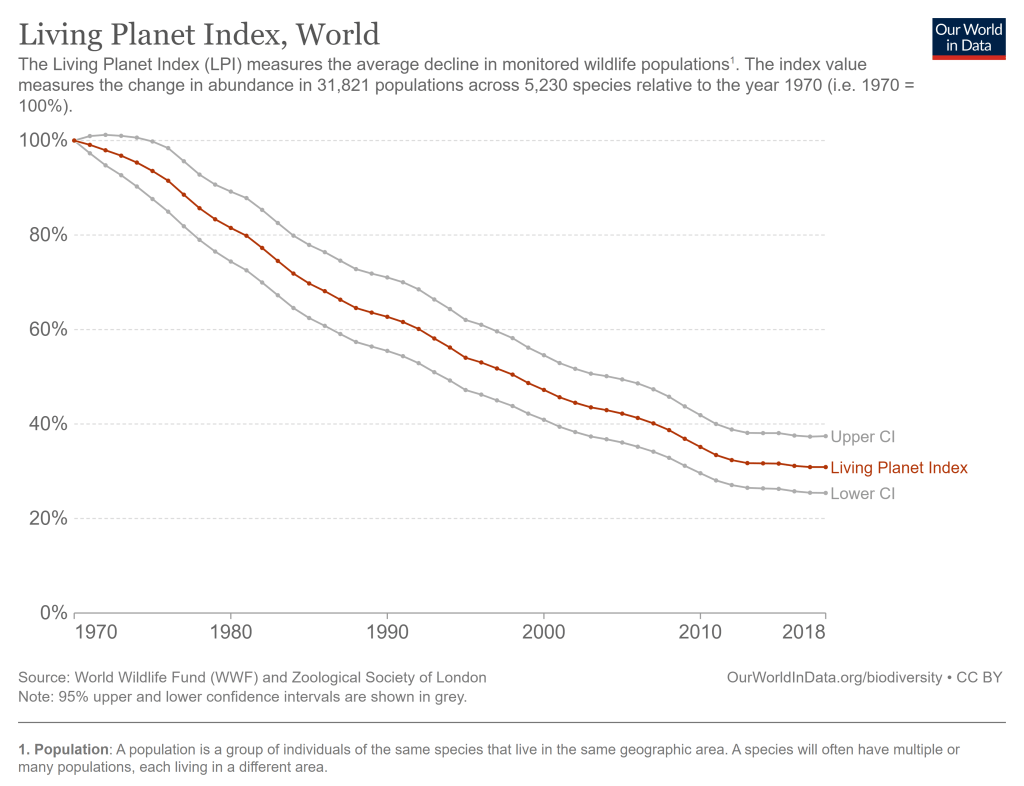
The World Wildlife Fund states that half the planet’s wildlife population has vanished since 1970 as a result of human activity.   52 percent of Earth’s mammals, birds, reptiles, amphibians and fish disappeared over those 50 years, 40% of all insects species and 60% of birds are declining globally.

And those figures do not take into account the total populations of the different species of birds, insects and wild mammals that are being killed off or starved from lack of natural habitat. When did the moths last bang themselves against your lighted nightime windows?- when did the smashed insects last cover your windscreen with their bodies on that last holiday in the natural world?- when did you last see the huge flocks of birds that used to be everywhere?

That absence may seem of no  consequence (or even a relief!) to many humans (especially those who live in  urban spaces) but in  fact  we are all reliant on the multiplicity of other species for our survival-whether it be for pollination for our food, the birds that spread the seeds of life, the Mycorrhizal fungi  that  ensure plants and trees grow healthily, or the many predators and ‘pests” who keep life in  balance.

We need to  revive our lost understanding of our linkage to all other life on this planet. Not just  the species that humans ‘like’; our native fauna and flora and our pets, but ALL life. We must begin again to look and listen with respect and compassion to the living world around us and help  rebuild the natural  world that  sustains us. We are perilously close to cutting the remaining  threads that bind us to life on Earth.

Acknowledging that human ‘growth’ is in fact creating more dead spaces, (more concrete sealing over the soil, more trees felled, and fewer wild spaces to name just a few of our nature destruction options) . Planting trees, reviving diverse habitats and nurturing all other species  with compassion are just some of our key steps towards a better and sustainable world.

Sustainable Communities and Climate Change

As global  supply chains are increasingly threatened by  sea level rise and unpredictable weather,  insurance costs  will rise exponentially  and we will inevitably be forced to produce as much  food and essential  items locally as possible.

The sooner we begin  to develop sustainable  communities, the greater opportunity we have to mitigate those inevitable risks and keep  people and our environment protected. The strengthening of community  communication, connections and skills is a key aspect  of those changes.

While  communities will  gain  much from  greatly strengthened community and local  skills, we will  need to shed much of our current consumerist ‘growth’  mindset- a mindset  that  says our towns, businesses,  GDP and exploitation of the natural world, needs to  constantly increase. The  project  ‘Take the Jump’ provides excellent advice on reducing our footprint.

We know we live on  a finite planet  which is already exploited beyond its limits. As climate change accelerates, we will  be forced to get off the treadmill  of  ‘ growth’  and consumerism.

We need to  change the paradigm now from the god of ‘growth’,  to a respect  for all  living things-to  acknowledge that  we are inescapably  and thankfully part of nature and have to live within  its means.

A Few Little Pieces of Gold and Silver

A Revised Letter to the Editor to a local New Zealand newspaper:

The current New Zealand government has, in  a  few short months, proposed a Fast Track  Bill to permit friendly quick-rich developers to effortlessly destroy  our natural  environment  which  we  all rely upon, not just for our wellbeing, but for our survival. 

Similarly  the proposed revisions to  the Resource Management Act  not only assist in this quick-rich process by stopping Councils from  designating  for at  least  3 years  Significant Natural  Areas, but also permit farmers to  resume ‘mud-farming’ and other farm process  that not only destroy water quality  but significantly impact on the wellbeing  of farm animals.

But perhaps the pinnacle of achievement of this government to date in putting cash before humanity, is its proposal  to  resume Livestock Export by Sea. Thousands of cattle spend weeks at sea in pens wading in their own faeces horrific and terrifying conditions – but it makes lots of money!

The mark of a good human being is one who  treats all other living beings with kindness, compassion and respect.I find it extraordinary  that supposedly educated government ministers put money that they  and their mates dont really need  more of, before our long term  survival and our humanity.

I would therefore respectfully suggest  that  Prime Minister Luxon  and his Cabinet  Ministers, spend a month  at  sea in a livestock  transport  ship  wallowing in  their faeces as a learning experience.

____________________________________

Links

https://eds.org.nz/resources/documents/media-releases/2024/make-a-submission-on-the-fast-track-approvals-bill-using-edss-template/

https://www.rnz.co.nz/news/political/514993/government-reveals-first-changes-to-resource-management-act

https://www.rnz.co.nz/news/political/511689/government-drops-need-for-councils-to-comply-with-significant-natural-areas-provisions

https://www.scoop.co.nz/stories/PO2407/S00001/live-exports-a-global-animal-welfare-crisis.htm

SOME THOUGHTS ON  FISCAL  IMPLICATIONS OF CLIMATE CHANGE AND BIODIVERSITY LOSS FOR NEW ZEALAND (and others)

Climate change fiscal  costs are largely currently assessed as solely the impacts of major weather events and consequent  restoration costs. While restoration costs after extreme weather events are likely to  rise exponentially over the next  century  and  beyond, there are significant other fiscal  impacts that also need to  be factored into planning. Note also  that  damage to infrastructure from climate change will  steadily increase in  both intensity and frequency over the next  100  years and beyond.

Ignoring future planning for these certainties will  result in  even more damage to  New Zealand’s economy and its citizen’s livelihood   safety and wellbeing  than is necessary. The impacts of climate change will be disproportinately felt by  those with limited incomes.

The longer we delay  anticipating and responding to the impending fiscal risks from  climate change, the greater the impacts will be on New Zealanders.

Food security for all, but particularly those with limited or no  income, is a key issue in  maintaining the wellbeing of New Zealands’  human population.

As climate change increasingly impacts New Zealand,  food supply chains are likely to  become more and more disrupted, resulting in  increasing costs  and decreasing volumes for food and other supplies.

Supply chain  disruption will occur for  a number of  reasons:

  • More and more frequent intense  climate events will  result in more  frequent road/rail  washouts  and flooding of increasing magnitude both within  New Zealand and beyond.
  • Sea and airline cargo  will  be increasingly disrupted by  extreme  weather events  (including a significant rise in  flight turbulence)  and  intense oceanic storms,  resulting in increase  damage to  transport vehicles and food stocks, higher  insurance costs and resultant food price increases, as well  as disincentives for farmers to produce more produce as export costs rise.
  • Drought,  flood and increases in  temperature in New Zealand and overseas  will  result in  reductions in animal numbers  and plant based food.
  • Rising sea temperatures, along with  ongoing unsustainable  fisheries exploitation are likely to  mean  the large NZ fishing industry  will  collapse within  a few decades
  • The recent  expansion of the dairy ’industry’  into  areas of New Zealand which  are  totally reliant on  intensive irrigation, like the majority of the East  Coast of the South Island, means such  areas will  become completely unsustainable for water intensive crops and  animals. Already  high irrigation levels  in Canterbury,  as a result of drought, are resulting in  unsustainable levels of water being drained from  local  rivers and aquifiers as well  as nitrate and other pollution of potable water supplies
  • Rising sea levels will  increasingly impact  on  both sea and airport  infrastructure. Most of New Zealand’s major airports are built in  flood prone areas or  close to the sea,  and  rising tides will  impact  on port sea  walls,  wharves, cranes and  container storage areas. The cost of rebuilds and/or relocation of air and sea port infrastructure are very  significant.
  • Consequent reduced  food production for export  by  New Zealand food producers will result in  increasing balance of payment’s deficits which  will  likely  result in  fewer overseas food and other  imports, as well  as less government taxation, resulting in  less income to  finance climate change mitigation.
  • As climate instability increases, specific areas of New Zealand like Northland and the East  Coast  of the North Island are increasingly vulnerable to major ongoing  flood and slip  damage and  consequent food production losses. South Island East  Coast  and Nelson droughts are  also becoming more frequent, with similar consequences.

Climate Change is also not only impacting of food supply but is  also beginning to  significantly impact  on  overall  insurer costs for housing,  businesses and new ‘developments’. As insurance premiums rise, all  fiscal  transactions will  slow, as  fiscal risks to  suppliers and purchasers  increase. A slowing economy ( estimated  conservatively as  a reduction of at  least  20% in 30 years) will result in  job losses and further risks to  human wellbeing, unless forward planning and implementation occurs now

Disruptions to and increased risk in  air flights will also  inevitably  result in  progressive reductions  in  tourism  income into  New Zealand (currently 11.4% of GDP)

The recent  analysis of Civil  Defence responses to the Hawkes Bay weather event has demonstrated that  Civil  Defence is not sufficiently resourced to   respond adequately to  even the current level  of extreme events.   Two  cyclones within  a few weeks,  as a Vanuatu  has recently  experienced, would stretch CD to breaking point. Significant increases in central   and local CD resourcing are going to be essential. Similarly, Police and NZ Army will  need upgrades to  cope with  the increasing frequency and magnitude  of climate extreme events.

Energy Consumption

New Zealand’s increasing consumption of energy, particularly in  increased use of EVs and other machinery that is being transitioned to  electrification and also IT /AI/Cloud based impacts. While NZ currently has just  sufficient sources of renewable energy, if current electricity  demands continue to increase, considerable investment in  renewable energy production in  solar  and wind will  be required.  

Carbon Credit Offset  Costs

If we continue under this current government policies to  take less action on  local  carbon reduction, we will  need to  purchase increased offshore  carbon  credits in  the billions of dollars to  meet  our international  obligations. Additionally, failure to meet  our international  obligations will  impact  on  our capacity  to export our produce to many countries.

Biodiversity Loss

The loss of New Zealand’s indigenous biodiversity is  well  documented and acknowledged as a major ongoing concern. However biodiversity loss of both  indigenous and non-indigenous flora and fauna  is occurring at an  alarming rate in New Zealand.

 We do  not  fully understand the intricate interconnections that occur between all  species in Earth’s  soil  and air  and the risks to  inadvertently tripping ‘tipping-points’ resulting in extreme  and sudden biodiversity loss are  consequently high. There are also  significant  difficulties in  attempting to  measure the fiscal  implications of biodiversity loss. However the current trajectory  of biodiversity loss in New Zealand and across the world, has the potential to  not only severely contract  GDP globally,  but potentially to  extinguish  all  life on  earth.

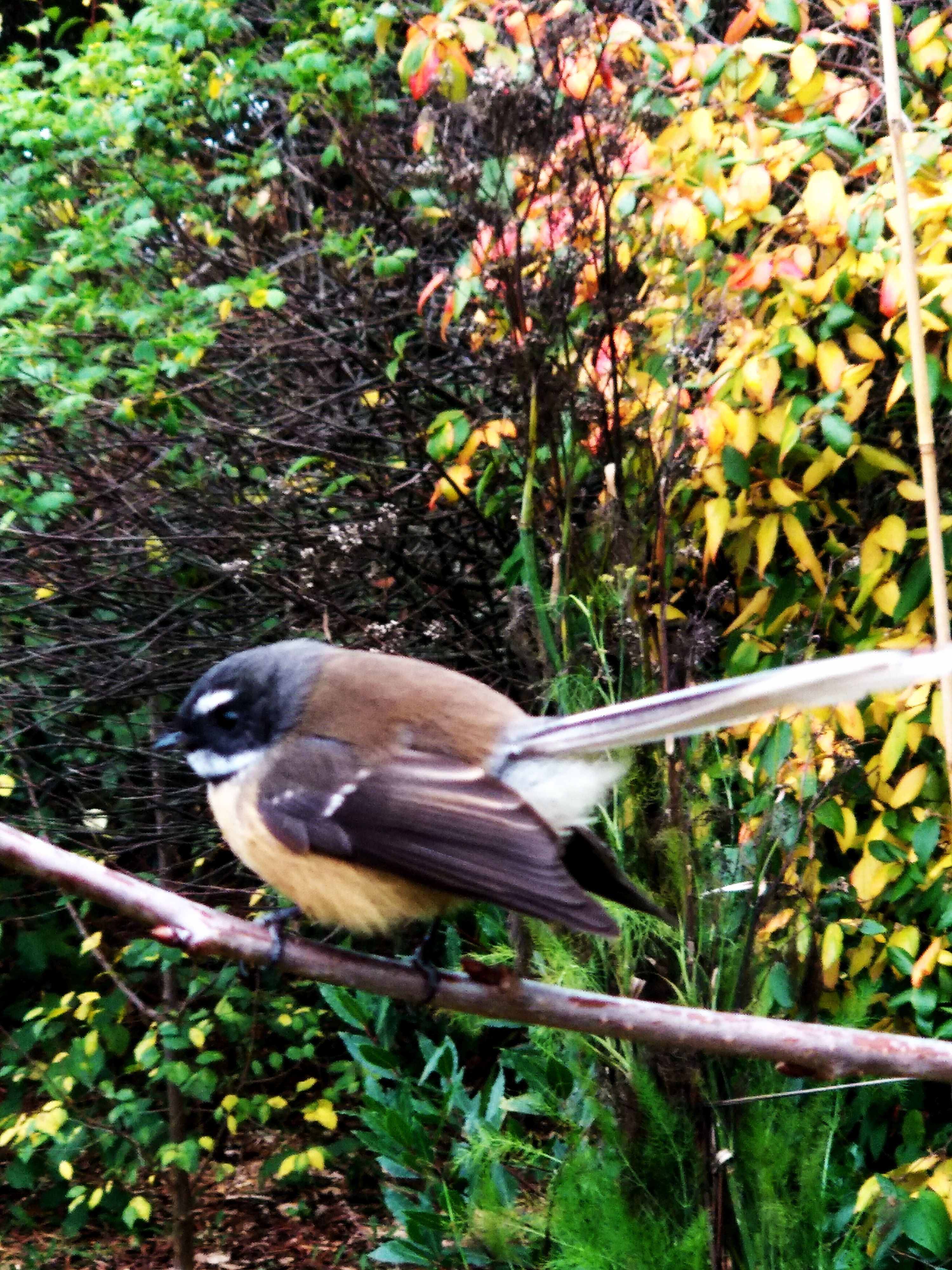
Piwakawaka (NZ's fantail)

The fertility of our soil, increasingly contaminated with  artificial  fertilizers, pesticides and weedicides is rapidly  deteriorating, particularly as mycorrhizal fungi; essential  to soil fertility, cannot survive in toxic environments. New Zealand’s continued capacity to  produce high volumes of agricultural  exports will  therefore be compromised in  the medium  to long term. The loss of pollinators  through toxicity, loss of habitat  and  introduced viruses is also a  major risk

Population Impacts

In recent years  NZ  governments have  increasingly used  migrant labour as a  cost-effective  mechanism  to increase GDP, however without the consequent   necessary increased development of critical  infrastructure in housing,  health or education. Rapidly increased populations have also  put increasing pressure on  biodiversity as ‘developed’ urban areas have expanded exponentially, and factors like recreational  fishing and foraging by  ever  larger numbers of people , impact  on  species numbers.

Potential  Solutions

Forward planning is urgently required  to both proactively  reduce the inevitable adverse impacts of climate change and to  ensure sufficient funding and other resources are available to  local  and regional  government and local  communities. The human  and fiscal  costs  of not proactively planning  for the inevitable will  be exponentially larger unless work is begun  now.

 Every Local community  must  be encouraged  and resourced to become as self-sufficient as possible as supply chains are increasingly disrupted.

Local  versus National

It is clear that  local  governments will  not be able to  finance the continuous work  to  both  reduce  local  climate change impacts and to  respond to local   adverse events through rates increases. A  formalised collaborative practical  partnership  between local and national  funding bodies needs to be established specifically to  address climate change risks.

National Resourcing

National  systems are  becoming  increasingly financially pressured to  respond to  adverse event mitigation. It is therefore be essential  to  urgently establish  a national  funding body , likely based on  the ACC contribution model that  can   resource the immense amount of work  required.

Iwi

Local  Maori iwi have traditionally played an immensely valuable role in  supporting local  populations put at  risk  by  weather and other adverse  events . Because of their  strong local  knowledge of the environments and resources  and connections and their hugely  practical  responses to  events , iwi  need to be  fully resourced to  support ongoing emergencies. Further, local  iwi’s traditional  and Te Tiriti role of guardianship  (Kaitiaki) of their lands needs greater recognition and support.

_______________________________________________

References

https://www.oxfordeconomics.com/resource/the-global-economic-costs-of-climate-inaction

ashttps://www.sciencedirect.com/science/article/abs/pii/S1002016023001388 

https://www.abc.net.au/news/2024-05-22/the-link-between-climate-change-and-turbulence/103877522

Piwakawaka (NZ's fantail)

Don’t Buy This Product We’re Advertising!

Girl in a Natural World

Have you ever seen that kind of email header in your inbox? -hmmm-maybe not!

(Note: this post has been reproduced with the kind permission of changethatmind.com )

Our ‘modern’ society puts enormous pressure on all of us to consume and buy more; whether it’s the ads you see pop up on your smartphone as you scan the web, your social media accounts, your local newspaper or your TV, the billboards on your way to work or on  the public transport you use-the exhortation to buy, buy, buy is constant and ever more insistent.

And our politicians extol the virtues of an ever bigger GDP, of ever more ‘progress’.

And we are all the victims of this propaganda war; we can’t escape, and we all succumb to one degree or another. We feel the need to have something more modern, something better something bigger, something more ostentatious, or even just keeping up with our friends, family or colleagues to have something at least as good as theirs. Why is that, do you think?

We’ve all heard that stuff about there’s only one Earth, but we all act like we don’t believe it and keep consuming enough for at least two! Maybe you’ve noticed how every year there’s a little less greenery, a little more concrete, or even how there’s far fewer bugs that splatter on your car windscreen, or that you don’t hear the birds you used to hear and see when you were younger.

Do you ever wonder why almost all the things we buy are inanimate things? -made of plastic, metal or dead plants?

So as our human population increases more and more, and every one of us wants more and more on this lonely little planet- what’s going to give?

And what can we do instead of consuming more and more?

‘Take the Jump’ has some great suggestions on how to decrease your footprint in the world…

Take The Jump

What if we all reduced our consumption back to the level of what was being consumed in the 1950s in the West? How hard would that be?

The ‘de-growth’ strategists give us a realist’s views of what we need to do to save our planet, and live a fulfilled, joyful and connected life.

Below is CNBC’s take on what degrowth means…

And then there other parallel strategies that can also help reduce our footprint like reducing the stuff or ‘clutter’ in your home.  ‘Homes & Gardens’ have some great ideas on reducing clutter. And there can be a certain pleasure in letting others get some enjoyment from the things you no longer need; whether it’s donating them to a charity or recycling agency, or selling them on Ebay or whatever your country’s equivalent online trader happens to be.

There’s no doubt our world is changing, and humans.  inevitably, will have to change along with those changes- whether we choose to, or whether nature chooses for us.

Our making the choice for ourselves now is so much the better choice!

To a more fulfilled life and better world!

Paul at ChangeThatMind.com

Note that ChangeThatMind is not an affiliate of ANY of the agencies noted in this post; and thence does NOT receive any payment on any of the products not sold through this website!)


Other Relevant Posts

Discover Hope for Humanity’s Future

https://www.the-trouble.com/content/2024/1/16/repair-the-rift-a-review-of-slow-down

Boiling Frogs-again…

You of course know the old (true) metaphor) that frogs in a pot which is slowly heated up, can’t register when the water is too hot for their survival and get boiled alive..

Well, something very similar is now happening for humans across the Northern hemisphere.

Source photo: https://showyourstripes.info/c/europe/all

And something very similar is likely to begin occurring in the Southern Hemisphere in early 2024 with the advent of El Nino and the rapid rise in Pacific ocean temperatures.

Source: https://research.csiro.au/acc/fifty-years-of-carbon-dioxide-co2-measurements-in-the-background-atmosphere-of-se-australia/

But it’s obviously all ok, because all our politicians around the world have far more important things to worry about– their next election defeat for starters, cosying up to big business for another, or sending another billion dollars’ worth of weapons to Ukraine. It’s as though climate catastrophe doesn’t really matter- if we just talk about it from to time and do nothing- that will placate the masses…

The response to the Greek Islands’ wildfires largely caused by climate change are just one of so many hypocritical and insane responses to climate change. The primary purpose of the fire response is not to eliminate the risks to vegetation and wildlife- oh no!-its to ensure that more tourists can flown in next year – and consequently ensuring that CO2 production from the thousands of tourist jets flying in and out of Greece ensure further climate catastrophe. Or we may give the example of why Paris has spent billions to clean up the Seine River -not to ensure river wildlife can return to the river after a century, but to ensure there will be millions of humans attending the Paris Olympics- all coming in on those CO2 producing jet planes from around the world…

Source : EDO https://edo.jrc.ec.europa.eu/edov2/php/index.php?id=1000

We need to ensure our communities can more easily adjust to the changes to our world and lifestyles that will occur whether we like it or not. Global trade will shrink as a result of more dangerous weather and destruction of sea, air and land routes. Transport insurance costs have already risen and will continue to escalate sharply as risks increase exponentially in the next few years. Local weather is becoming more and more unpredictable and dangerous. Multiple points of access to resources at a local level will become a priority.

In addition, to try and mitigate some of the impacts of global warming, species loss and destruction of soils and all the other species that we rely on for our survival, we need to urgently action the following.

In no particular order of priority (because they are all priorities), the following initiatives need to be initiated—NOW! …..

  • All food and products are produced within a 20km radius of major population centres. This limits both the transit/CO2 costs to the customer, and the transit costs of the producer.
  • Essential resources that cannot be produced or accessed locally are stockpiled in key places locally.
  • Transportation routes to other countries and locally, are multi-dimensional- ie different modes of transport which minimise biodiversity and climate harm.
  • All sales of goods account for their real costs to the environment.
  • All government and local government decisions take into account the environmental impact on emissions and biodiversity.
  • Businesses annually account and taxed for the environment costs of their business operations. All sales of goods account for their real costs to the environment.
  • All homes and businesses are retrofitted with high standard insulation. Where feasible solar panels are installed which link to the electricity grid.
  • Water from roofs is stored for either personal use or recycled into the water supply.
  • Urban areas and individual housing must have trees planted in every available area where food is not being produced.
  • All towns and cities are required to provide free or very low-cost community gardens and individual allotments for citizen food production.
  • Other species have the same rights as humans. A formal recognition by the UN and all state actors that all life is sacred and do not exist solely for humans’ benefit.
  • All products produced are capable of repair (or cannot be sold) and real recycling and repair occurs locally.
  • Governments and businesses are required to restore indigenous biodiversity to an agreed percentage each year.
  • Air travel is banned unless for absolutely essential business and family issues (e.g. tourism, global sports and cultural events are limited).
  • Solar, wind-powered or sustainably charged battery-powered sea, air and train vessels are developed and effectively utilised.
  • Farming is required to transition to sustainable practices within 10 years (no sprays, chemical fertilisers, and no ploughing- (use of permaculture, organic farming and biochar among other tools).
  • Indigenous trees are planted on a vast scale, on the understanding that they will never be cut down and ‘harvested’.

_____________________

The above initiatives may seem extreme to you- or even perhaps ridiculous and totally unnecessary. Why, you might say, can’t we, as Bill McKibben argues in his New Yorker article, simply return to 1960s levels of consumption?

The reality is that we have gone too far- way too far, beyond that. We have since had 80+ more years of consumption gone crazy, of CO2 production through the roof and an enormous amount of the biosphere destroyed. We not only need to stabilise humans’ impact on the living world we rely on for our existence, we need to start to actively repair it.

And yes, many of these proposals will have an impact on jobs; but without this forward planning job losses are going to be least of our worries- there will be little long term employment ins world of climate uncertainties and ongoing climate disasters.

Planning and actioning changes now, to cope with some of the enormous impacts climate change will have on our lives, will reduce some of the high risks of loss of income, food and essential resources that every one of us will face in our new climate world.

The alternative does not bear thinking about.

Postscript

In response to the recent US Congressional hearings on whether UFOs and aliens really exist, many of the U.S. public have stated that we really need to know whether we as human beings are really ‘alone’ in the Universe.

The unequivocal answer is of course that we are not alone, there are millions of sentient species right here on this planet that we have never bothered to try and communicate with as equitable partners. They may not look like us, behave like us, destroy the planet in the way that we do, (just like in fact our hypothetical alien friends from outer space would do), but they are, nevertheless our partners on this little world- and we are NOT alone!- let’s start to behave as though they really are our partners on this world!

______________________________________________

Links

https://www.sciencedaily.com/releases/2023/05/230517122123.htm

https://jonathancook.substack.com/p/why-action-on-the-climate-crisis?

http://www.paecon.net/PAEReview/issue96/Rees96.pdf

https://theecologist.org/2023/jul/31/future-what-future

A Saner New World

As the world heads into an unknown climate world, we need to be planning for a different future than the globalized one we imagined we would continue to live in.

In my little country of New Zealand, tucked away deep in the South Pacific ocean, rapidly warming surrounding oceans are creating a new climate world for us of sudden intense rainfall with increasingly damaging floods and higher temperatures.

More intense and more frequent weather events are allowing us the opportunity to see how completely dependent the living world is, including us humans, on the weather.

Where once we could rely on relatively stable weather patterns, the reality has dawned on us that our weather will become increasingly more unstable, intense, erratic and more damaging; not just for a few years, but for many many centuries to come.

But nowhere do we seem to be planning for this inevitable future. A globalised world of long supply chains of ocean going behemoths, cargo jets and steel rails are becoming rapidly increasingly vulnerable to weather events and ever-increasing insurer’s costs. (even if we ignore the impact of the massive CO2 injections to the atmosphere those long supply lines make!)

We must therefore rapidly plan for vastly localised food, energy and other necessity production and distribution; with short supply lines which are less impacted by climate extremes.

The result of localised production will be a smaller range of products, often less sophisticated, an immense reduction in exports to far-flung places which will be offset by localised production employment, cheaper local food and products produced on a smaller scale which require far less local resources and exploitation of the environment, and ultimately a political realisation that each economic /state entity can be largely independent of its bigger and more powerful neighbours and just needs to simply be accountable to its local population.

This does not mean a return to feudal times or the loss of many of the gains in communication and shared knowledge humans have acquired in the past 200 years. But it does mean an end to the big international corporations whose only motivation for existence is greed rather than also serving their local populations.

It also means a gradual decline in consumerism and international tourism as populations re-learn to connect to their local environments and draw strength and joy from their local communities without further destroying their own natural environments.

In the case of building a sustainable world for humans other species- less is most definitely more!

_____________________________

Links

https://www.commondreams.org/opinion/ocean-temperatures-heating-up

Super-charging our Descent into the Unknown

While a savage war grinds on in the Ukraine, killing hundreds of thousands of young men and women on its battlefields for no good reason (along with the other less visible but nonetheless as brutal wars in Yemen, Palestine, Syria and various states of Africa); planet Earth heads ever more rapidly down the slope to a new world: a world where wild weather is the norm, where temperatures and sea-levels climb ever higher at an increasing rate, and where fewer and fewer living things can exist.

A world where humans have increasingly become the predominant inhabitants. A world of humans convinced of their supreme intelligence and foresight when all the factual evidence suggests otherwise. A world where humanity’s short-term avarice has become the dominant driving force for major decisions about our long-term future.

Global warming and loss of bio-diversity are creating a world for which humans and others species are not prepared and will likely not survive in. That global warming and biodiversity loss is purely driven by greed. We do not need all this inanimate ‘stuff’ we have created to lead a full and happy life, but we are hell-bent on acquiring it!

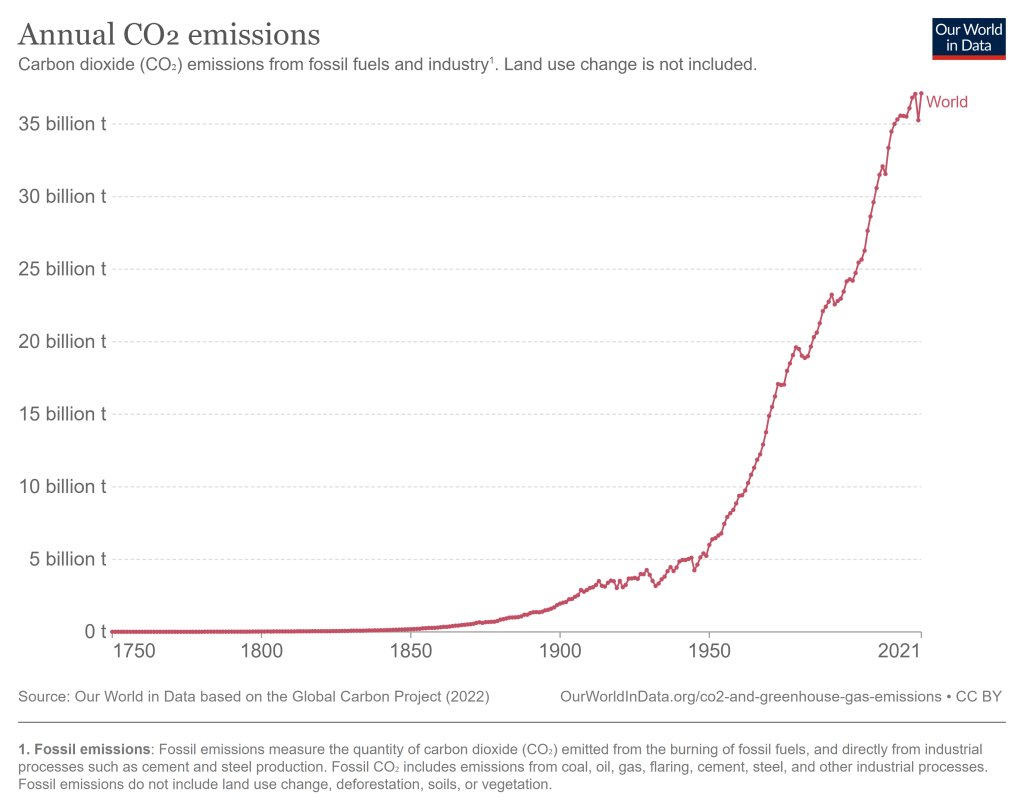
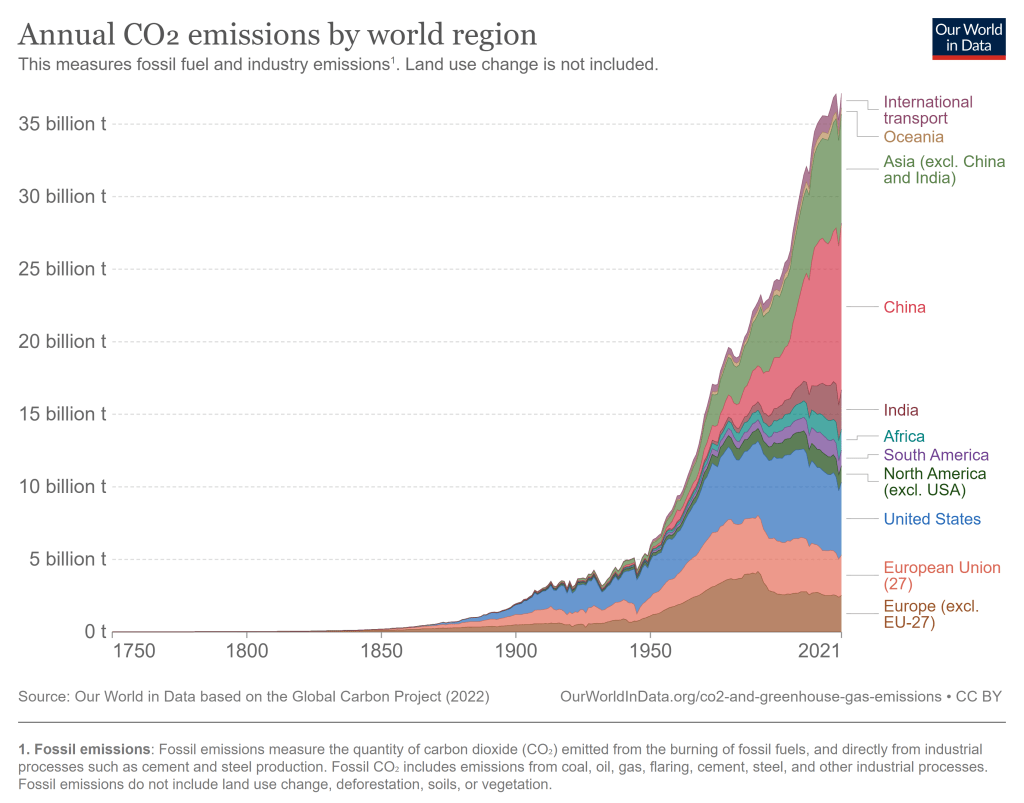
Note that the emissions shown in the above graph relate to the country where CO2 is produced (i.e.production-based CO2) , not to where the goods and services that generate emissions are finally consumed. 

But the greatest threat to us is not so much the steadily increasing temperatures and wilder weather around the globe caused by man’s constant production of Co2- but the loss of other species. Note that the graph below by Living Planet relates only to ‘wildlife’ , which in their terminology, only includes figures on vertebrate species – mammals, birds, fish, reptiles, and amphibians. It does not include insects, corals, fungi, or plants. The corresponding loss of total volumes and different species of insects is equally catastrophic. And man, not simply through his/her actions in increasing global temperatures, but predominantly through loss of habitat to produce more stuff, is the cause of these losses.

If we were to take the current reductionist simplistic approach to these losses we might say that we have no idea what impact these losses will have on humans, or what ‘benefits’ we could extract from those species if they were to survive. However if we were truly the intelligent species we claim to be, we would be examining the relationships between all these species, including ourselves and determining to preserve wherever possible, the current species we have.

We simply do not have a clue how each of the millions of species on this planet uphold the web of life here.

Increasingly ‘science’ is coming to the conclusion that all living things are sentient– they have awareness and are thus worthy of our respect, empathy and kindness, and a recognition and desire by humans to wherever possible preserve the lives of all other living things.

Death by a thousand cuts: Global threats to insect diversity. Stressors from 10 o’clock to 3 o’clock anchor to climate change. Featured insects: Regal fritillary (Speyeria idalia) (Center), rusty patched bumble bee (Bombus affinis) (Center Right), and Puritan tiger beetle (Cicindela puritana) (Bottom). Each is an imperiled insect that represents a larger lineage that includes many International Union for Conservation of Nature “red list” species (i.e., globally extinct, endangered, and threatened species). Illustration: Virginia R. Wagner (artist). https://www.pnas.org/doi/10.1073/pnas.2023989118

And while various mainstream media in the West (and almost nothing in China and Russia) talk about the latest research about climate change and biodiversity and how we need to be doing ‘something’ to address it, and while politicians and bureaucrats put in place global and state agreements to ‘manage’ climate change-in reality , nothing is happening to reduce the risks to us all.

And agreed, the path we are heading down is now a predetermined one, to very high global global temperatures for the next few hundred years or more that will almost certainly make life a living hell literally, but no-one is actually creating the mechanisms to stop humans creating more and more energy for more ‘stuff” we don’t need.

Our rate of destruction of this planet is not reducing!

And yet we humans are Masters of the Universe, are we not?

___________________________________________

Links

https://www.un.org/sustainabledevelopment/blog/2019/05/nature-decline-unprecedented-report/

https://www.pnas.org/doi/10.1073/pnas.2023989118

https://www.theguardian.com/environment/2023/apr/02/bees-intelligence-minds-pollination

https://www.theguardian.com/lifeandstyle/2023/apr/12/the-trauma-doctor-gabor-mate-on-happiness-hope-and-how-to-heal-our-deepest-wounds