
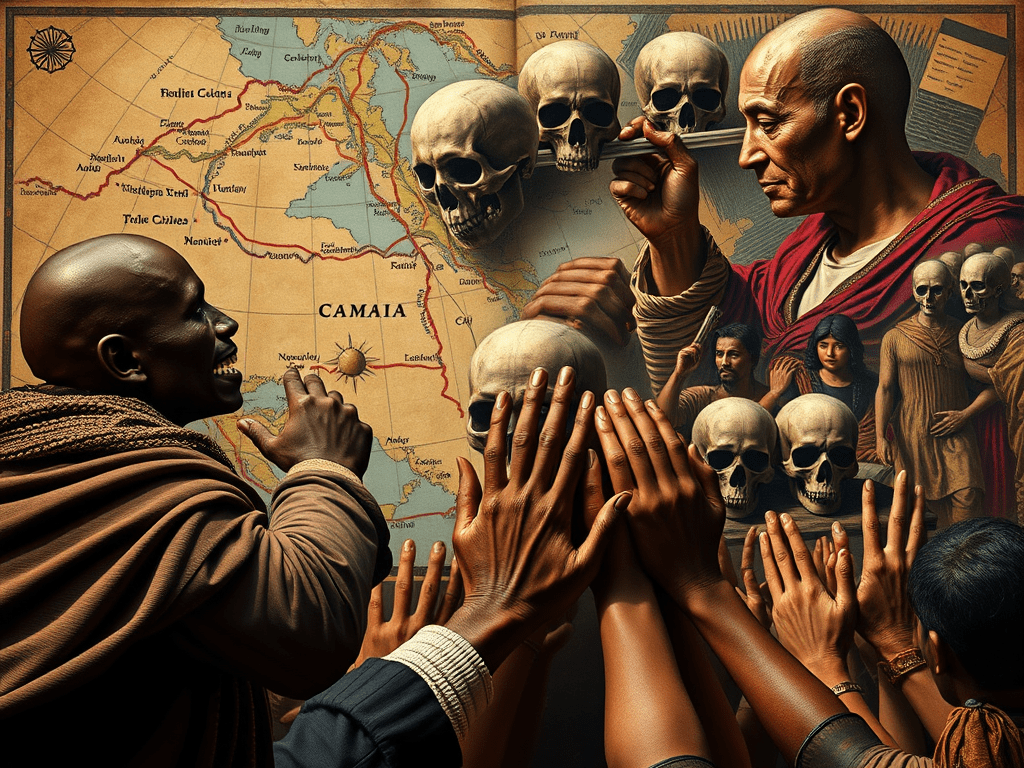
Racism was not a side-effect of empire—it was its operating system. From the 15th-century “Age of Discovery” to 21st-century border regimes, racial hierarchies have justified land theft, slavery, resource extraction and permanent war.
We outline how racism powered colonialism—and why it still shapes our world, as we see in the large recent populist responses in Europe and the US to immigration from non-white countries.
I would argue that we are, as human beings, inherently racist. We cherish the human group we belong to; the way we look, the way our group behaves, the things that are important to us. Those that look, and/or behave differently to us are therefore not ‘one of us”- they are outsiders, a threat to us and our group’s safety and wellbeing. Who we are is ‘normal’ – those ‘others’ are not normal.
That defensiveness against ‘others’, I would argue, is the root of racism. While that fear response may be deeply imbedded in our psyche, it can, and must be rooted out with clear rationality and understanding for those ‘others’. If we are to be truly human, we must treat all other living things with the kindness and compassion we expect for ourselves.
Conquest Begins with Name-Calling: “Savage” as a Licence to Kill
Greek and Roman writers already labelled outsiders “barbarians”, but the Atlantic world turned prejudice into policy. English colonisers depicted the Gaelic Irish as dark-skinned degenerates; Spaniards painted Indigenous Americans as cannibals; Dutch and Portuguese traders recast West Africans as “beasts of burden”. Once economic incentives for plantation slavery exploded, stereotypes hardened: Africans were now naturally servile, sexually voracious, mentally inferior—and therefore made for slavery. The perjorative demeaning language used to describe non-whites by ‘white’ people across the world is no accident. Language defines..
In the 21st Century, non-white immigrants to Western countries are seen as a threat to European ‘values’ culture and economic wellbeing. Current immigrant levels to the US and Europe are a direct result of economic and safety destabilisations caused by earlier extractive colonial policies and the West’s immensely destructive wars in those countries. In addition, Western governments, as opposed to their ‘white’ populations, have welcomed these new cheap labour immigrants to bolster their GDPs.
“Scientific” Racism: Empire in a White Lab-Coat
19-century European universities measured skulls, mapped skin tones and coined terms like “Caucasoid” to give racism the veneer of objectivity. The Dawinian science of evolution was used to delineate some human ‘races’ as less genetically evolved, with of course the white races at the top! This absurd and unscientific use of evolution were used by many in the West and exploited in the eugenics movement, and in its extreme form by the Nazis, and latterly the Zionists.
3. Britain’s ‘Liberal’ Empire
“Violence was not a one-off occurrence… it was systemic and part and parcel of Britain’s liberal imperialism.”– ‘Legacy of Violence-
A History of the British Empire’ Caroline Elkins (2023)
In the 19th century, Medical journals warned that “negro lungs” were unfit for cold climates to help justify keeping indentured labourers on Caribbean sugar plantations. Anthropology museums displayed colonised peoples alongside fauna. These ‘scientific’ findings were incorporated into colonial legal codes: the 1885 Berlin Conference carved up Africa on the assumption that Whites could best steward African land and bodies. Britain’s ‘protectorates’ listed below are a ‘sublime’ example of the racist mentality of the British Foreign Office. Why these populations would need ‘protecting’ from themselves was never adequately explained…
| Territory | Protectorate proclaimed | Today part of … |
|---|---|---|
| Malta | 1800 | Malta |
| Ionian Islands | 1815 | Greece |
| Mosquito Coast | 1838 | Nicaragua / Honduras |
| Aden (W. & E. Protectorates) | 1872 | Yemen |
| Cyprus | 1878 | Cyprus |
| Sultanate of Zanzibar | 1890 | Tanzania |
| Bechuanaland | 1885 | Botswana |
| British Somaliland | 1884 | Somalia |
| North Borneo | 1888 | Malaysia (Sabah) |
| Brunei | 1888 | Brunei |
| Sarawak | 1888 | Malaysia |
| Maldives | 1887 | Maldives |
| Sikkim | 1861 | India |
| Barotseland | 1900 | Zambia |
| East Africa Protectorate | 1895 | Kenya |
| Uganda Protectorate | 1894 | Uganda |
| Nyasaland | 1893 | Malawi |
| Northern Rhodesia | 1924 | Zambia |
| Swaziland | 1903 | Eswatini |
| Basutoland | 1868 | Lesotho |
| Gambia Protectorate | 1894 | The Gambia |
| Sierra Leone Protectorate | 1896 | Sierra Leone |
| Nigeria (N. & S. protectorates) | 1900 | Nigeria |
| Qatar | 1916 | Qatar |
| Bahrain | 1861 | Bahrain |
| Trucial Oman | 1887 | UAE |
| Cook Islands | 1888 | New Zealand (self-governing) |
| Niue | 1900 | New Zealand (self-governing) |
| Tokelau | 1889 | New Zealand |
| British Solomon Is. | 1893 | Solomon Islands |
| Gilbert & Ellice Is. | 1892 | Kiribati & Tuvalu |
| Tonga | 1879 | Tonga |
| Oman (Muscat & Oman) | 1800 | Oman |
| Bhutan | 1911 | Bhutan |
From Kenya’s “Pipeline” detention camps to Malaya’s New Villages, London cast mass incarceration, forced labour and sexual violence as “rehabilitation” for racially suspect subjects. Files were then sealed for decades under the Colonial Papers Destruction Policy.
Comparative Brutality: France, Belgium, Germany
- French Algeria: Settler colonialism embedded in the département system; with 1.5 million Algerians killed during the 1954-62 war of independence (Al-Jazeera retrospective).
- Belgian Congo: Leopold II’s rubber regime caused an estimated 10 million deaths—A BBC investigation calls it “one of the greatest mass murders in history”.
- German South-West Africa: 1904-08 extermination order against the Herero and Nama is now officially recognised by Germany as genocide.
British India: current scholarship puts the excess-mortality death toll attributable to British colonial policy in India between 1881-1920 alone at roughly 50–165 million people.
Racism after the Empires Recede
Decolonisation brought new flags, but not justice. The UN confirms that “colonialism lives on” in racial profiling, poverty and unequal trade. Former plantation economies still dominate global commodity chains, even while end-use processing for value addition to those raw commodities continues to happen in the Global North. France’s banlieues, Britain’s Windrush deportations, and the U.S. racial wealth gap all map precisely onto old imperial shipping routes.
Environment Impacts of Racism
The climate crisis is driven by the same extractive logic that cleared forests for sugar and cotton. Former colonies already suffer temperature increases twice the global average—a direct legacy of shipping carbon to Europe while deforesting the colonies’ natural environment- that same natural world many indigenous populations relied upon for their survival.
Towards Reparatory Justice
- Unveiling the Truth: Ensure that all colonial archives are opened to the public and for research (UK still classifies this information under the “migrated archives” rule).
- Reparations: From debt cancellation to technology transfers—see UN-DESA Policy Brief #96 along with fair funding reparations from ex colonial powers for their brutality and economic extraction.
- Education: Develop truthful, accurate and non-ideologically driven curricula for each ex-colonial country and its coloniser which explains the rationales and impacts of racism and consequent colonialism from each side.
Palestine 2023-25: A Live-Streamed Genocide Enabled by Racialised Imperial Logic
The same racial logic that once classified Indigenous peoples as “savages” and Africans as “natural slaves” is now redeployed to portray Palestinians—especially in Gaza—as irredeemable terrorists whose lives are expendable. Western diplomatic, financial and military support for Israel’s 2023-25 assault is therefore not an aberration; it is the continuity of a 500-year-old pattern in which white-majority states licence settler violence against racialised “others” while declaring themselves civilised.
Genocide is apparently what “non-white” actors commit; white or white-allied states are presumed incapable of it. Western media highlights Israeli “security” and terrorists’ ‘hostages’ while Palestinian deaths are counted in opaque “casualty” statistics, stripped of names, faces, context, and their 70 + years living under Israeli colonisation completely ignored. Bizarrely, peaceful protesters against Israeli savagery in Gaza in France, Germany, Britain and the US, among many, have themselves been labelled as terrorists and arrested.
France banned pro-Palestine demonstrations within days; police invoked emergency powers against students wearing the keffiyeh. The UK Home Secretary equated Palestinian flags with “support for terrorism”. Germany’s Berlin Senate excluded Palestinian speakers under the IHRA definition. These measures show how racialised imperial violence abroad is coupled with shrinking anti-racist space at home.
Trump’s ‘War’ on Immigration
The role of racism in Donald Trump’s immigration agenda is not incidental—it is the engine. From his 2015 campaign launch to the executive orders signed on Day 1 of his second term, Trump has consistently racialised immigrants, fused white-nationalist grievance with policy, and leveraged state power to punish Black, Brown and Muslim communities. Bizarrely the United States economic growth has historically largely been fuelled by immigration- but only immigration from the ‘right’ places; from Western Europe.
Trump’s language about immigrants betrays the racist underpinnings of his anti-immigration policies -‘“These aren’t people. These are animals” (referring to Central-American migrants), “Shithole countries” (Jan 2018): Trump asked why the US admits people from Haiti, El Salvador or Africa instead of Norway..
Such statements activate what scholars call “demographobia”: the fear among whites that they are being “replaced” by higher-fertility non-white minorities.
The Great Replacement theory—the belief that elites are deliberately replacing whites with non-white immigrants—moved from far-right chatrooms to Trump’s 2025 National Emergency declaration, which frames migration as an “invasion” threatening “national character”.
Further Reading & Tools
All links open in a new tab. Bookmark this list for classroom or activist use.
- OHCHR 2023 summary report on colonial legacies and racism
- Sheffield University student blog (peer-reviewed sources)
- Harvard Business School – Caroline Elkins interview & book excerpt
- Lowcountry Digital History Initiative – New World Racism timeline
- EBSCO Research Starter: Colonial Models of Racism
- DW – Scientific Racism’s Roots in Colonization
- The Guardian – Mau Mau torture files
- BBC – Congo genocide under Leopold II
- Al-Jazeera – Algerian war & settler colonialism
- UNEP – Climate injustice & colonial extraction
- UN-DESA Policy Brief #96 – A New Reparatory Scenario
- UN-DESA Working Paper #174 – Colonialism & the wealth gap
- Amnesty International – Global colonialism & death of liberal democracy
- Journal of Global Slavery – Special issue on reparations
- Soundings Journal – Colonial Racism Today (open-access)
Feel free to republish under Creative Commons CC-BY-SA 4.0 with attribution to the author and a live link to this post.
 New Antarctica