A research paper published by Oxfam, published to coincide with the World Economic Forum at Davos in late January 2015, shows that the richest 1 percent have seen their share of global wealth increase from 44 percent in 2009 to 48 percent in 2014, and at this rate will be more than 50 percent by 2016. Members of this global elite had an average wealth of $2.7 million per adult in 2014.
In my view, the issue is less that the disparity between the rich “elite”‘ is widening, and more to do with how that rich “elite” use their power and influence. Provided people have enough to eat, good sanitation, clean water, safe housing and peaceful living environments, the issue of disparate incomes becomes less an issue of need , and more of perception and unfairness. Why should I be poor when you are rich, and you clearly have no more r right to those riches than I do, and certainly don’t use those riches in a way that benefits anyone other than yourself and your immediate clique?
The concern about the majority of the wealth and power and control resting with a minority of the word’s population is therefore not so much an issue of how the world’s “wealth” is shared, but the quality of the decisions that are now being made about our future world as a result of the disenfranchisement of decision-making from those who are connected to their local environment. That wealthy elite make their decisions on the property they own based almost exclusively on how much profit can be accrued through its exploitation.
The history of absentee landlords in Scotland and Ireland in the late 18th and 19th centuries is unequivocally clear on this, and a lesson for today , where more than 50% of the world will soon be owned owned by absentee owners.. The welfare of Scottish and Irish rentees on the land was of absolutely no concern to the landlord in most instances. Neither was the environmental destruction of the land of any concern, unless it impacted on profit or pleasure.
Those who remain connected to the land, particularly inter-generationally, have a much greater driver to ensure it remains sustainable for the long-term. Bad short-term decisions can undoubtedly still be made that destroy natural habitats and species, by those connected to the land, but an algorithm of exploitation based purely on short-term monetary gain, does not make sense to those who will inherit that land in the future.
As just one of so many examples, in New Zealand, the rise of dairy absentee millionaires and conglomerates who buy up large tracts of pasture land (which was once dense bush with a myriad of species within it) and then proceed to destroy the land through unsustainable exploitation of the water resources available to them and the long-term contamination of the water table with dairy foecal and nitrate pollutants. Once the profits have gone from the “business” and the land destroyed, those absentee landlords will take their money and move on to another more profitable exploitation option.
The rapid erosion of local ownership to land and property therefore is not simply and issue of equity or even poverty; but more importantly, just one more ingredient in that lethal recipe for environmental global disaster.
The Intergovernmental Report on Climate Change earlier this year noted if action is not taken “soon’ the resultant 2C increase in global temperatures will have ‘severe’, and ‘irreversible” impacts on human habitation and economic activity.
Governments, in their desperation to feed the “god of growth” are increasingly making more and bigger foolish decisions that undermine our sustainability as a species on this planet. Take for instance, the ever-increasing taxpayer dollars pouring into oil and gas explorations, or the actions of corporate-resourced governments such as the UK or New Zealand, with their intent to emasculate regulations that protect the environment against corporate interests . Or the potential horrendous environmental impacts of international agreements such as the Trans-Pacific Partnership Agreement (TPPA). The “god of growth” must be fed, regardless of the consequences to our planet and the species who inhabit it.
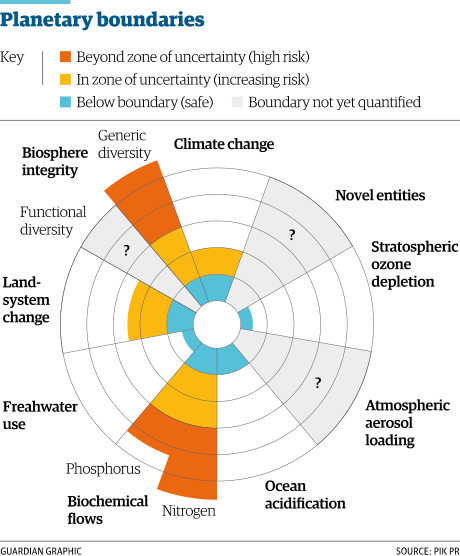
While climate change gets all the press these days in the media; it should be noted that climate change is just one of a multitude of impacts of homo sapiens’ drive for “progress’ and ‘growth’ over the past 200 years. For those species (including humans) at the sharp end of climate change- those in tropical countries or drier hotter climates, the impacts are likely to be truly horrendous over the next 100 years -and for the next few thousand or perhaps million years beyond that. However what underpins this destruction of our planet is our incurable arrogance that we are somehow “superior” beings who are overlords of the other species on this planet.
It is absolutely undeniable that unless we can co-habitate with the other remaining species that we have not killed off as yet-we too are doomed as a species. We are entirely reliant on other species for our short , medium and long-term survival. No amount of concrete or tar or metal or money can hide this fact. The journey to bio-extinction in the pursuit of profit in New Zealand is just one of countless stories of man’s folly.
What is required is a fundamental shift by all humans on this planet to understand that every other species shares an equal right to life on our little blue ball. Killing off a species or a few million individual sentient beings to make way for a shopping mall, is just nonsensical.
While we may pretend, we have not behaved in any way as caretakers of this planet; we have not behaved rationally and with fore-thought, we have not allowed the blinkers to fall from our eyes to let ourselves see the folly of our shallow understanding that because we are homo sapiens, then anything that does not exist or think like a homosapien is inferior, and not worthy of life, unless it is for our use: for us to kill and eat, or for human tourists to gawp at while they destroy the surrounding environment. A supposed scientific principal which argues that other species are inferior to one particular species whose “superiority” is based on the core attributes of that one species and no other, is a rather dubious piece of scientific endeavour! This superficial belief, called anthropocentrism, must be eliminated from human consciousness, if we are all to continue to thrive or even survive on this planet.
To put it bluntly, those rationales exhibit primitive thinking and zero compassion for other species; let alone a rather dubious understanding of the laws of cause and effect.
As Prof. Will Steffen of the Australian National University and the Stockholm Resilience Centre notes; “Some people say we can adapt due to technology, but that’s a belief system, it’s not based on fact. There is no convincing evidence that a large mammal, with a core body temperature of 37C, will be able to evolve that quickly. Insects can, but humans can’t and that’s a problem.”
In all the reports about climate change or even loss of bio-diversity it is very rare to see an analysis of the impacts of homo sapiens’ folly on other species. In almost every case you will instead see a superlatively superficial analysis of the impacts of climate change in dollars and cents, or the cost of a species lost we can no longer exploit. Those analyses are proof in themselves that we have lost our way as a species in a spectacularly ignorant way.
T.S. Eliot’s famous poem, The Hollow Men, ends with the following lines…
This is the way the world ends
Not with a bang but a whimper.
A recent study, led by applied mathematician Safa Motesharrei of the National Socio-Environmental Synthesis Center and using new statistical modelling methods, predicts that this current civilization will likely collapse in another twenty to fifty years. The study draws analogies with past human civilizations; the Assyrian, Roman, Mayan, Minoan, the various Chinese empires…. We can assume that like us; the populations of those civilizations had every reason to believe their civilization was unique and would last forever. While civilisational collapse is quite rare, characterised by entire ways of life, systems of thought, cultural values and worldviews disappearing, political collapse occurs frequently ( eg empires and kingdoms disintegrating). What appears likely to happen in our modern context, given the confluence of a number of catastrophic events, is civilisational collapse.
While this particular study has been sharply critiqued by journalists and scientists alike for its simplicity and generalisations ; the broad conclusion that, as Paul Simon aptly put it ,”everything put together falls apart” , is a healthy reminder of human hubris.
The single most important story unfolding in not-so-slow-motion on this planet is the ongoing destruction of the natural world in the name of “progress” and “growth” (ie consuming ever more “stuff”) by humans; , which will in the near future, significantly negatively impact on this species. Despite our insistence to the contrary, humans are entirely reliant on other species for our survival. It is a given that is blindly ignored by politicians, businesspeople and businesses and all those with a current stake in the way our “civilization’ currently works ( ie all of us).
As key resources become more expensive to extract, the world economy (which is apparently now the full extent of this ‘civilization’) begins to contract and distort . And as the gap between rich and poor widens, the “have-nots” increasingly demand in more and more violent ways, their right to a slice of the pie. As the oceans and atmospheric temperatures rise, so do the pressures on our artificial nation-states. As we progressively and rapidly eliminate species after species to produce more things, to make “progress”; our chances of long term survival as a species are being rapidly reduced. Our civilization demands that we assume that we have an infinite volume of resources to consume for the infinite future in a closed planetary system – a small contradiction in terms! We are indeed heading for the perfect storm.
Study after academic study shows that the more we gain from a civilization’s prosperity, the more we are blind to its failings and contradictions and its inevitable fall. This tunnel vision says , that ‘if I am doing well out of this catastrophe then it cant be a catastrophe at all!’
Homo sapiens pride themselves on their remarkable intelligence; their capacity to manipulate their environment for their own ends. They appear unable to grasp that that self-definition process of appropriating everything good, intelligent and wonderful to human attributes, is simply the result of their blinded vision. If by definition, species that manipulate their environment are determined to be superior to all other species; then lo-and-behold!- homo sapiens are superior beings! Because homo sapiens are above all other traits, social beings, all of us have an intensely strong need to “fit in”, to belong to the group. Agreeing with other people on ‘our’ group’s thought processes and paradigms is an essential part of this togetherness. However, agreement does not it make it truth.
Thus, it does not matter that the capacity to manipulate the environment for the benefit of our species and at the expense of all other species on this planet might not be quite such an intelligent thing to do, given that the environmental devastation and species destruction is largely for homo sapiens’ short term pleasures, power and baubles.
Were we to say that a species that can sustain itself easily and efficiently without damaging its environment in the process, were more ‘worthy’ beings than other species ; then homo sapiens would not be registering on the short-list!
Over the millenia, homo sapiens have been able to convince themselves that people of other cultures, or colour, or background are inferior to one’s own culture because of this self-defining process. Using the same intellectual process, the more different another species is from ourselves, the less worthy , less intelligent, more expendable and worthy of our exploitation and destruction that species becomes. The more differentiated from our species the “other” is, the easier it is to dismiss its inherent traits and qualities and its right to life. However on our ever smaller blue planet, we no longer have the luxury to differentiate between “them’ and ‘us”.
How much easier then is it to dismiss the equality of other species with ourselves when their characteristics, strengths and skills are so different from homo sapiens, and when it is so much to our benefit to be able to kill and exploit other species without moral qualms.
As Henry Gee also points out succinctly in his Guardian article , each species’ particular traits or “strengths” are based purely on, firstly, what biological mechanisms of sense are available to them ,and secondly, how they use those senses to that species’ best advantage. Homo sapiens may not value our sense of smell because its not a particularly efficient sensing mechanism in homo sapiens, but you can bet a dog does!
The capacity for self-delusion in our species is immense. Witness the largely American driven anti- climate -change camp. Of course we cannot be destroying our planet with C02 through industrialization, because capitalism and owning the means of production is the reason for our being! – after all, aren’t we, the US consumer, the greatest people on earth because our nation is the epitome of capitalism?
As another example of collective self-deception, Seth Klarman, the manager of the $27billion hedge fund, the Baupost Group, recently remarked on the similarities of the world’s banking system to the ‘Truman Show’, the late nineties Hollywood film, where the lead character “lives a seemingly charmed world, snuggled comfortably into an American suburbia of white picket fences and crisply cut lawns. But gradually Truman starts to notice something is not quite right. He is actually trapped inside a film set controlled by hidden directors, and discovers to his horror that he is the unknowing star of the world’s most popular reality TV show.” In one of the more blatant nuances of reality shifting homo sapiens have acquiesced to, our financial system is in essence simply one of “smoke and mirrors” -the manipulation of facts and figures designed to obscure reason and reality; a fragile house of cards.
The dreaded “black swan”!
One key point of difference with previous human civilizations around the world is that our current civilization is a global one; each of the parts are inextricably connected. Apart from a few small tribes in isolated areas, every one of us has bought in to this unique method of environmental destruction. Thus when this civilization collapses -(and it is a “when” and not an “if” ), that collapse will be both more rapid and more global; there will not be another model of homo sapien civilization around for the survivors to pin their hopes on. The other significant difference with other previous human civilizations is this current one’s geographical reach. Vast areas of the planet have now been laid waste in the name of human progress.
So, while the modelling conducted by Safa Motesharrei may be flawed, it does provide an opportunity for serious debate about the direction this global civilisation of ours is taking us..
Over the last 20 years there has been increasing scientific evidence of the reality that “animals” vary little from homo sapiens in terms of their capacity to feel, to have cognition and to be aware of their circumstances. That very ‘useful’ set of historical assumptions of the lack of true ‘awareness’ of other species compared to homo sapiens, which has enabled those of us who wish to kill or hurt other species on the grounds of their implicit inferiority to humans, has now been fully discredited.
Tilly
It is therefore inevitable that, over the next few decades, a global ethical and moral shift to the full valuing of other sentient life on our little planet will occur. This will in turn translate into a massive reduction in meat eating by homo sapiens and the need for environments where other species are respected and protected. While this world-wide ethical and moral shift and its translation into alternative action to value other species as we would our own, may currently appear absurd to my dear readers, it is worthwhile to consider how rapid the global moral and ethical shifts against issues such as slavery or the rights of women have occurred in the last 200 years.
It is therefore vital that both states and individuals start to explore both the implications of that shift in attitude towards species other than our own, and to assist in driving that change towards a better world for all of us who inhabit this little blue world.
While the challenges to the economic environment of those state entities whose economies are predominantly reliant on the export of meat are undoubtedly immense if we are to shift to a no-kill economy; the opportunities as a world leader in environmental and species ethics and practice are also enormous.
The evidence for the greater efficiency and sustainability of a non-meat based agrarian economy is out there now; we can start to plan for this inevitable change or be sidelined by other more ethical and forward looking economies. No-kill agricultural produce that is produced in a fully environmentally sustainable way, will be in huge and ever-increasing demand as the ethical and moral framework of our species shifts its awareness in the decades to come.
Given the indisputable evidence that other animals than homo sapiens have the same value and senses as ourselves, it is imperative that all laws regarding the management of animals ensure that no cruelty or suffering is permitted under government regulation.
In just one of many examples of research into animal behaviour that explores the real capacities of other species, the recent Guardian article on the work of Tetsuro Matsuzawa at the Primate Research Institute of Kyoto University exposes how chimpanzees on a number of cognitive fronts are superior to homo sapiens .
It is important to note that all research by homo sapiens is naturally slanted to place positive attributes on those skills that are traditionally deemed “human”, and to either ignore , minimise, ridicule or even simply not observe those skills and attributes of other species that are less familiar to us or deemed by humans to be not important or irrelevant. In addition, our sensory range as humans limits our capacity to even understand at a basic level , th edepth of awareness of many other species.
One revealing comment by Prof. Matsuzawa in the Guardian article is his statement that “As humans evolved and acquired new skills – notably the ability to use language to communicate and collaborate – they lost others they once shared with their common simian ancestors. “Our ancestors may have also had photographic memories, but we lost that during evolution so that we could acquire new skills,” he says. “To get something, we had to lose something.” As the supremely arrogant and species-centric organisms that humans are; we have glorified our skills, while ignoring our sensory and cognitive deficits in comparison to other species on the planet.
Perhaps our most unique skill, is our capacity to manipulate our environment to suit our own ends. It is likely to also be our, and the rest of the species on this planet’s , undoing.
Postscript
A recent article in The Guardian entitled “The American lawyer seeking human rights for chimpanzees” examines with some incredulity and implied mirth at the idea-that a US lawyer is campaigning for chimpanzees to have the same legal rights as human beings. The article references the NonHumanRights Project ; one of the first of many human organisations devoted to rights and equality for all sentient beings on this planet.
Over the years, there have been many discussions about the potential to create large-scale organic farming enterprises to replace the disastrous impacts of chemical farming.
A lovely article by Tom Philpott of Mother Jones outlines one attempt by some US farmers to break the dead-end cycle of spraying, tilling and loss of environment caused by commercial farming, using no-plough methods and winter “cover crops”. While this method does not completely eliminate the toxic impacts of spraying ; it does go a long way to develop large-scale sustainable farming practice.
Another “new” farming concept is is the use of charcoal in soil. Native american indians used Terra preta in pre-Columbian times to create long term sustainable gardens in environments where high rainfall leaching should have made sustainable agriculture impossible.
Given that at least a third of commercially produced food is wasted, it would seen perfectly feasible to create food sources closer to food consumers, allowing less wastage in transit, and better targeting of food production to need.
We dont need the environmental destruction that is touted as necessary by agribusiness to create sustainable global food production. We don’t need to keep killing our essential insects with insecticides, spraying weedicides to control the plants we dont want, constantly digging up the soil to destroy its structure and life, and destroying more and more natural environments and the plants and animals that live there, for short-term gain. We can live a wonderful sustainable and more joyful life through living instead of buying.
A recent sobering article in the Guardian notes that as of May 2013 we have now reached the new exciting record of having 400 parts per million of Co2 in our atmosphere!
The Guardian states that:
The last time so much greenhouse gas was in the air was several million years ago, when the Arctic was ice-free, savannah spread across the Sahara desert and sea level was up to 40 metres higher than today.
These conditions are expected to return in time, with devastating consequences for civilisation, unless emissions of CO2 from the burning of coal, gas and oil are rapidly curtailed. But despite increasingly severe warnings from scientists and a major economic recession, global emissions have continued to soar unchecked.
However what is most sobering, is that last slide in this Guardian narrative, which shows the likely scenario of reaching 1000 parts of carbon dioxide per million by 2100 if industrialization continues as it has for the past 200 years; which is everybody’s best guess at this point.
Not one government in the world is committed to real carbon dioxide emission reductions at this point. Most governments talk about reducing carbon emissions, but in reality pedal “progress’ and ‘economic growth ” as the panacea to their little national problems of recession or poverty… However “growth” and “progress” are the true causes of our death-wish.
By the time real decisions are made to reduce industrialization and consumption globally, we will be well and truly past the point of ensuring our survivability as a species with any significant numbers on the planet, along with thousands of other species. In reality, right now, we are long-gone.
What the impacts of living on a planet with 1000 parts per million of carbon dioxide will be; no-one knows. Nor do we know what the short to medium term impacts of this totally never-before-witnessed sudden change in our atmospheric composition will have on this planet.
Nor does anyone know, even if we stop producing CO2 right now, how long it will take before CO2 levels start to decline, and consequently the world’s climate begin to return to”normal ” conditions. Quite possibly it may take thousands of years for climate conditions to return to the levels of the 1960s; if they ever do at all.
What we do know is that we have entered an unfamiliar world-there is no going back.
George Monbiot in his blog “The Great Unmentionable” once again powerfully articulates the insanity of consumerism -the relentless drive by governments, media and corporates to encourage us all to not only maintain our spending on foolish things, but to increase it.
Monbiot points out that it is not heating lighting and transport which are the predominant carbon emission culprits-it is the “stuff’ we buy – which increasingly is produced for “us’ Westerners by ‘those’ people over there.
In its quest for economic growth and more wealth for the wealthy, corporates attempt to even commodify nature; where would we be for instance without our little sticky labels on our fruit and veges, not knowing which international conglomerate had marketed that piece of produce?
But by far the most insidious aspect of consumption of “stuff” is the central part it plays in the relentless destruction of the natural world- the loss of natural habitat, the annihilation of species after species, for more pieces of short-lived pieces of ‘stuff ‘ that no human will want in a year or so.
The environment may be able to be resurrected after the factories have been pulled down, as some artificial and dumbed-down version of true nature -but without the ever-growing list of extinct species that can never return to us.
Maple Trees in Autumn
As our species becomes more and more urbanised, we lose our awareness of our indelible link with nature; our capacity to just watch and listen and wonder at the glorious real world around us ; our heads down watching ‘smartphone” screens or plugged in to our latest preference for noise on our mp3 player. We become immune to the beauty and randomness and unexpectedness of nature of which we are an integral member-and have blinded ourselves to that reality.
Instead of being open and alive to new and unexpected events and situations, we increasingly self-select our perception of the world from an ever-narrowing mechanical IT menu driven by our past experience.
We lose our connectedness to the world around us-our inherent knowledge that we are transient fragile beings like all other sentient things on this planet: that we are different-but no better- than all the other species we live with.
The standard response to the current financial crisis has been to punish the presumed debtors. Are the creditors blameless, then? asks Dinyar Godrej.
It’s almost a reflex. Think about debt and we think first about something owed. Then come secondary considerations of whether it ‘should’, ‘ought’ or ‘must’ be paid back, how this should happen, and whether possible.
Large outstanding personal debts – say a mortgage taken out during a housing bubble – can turn even the stoutest of us into ‘quivering insomniac jellies of hopeless indebtedness’ (as Margaret Atwood so accurately puts it). Debt is, we feel, whatever the rights or wrongs, ‘our own fault’.
We can’t help it, we are socialized to take such a moral view of debt.
T.S. Eliot’s The Hollow Men alludes to the end of the world coming “not with a bang, but with a whimper..” However the end of capitalism will not be the end of the world; far from it. It will be a glorious new beginning for humans and the other species on this planet.
In a blink of evolution’s eye, capitalism has done more damage to the planet we co-habitate, than any meteorite strike or cataclysmic galactic event. The destruction of species is occurring at phenomenal speed, the changes to our climate through gaseous emissions, the poisoning of much of our planet for millenium… and for what?- a bank balance with lots of numbers?, some pretty things that self-destruct in your hands after a year or two?, the capacity to tell your friends about all the places you have seen?; merely “Dust in the Wind” as the band Kansas would say..
To change the direction of this juggernaut of self-destruction requires more than political will, a mass movement or a United Nations declaration; we are all of on board this juggernaut -whether we are up there in the driving seat, or hanging on for dear life on the roof desperately trying to claw our way inside to the easy seats while it hurtles towards oblivion. We all have an investment in ensuring that this insane model of “progress” continues; we are “locked in” for the ride. .. (the university degree that you spent all those years sweating over so you could get the job of your dreams, the expensive house you spent years slaving away at a horrible job to afford, or simply the years you spent at the factory so your kids could get an education…)
However some have a greater investment in it than others.
It’s almost as though there is a “coefficient of adaptation” associated with human societies that varies with the relative level of “development” (whatever that means) which describes the amount of change that a social system can effectively assimilate without becoming unstable. It’s not just quantitative, but also qualitative, having clear hot-button issues (often related to women and the role of government) that, if pushed too hard, accelerate the movement toward state change.
What also happens, of course, is that the powers that be, regardless of the particular discipline or sector, see the abrupt change as a threat and, like white corpuscles rushing to staunch a wound, leap forward in defense of the status quo – regardless of the relative merit of the new proposal. This is where I get hung up. It’s as though the “system” embraces the status quo, even though things are clearly not working very well and treats thoughtful new proposals as mortal threats, even as people die and suffer because of the present policies. And it’s not just that they defend the status quo, but that they leap to attack the new ideas in very non-rational and sometimes inhumane terms.
Does all this imply we should all be living as medieval peasants in some country idyll?
Kelp seaweed
No , but we can, if we have time, start to turn the wheel, take the foot off the accelerator and truly experience the scenery-instead of watching it whipping past in a blur. Imagine if the money and hype that is now put into selling this or that useless product, was instead put into showing you how to work alongside your neighbour, how to create living spaces around us instead of neat and tidy ones, how to co-exist with the other species we live alongside, how to avoid conflict and promote peace, how to stop and just enjoy these brief moments we all have in this life.
Yes, we surely need good sanitation, clean water, cheap healthy food and good shelter. There is plenty to go around for all the billions of humans on this planet right now. Yes we will need to learn how to consume less and enjoy more; there are plenty of tools out there to do that right now if one cares to look.
We cannot afford to have people control this world and its resources whose only interest is the production of power and money for themselves and to hell with everything and everyone else. Those fools are dragging us to oblivion , the point at which literally this planet becomes a hell-hole. Poisoning the world and its living things, paving over the living earth, killing our fellow species, for a few cheap baubles -that is truly insane. Sadly we are all “locked-in”: -we cannot see the madness.
But, there is a saving grace to this. While Lovelock has reneged on his view of the Earth as a living entity “Gaia”- this planet has not! We are rapidly reaching the point as humans where we are opening our eyes to the damage we have caused; where the cost of “improving’ or maintaining our standard of living becomes too great-we have reached “peak capitalism”.
And just as with “peak oil”, the point of optimum utilization of a particular process is invisible to the onlooker; the forces change and adapt. The price of oil rises inexorably year by year but we only notice the ebbs and falls; the capacity to pump oil crude out of the ground wanes, but production stays with demand as we develop more costly and more environmentally damaging processes like shale oil… and consequently economies begin their progressive wilt under the ongoing pressure….
The fundamental flaws in the capitalist system become ever-widening abysses into the unknown; and we have the opportunity now to create something wonderful for ourselves as human beings and for our fellow species on this planet.
That opportunity is neither capitalism or communism or any other “ism” created to capture or -redistribute the “wealth” of this planet. It is an understanding that we are not the guardians of this planet, (we have made the most appalling job of trying to do that!); we are simply co-habitators whose guidance will come from listening and valuing everything around us.
In recent days we have seen vast Western media publicity on the Boston Marathon bombings: the dead, the wounded and the likely perpetrators. At the same time, more than 140 people have been killed in multiple bombings in Iraq with almost no Western publicity. And no doubt, many more “invisible” killings in other countries have occurred over that period, including at least 5 people killed by US drone attacks, ‘collateral damage’ killings in Afghanistan, not to mention the mercenary wars going on in Mali and other regions in Africa, and the Burmese civil wars.
In my world view, every being killed is worthy of equal respect and value as another. I believe it is important if we are to be truly compassionate human beings; (and is it not compassion that marks us as being fully human?), that we pay our respects to those who have been killed and wounded in Boston, but that we also also pay our respects to all those who have died elsewhere. I will also mourn all those multitudes of beings from other species who we as humans have killed in our war against our own environment; whether it be through our “need’ to eat other fellow mammals or fish, or simply the collateral damage from agri-business, mining, logging, chemical spills, or our relentless need to seal the ground over for roads, carparks and buildings…..
Why are we so selective in our valuing some humans over other humans, and why are humans so highly prized over other species on this planet?
In my understanding, we value those who are most like us, and de-value those who are not like us-the other”. That “otherness” is encompassed in our judgements about everything about our world; from people with other skin colours not our own, to living beings who are not ‘cuddly’ and warm (and furry?) like us mammals. In addition, from birth we are fed a diet of reminders of what a savage world it is outside , and only “we”, the familial clan, can protect you. Upbringing, fear, ignorance and a small smattering of genes, all combine to give us permission to brutalize all those who are “other”.
Without these selective filters on our senses, we would be able to see that “we” are no better than “them” , we are fundamentally and unequivocally equal ; we co-habit this little blue ball together, and for own collective wellbeing we must nourish and protect our fellow travellers on this journey through the universe.
Are we really that simpleminded and judgemental and superficial to do otherwise?- it would sadly appear so.
In the last few years, New Zealand has seen a massive decline in honey bees. In my little garden in summer a few years ago, when all the flowers would be at their peak, there would be many more honey bees than bumblebees and german wasps; but no longer. This year the number of honey bees I sighted all summer, I could count on two hands.
“Uncontaminated ” research- ie not funded by chemical companies, has established clear correlations between CCD (Colony Collapse Disorder) and pesticides called neonicotinoids; chemically similar to nicotine . The most common of these is a pesticide called imidacloprid. Two others are clothianidin and thiamethoxam.
However the correlations are not precise; it appears to require cumulative poisoning over months and perhaps years for the effects of the neonicotinoids to wreak their havoc on bees. And as with other poisoning effects , the impacts on the bees may lead to a lack of resistance to other diseases which can not be directly attributable to the neonicotinoids. The EU has recommended a two year ban on the use of neonicotinoids in specific circumstances, but that may go nowhere to identify or address the issues of CCD. Nature is by definition messy and complex, while man’s actions are linear and relatively unsophisticated. We may not be absolutely sure of the correlations-yet the results are very very clear and disastrous for us all.
As Jill Richardson, in her How We Could Prevent Massive Bee Deaths and Save Our Food article notes at Alternet, Although there’s little private citizens can do, beyond submitting comments to the EPA about these pesticides, contacting your representatives, and perhaps even getting your own beehive, you might be surprised to find out that these toxic pesticides are widely available for home use. Bayer sells imidacloprid in products sold for use on roses, flowers, shrubs, trees (even fruit and nut trees!), and lawns. Even the flea treatment Advantage sold for your pet contains it!
Once again we see the power of corporates to distort research, government agency decision-making, and the truth; even while knowing that the results of their actions are environmentally disastrous for us all.
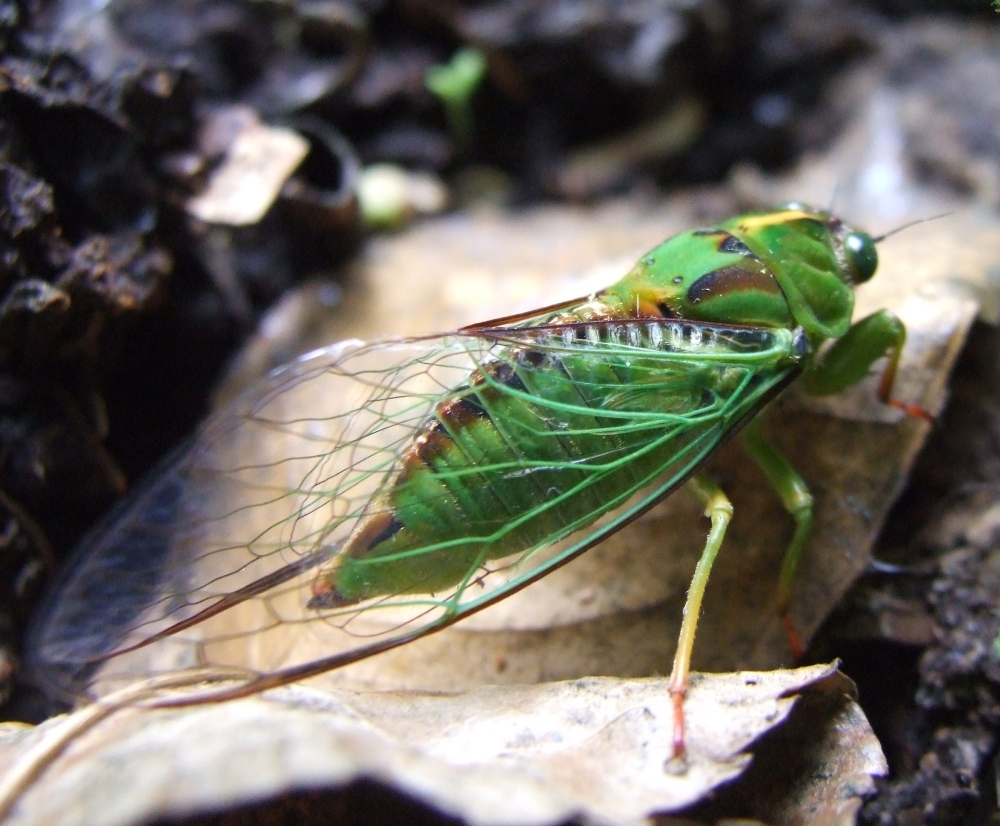
cicada
Repeatedly, throughout the 20th and 21st centuries, we have seen the power of money over-ride the intrinsic value and beauty of this world’s environment,. our co-habiting species and even homo sapiens’ wellbeing. Like the cumulative destructive power of neonicotinoids, we are seeing the cumulative destruction of our planet for corporate greed beginning to descend on us at ever-increasing speed.
A coalition of interest groups, activists and beekeepers took the issue into their own hands on Thursday to slash the use of bee-killing pesticides in an effort to protect them and the future of food. Pesticide Action Network (PAN), Center for Food Safety, Beyond Pesticides and four beekeepers are among the team who want bees safe from the chemicals that include clothianidin and thiamethoxam. Even if it takes suing the government. How are they able to bring a case against the Environment Protection Agency (EPA) for this problem?