A recent sobering article in the Guardian notes that as of May 2013 we have now reached the new exciting record of having 400 parts per million of Co2 in our atmosphere!
The Guardian states that:
The last time so much greenhouse gas was in the air was several million years ago, when the Arctic was ice-free, savannah spread across the Sahara desert and sea level was up to 40 metres higher than today.
These conditions are expected to return in time, with devastating consequences for civilisation, unless emissions of CO2 from the burning of coal, gas and oil are rapidly curtailed. But despite increasingly severe warnings from scientists and a major economic recession, global emissions have continued to soar unchecked.
However what is most sobering, is that last slide in this Guardian narrative, which shows the likely scenario of reaching 1000 parts of carbon dioxide per million by 2100 if industrialization continues as it has for the past 200 years; which is everybody’s best guess at this point.
Not one government in the world is committed to real carbon dioxide emission reductions at this point. Most governments talk about reducing carbon emissions, but in reality pedal “progress’ and ‘economic growth ” as the panacea to their little national problems of recession or poverty… However “growth” and “progress” are the true causes of our death-wish.
By the time real decisions are made to reduce industrialization and consumption globally, we will be well and truly past the point of ensuring our survivability as a species with any significant numbers on the planet, along with thousands of other species. In reality, right now, we are long-gone.
What the impacts of living on a planet with 1000 parts per million of carbon dioxide will be; no-one knows. Nor do we know what the short to medium term impacts of this totally never-before-witnessed sudden change in our atmospheric composition will have on this planet.
Nor does anyone know, even if we stop producing CO2 right now, how long it will take before CO2 levels start to decline, and consequently the world’s climate begin to return to”normal ” conditions. Quite possibly it may take thousands of years for climate conditions to return to the levels of the 1960s; if they ever do at all.
What we do know is that we have entered an unfamiliar world-there is no going back.
George Monbiot in his blog “The Great Unmentionable” once again powerfully articulates the insanity of consumerism -the relentless drive by governments, media and corporates to encourage us all to not only maintain our spending on foolish things, but to increase it.
Monbiot points out that it is not heating lighting and transport which are the predominant carbon emission culprits-it is the “stuff’ we buy – which increasingly is produced for “us’ Westerners by ‘those’ people over there.
In its quest for economic growth and more wealth for the wealthy, corporates attempt to even commodify nature; where would we be for instance without our little sticky labels on our fruit and veges, not knowing which international conglomerate had marketed that piece of produce?
But by far the most insidious aspect of consumption of “stuff” is the central part it plays in the relentless destruction of the natural world- the loss of natural habitat, the annihilation of species after species, for more pieces of short-lived pieces of ‘stuff ‘ that no human will want in a year or so.
The environment may be able to be resurrected after the factories have been pulled down, as some artificial and dumbed-down version of true nature -but without the ever-growing list of extinct species that can never return to us.
Maple Trees in Autumn
As our species becomes more and more urbanised, we lose our awareness of our indelible link with nature; our capacity to just watch and listen and wonder at the glorious real world around us ; our heads down watching ‘smartphone” screens or plugged in to our latest preference for noise on our mp3 player. We become immune to the beauty and randomness and unexpectedness of nature of which we are an integral member-and have blinded ourselves to that reality.
Instead of being open and alive to new and unexpected events and situations, we increasingly self-select our perception of the world from an ever-narrowing mechanical IT menu driven by our past experience.
We lose our connectedness to the world around us-our inherent knowledge that we are transient fragile beings like all other sentient things on this planet: that we are different-but no better- than all the other species we live with.
The standard response to the current financial crisis has been to punish the presumed debtors. Are the creditors blameless, then? asks Dinyar Godrej.
It’s almost a reflex. Think about debt and we think first about something owed. Then come secondary considerations of whether it ‘should’, ‘ought’ or ‘must’ be paid back, how this should happen, and whether possible.
Large outstanding personal debts – say a mortgage taken out during a housing bubble – can turn even the stoutest of us into ‘quivering insomniac jellies of hopeless indebtedness’ (as Margaret Atwood so accurately puts it). Debt is, we feel, whatever the rights or wrongs, ‘our own fault’.
We can’t help it, we are socialized to take such a moral view of debt.
T.S. Eliot’s The Hollow Men alludes to the end of the world coming “not with a bang, but with a whimper..” However the end of capitalism will not be the end of the world; far from it. It will be a glorious new beginning for humans and the other species on this planet.
In a blink of evolution’s eye, capitalism has done more damage to the planet we co-habitate, than any meteorite strike or cataclysmic galactic event. The destruction of species is occurring at phenomenal speed, the changes to our climate through gaseous emissions, the poisoning of much of our planet for millenium… and for what?- a bank balance with lots of numbers?, some pretty things that self-destruct in your hands after a year or two?, the capacity to tell your friends about all the places you have seen?; merely “Dust in the Wind” as the band Kansas would say..
To change the direction of this juggernaut of self-destruction requires more than political will, a mass movement or a United Nations declaration; we are all of on board this juggernaut -whether we are up there in the driving seat, or hanging on for dear life on the roof desperately trying to claw our way inside to the easy seats while it hurtles towards oblivion. We all have an investment in ensuring that this insane model of “progress” continues; we are “locked in” for the ride. .. (the university degree that you spent all those years sweating over so you could get the job of your dreams, the expensive house you spent years slaving away at a horrible job to afford, or simply the years you spent at the factory so your kids could get an education…)
However some have a greater investment in it than others.
It’s almost as though there is a “coefficient of adaptation” associated with human societies that varies with the relative level of “development” (whatever that means) which describes the amount of change that a social system can effectively assimilate without becoming unstable. It’s not just quantitative, but also qualitative, having clear hot-button issues (often related to women and the role of government) that, if pushed too hard, accelerate the movement toward state change.
What also happens, of course, is that the powers that be, regardless of the particular discipline or sector, see the abrupt change as a threat and, like white corpuscles rushing to staunch a wound, leap forward in defense of the status quo – regardless of the relative merit of the new proposal. This is where I get hung up. It’s as though the “system” embraces the status quo, even though things are clearly not working very well and treats thoughtful new proposals as mortal threats, even as people die and suffer because of the present policies. And it’s not just that they defend the status quo, but that they leap to attack the new ideas in very non-rational and sometimes inhumane terms.
Does all this imply we should all be living as medieval peasants in some country idyll?
Kelp seaweed
No , but we can, if we have time, start to turn the wheel, take the foot off the accelerator and truly experience the scenery-instead of watching it whipping past in a blur. Imagine if the money and hype that is now put into selling this or that useless product, was instead put into showing you how to work alongside your neighbour, how to create living spaces around us instead of neat and tidy ones, how to co-exist with the other species we live alongside, how to avoid conflict and promote peace, how to stop and just enjoy these brief moments we all have in this life.
Yes, we surely need good sanitation, clean water, cheap healthy food and good shelter. There is plenty to go around for all the billions of humans on this planet right now. Yes we will need to learn how to consume less and enjoy more; there are plenty of tools out there to do that right now if one cares to look.
We cannot afford to have people control this world and its resources whose only interest is the production of power and money for themselves and to hell with everything and everyone else. Those fools are dragging us to oblivion , the point at which literally this planet becomes a hell-hole. Poisoning the world and its living things, paving over the living earth, killing our fellow species, for a few cheap baubles -that is truly insane. Sadly we are all “locked-in”: -we cannot see the madness.
But, there is a saving grace to this. While Lovelock has reneged on his view of the Earth as a living entity “Gaia”- this planet has not! We are rapidly reaching the point as humans where we are opening our eyes to the damage we have caused; where the cost of “improving’ or maintaining our standard of living becomes too great-we have reached “peak capitalism”.
And just as with “peak oil”, the point of optimum utilization of a particular process is invisible to the onlooker; the forces change and adapt. The price of oil rises inexorably year by year but we only notice the ebbs and falls; the capacity to pump oil crude out of the ground wanes, but production stays with demand as we develop more costly and more environmentally damaging processes like shale oil… and consequently economies begin their progressive wilt under the ongoing pressure….
The fundamental flaws in the capitalist system become ever-widening abysses into the unknown; and we have the opportunity now to create something wonderful for ourselves as human beings and for our fellow species on this planet.
That opportunity is neither capitalism or communism or any other “ism” created to capture or -redistribute the “wealth” of this planet. It is an understanding that we are not the guardians of this planet, (we have made the most appalling job of trying to do that!); we are simply co-habitators whose guidance will come from listening and valuing everything around us.
In recent days we have seen vast Western media publicity on the Boston Marathon bombings: the dead, the wounded and the likely perpetrators. At the same time, more than 140 people have been killed in multiple bombings in Iraq with almost no Western publicity. And no doubt, many more “invisible” killings in other countries have occurred over that period, including at least 5 people killed by US drone attacks, ‘collateral damage’ killings in Afghanistan, not to mention the mercenary wars going on in Mali and other regions in Africa, and the Burmese civil wars.
In my world view, every being killed is worthy of equal respect and value as another. I believe it is important if we are to be truly compassionate human beings; (and is it not compassion that marks us as being fully human?), that we pay our respects to those who have been killed and wounded in Boston, but that we also also pay our respects to all those who have died elsewhere. I will also mourn all those multitudes of beings from other species who we as humans have killed in our war against our own environment; whether it be through our “need’ to eat other fellow mammals or fish, or simply the collateral damage from agri-business, mining, logging, chemical spills, or our relentless need to seal the ground over for roads, carparks and buildings…..
Why are we so selective in our valuing some humans over other humans, and why are humans so highly prized over other species on this planet?
In my understanding, we value those who are most like us, and de-value those who are not like us-the other”. That “otherness” is encompassed in our judgements about everything about our world; from people with other skin colours not our own, to living beings who are not ‘cuddly’ and warm (and furry?) like us mammals. In addition, from birth we are fed a diet of reminders of what a savage world it is outside , and only “we”, the familial clan, can protect you. Upbringing, fear, ignorance and a small smattering of genes, all combine to give us permission to brutalize all those who are “other”.
Without these selective filters on our senses, we would be able to see that “we” are no better than “them” , we are fundamentally and unequivocally equal ; we co-habit this little blue ball together, and for own collective wellbeing we must nourish and protect our fellow travellers on this journey through the universe.
Are we really that simpleminded and judgemental and superficial to do otherwise?- it would sadly appear so.
In the last few years, New Zealand has seen a massive decline in honey bees. In my little garden in summer a few years ago, when all the flowers would be at their peak, there would be many more honey bees than bumblebees and german wasps; but no longer. This year the number of honey bees I sighted all summer, I could count on two hands.
“Uncontaminated ” research- ie not funded by chemical companies, has established clear correlations between CCD (Colony Collapse Disorder) and pesticides called neonicotinoids; chemically similar to nicotine . The most common of these is a pesticide called imidacloprid. Two others are clothianidin and thiamethoxam.
However the correlations are not precise; it appears to require cumulative poisoning over months and perhaps years for the effects of the neonicotinoids to wreak their havoc on bees. And as with other poisoning effects , the impacts on the bees may lead to a lack of resistance to other diseases which can not be directly attributable to the neonicotinoids. The EU has recommended a two year ban on the use of neonicotinoids in specific circumstances, but that may go nowhere to identify or address the issues of CCD. Nature is by definition messy and complex, while man’s actions are linear and relatively unsophisticated. We may not be absolutely sure of the correlations-yet the results are very very clear and disastrous for us all.
As Jill Richardson, in her How We Could Prevent Massive Bee Deaths and Save Our Food article notes at Alternet, Although there’s little private citizens can do, beyond submitting comments to the EPA about these pesticides, contacting your representatives, and perhaps even getting your own beehive, you might be surprised to find out that these toxic pesticides are widely available for home use. Bayer sells imidacloprid in products sold for use on roses, flowers, shrubs, trees (even fruit and nut trees!), and lawns. Even the flea treatment Advantage sold for your pet contains it!
Once again we see the power of corporates to distort research, government agency decision-making, and the truth; even while knowing that the results of their actions are environmentally disastrous for us all.
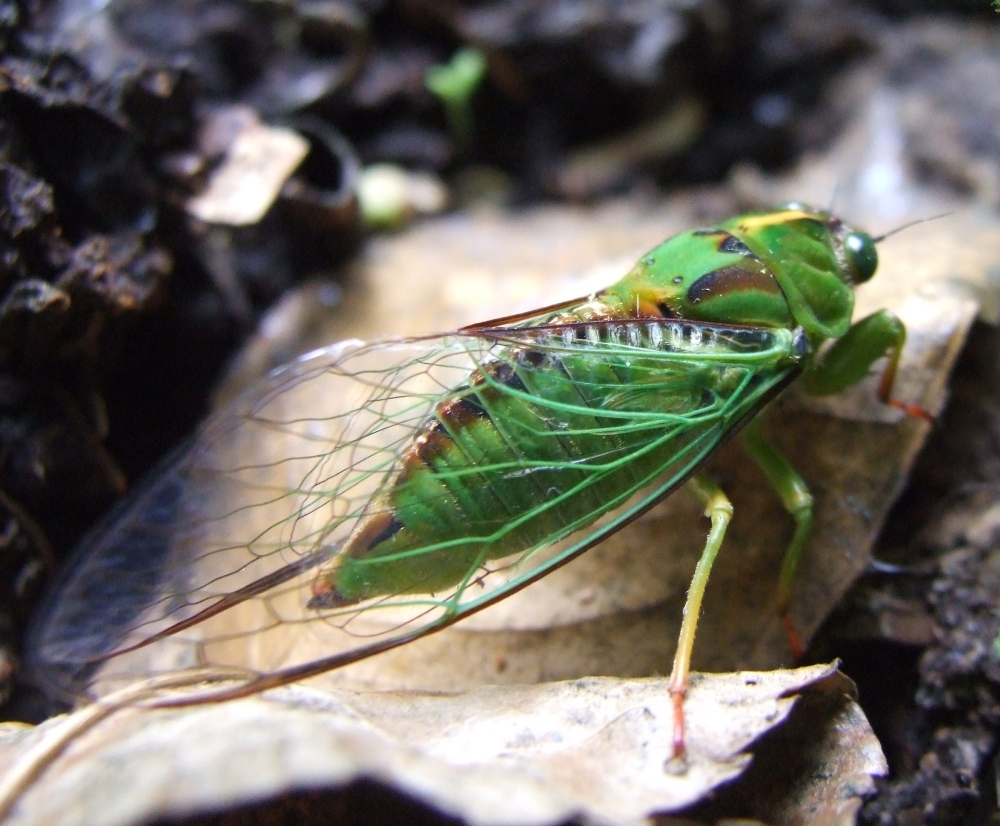
cicada
Repeatedly, throughout the 20th and 21st centuries, we have seen the power of money over-ride the intrinsic value and beauty of this world’s environment,. our co-habiting species and even homo sapiens’ wellbeing. Like the cumulative destructive power of neonicotinoids, we are seeing the cumulative destruction of our planet for corporate greed beginning to descend on us at ever-increasing speed.
A coalition of interest groups, activists and beekeepers took the issue into their own hands on Thursday to slash the use of bee-killing pesticides in an effort to protect them and the future of food. Pesticide Action Network (PAN), Center for Food Safety, Beyond Pesticides and four beekeepers are among the team who want bees safe from the chemicals that include clothianidin and thiamethoxam. Even if it takes suing the government. How are they able to bring a case against the Environment Protection Agency (EPA) for this problem?