
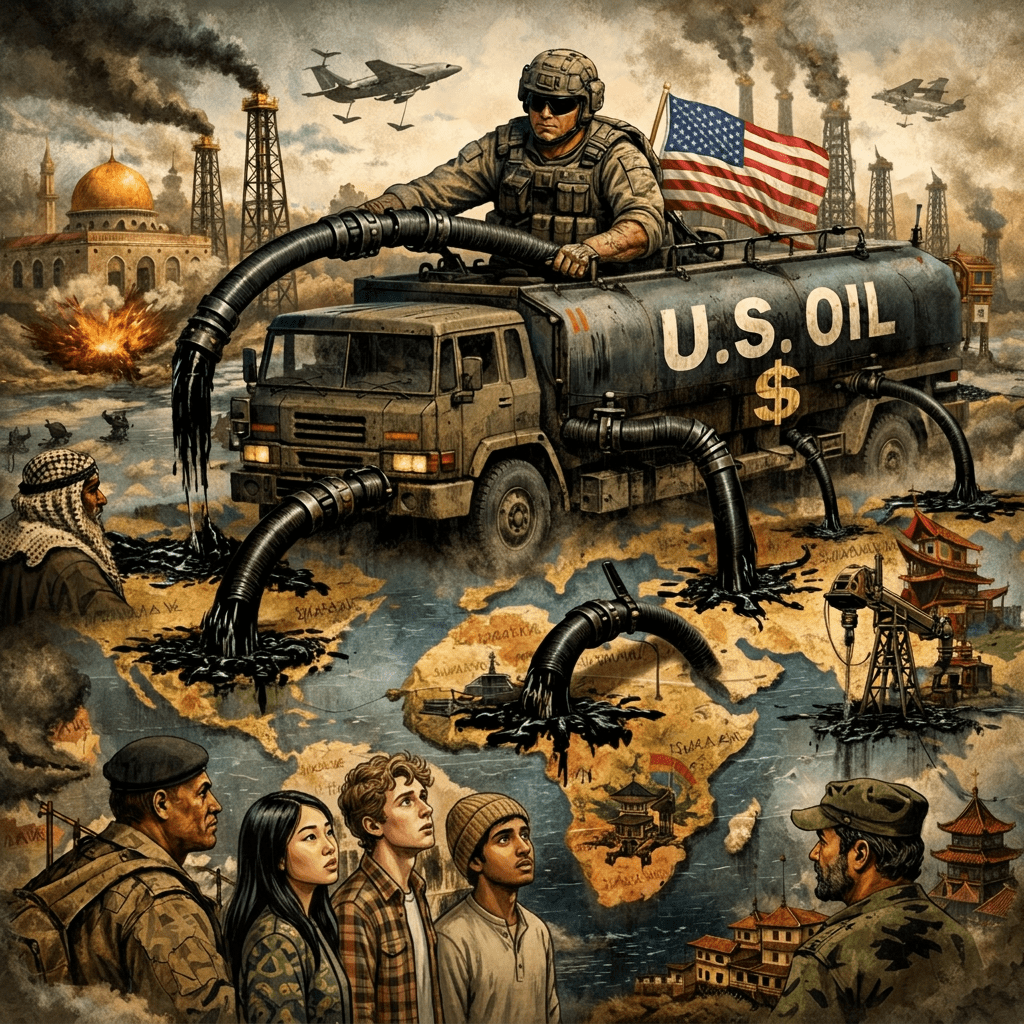
When we speak of American power abroad, we tend to picture aircraft carriers and drone strikes. But the most durable instruments of control are not military — they are financial.
Across the oil-producing world, from Baghdad to Tripoli, from Caracas to Buenos Aires, a sophisticated architecture of financial dependency has been constructed over decades. It operates through currency regimes, debt structures, sanctions networks, and complicit domestic elites.
Its goal is not merely to access oil, but to control the revenue streams that oil generates — ensuring that petrodollars flow through Western-controlled financial arteries, that sovereign wealth accumulates in Western-denominated assets, and that any nation attempting to redirect those flows faces economic (or military) strangulation.
This is not conspiracy theory. It is documented policy, visible in declassified government papers, central bank records, IMF structural adjustment programs, and the observable pattern of what happens to nations that attempt to nationalise their hydrocarbon revenues outside the Western financial system.
This post traces the mechanics of that system, names the mechanisms and the actors, and examines how targeted nations have begun — tentatively, painfully — to escape.
Part I: The Architecture of Control
1. The Petrodollar System: The Foundation
In 1974, when the Nixon administration — responding to the collapse of Bretton Woods and the gold standard — struck a deal with Saudi Arabia: the Kingdom would price its oil exclusively in US dollars and reinvest surplus revenues in US Treasury securities. In exchange, the US would provide military protection and weapons sales. By 1975, all OPEC members had agreed to price oil in dollars.
This arrangement created what economists call the petrodollar recycling system. Its implications are profound:
– Every nation that imports oil must hold substantial dollar reserves , creating permanent global demand for the US currency regardless of America’s own economic fundamentals.
– Oil-producing nations accumulate dollar surpluses that must be invested — and the financial architecture channels those investments into US Treasury bonds, Western real estate, and Western-controlled investment vehicles.
– The US can run persistent trade deficits because the world needs dollars to buy oil, effectively allowing America to consume more than it produces while the rest of the world finances the gap.
– Any nation that attempts to sell oil in currencies other than the dollar threatens this entire architecture and faces severe retaliation.
This is not merely an economic arrangement — it is the monetary foundation of American global hegemony. Former French Finance Minister Valéry Giscard d’Estaing called it America’s “exorbitant privilege.” It is the reason the United States can project military power globally while running deficits that would bankrupt any other nation.
Saddam Hussein announced in 2000 that Iraq would sell oil in euros. Muammar Gaddafi was developing a gold-backed pan-African currency — the “Gold Dinar” — for oil transactions. Hugo Chávez began accepting non-dollar payments for Venezuelan oil. These are not incidental data points.
2. Sanctions as Economic Warfare
The modern sanctions regime is the most visible mechanism of financial control. It operates at multiple levels:
Primary Sanctions: Prohibit American individuals and entities from doing business with targeted countries, entities, or individuals.
Secondary Sanctions: The more powerful tool — these penalise third-party nations, banks, and corporations for doing business with sanctioned targets. Because the global financial system runs on the dollar and clears through New York, secondary sanctions effectively force every bank on Earth to choose: access to the US financial system, or business with the targeted country. Almost all have chosen Washington.
SWIFT Exclusion: The Society for Worldwide Interbank Financial Telecommunication, headquartered in Belgium but deeply entwined with US policy, is the messaging system that facilitates international bank transfers. Being cut off from SWIFT — as Iran was in 2012 and partially again in 2018 — makes normal international commerce nearly impossible. When the US pressured SWIFT to disconnect Russian banks in 2022, it demonstrated that this supposedly neutral financial utility is, in practice, an instrument of American foreign policy.
Asset Freezes and Seizures: The US Treasury’s Office of Foreign Assets Control (OFAC) can freeze dollar-denominated assets — including central bank reserves held in US institutions or their correspondent banks. When the US froze Afghanistan’s central bank reserves after the Taliban takeover, it demonstrated that dollar reserves held abroad are not truly sovereign assets — they are conditional on Washington’s approval.
The cumulative effect: a sanctioned nation cannot sell its oil through normal channels, cannot receive payment in dollars, cannot repatriate revenue, and cannot use its own reserves. This is not an embargo in the traditional sense — it is financial asphyxiation .
3. Debt as a Weapon: The IMF and World Bank
For nations not subject to direct military intervention, debt serves as a parallel mechanism of control. The playbook is well-documented:
Step 1 — Inducement or Crisis: A nation either borrows heavily (often encouraged by Western institutions) or faces an economic crisis caused by commodity price fluctuations, capital flight, or external shocks.
Step 2 — Structural Adjustment: The IMF and World Bank extend emergency loans conditioned on “reforms”: privatisation of state assets (including oil companies), opening markets to foreign investment, cutting public spending, deregulating capital flows, and — critically — pricing energy and commodities at world market rates rather than subsidising domestic consumption.
Step 3 — Asset Transfer: Privatisation sells national oil assets at distressed prices to Western corporations. The nation loses control of its primary revenue source while remaining saddled with the debt that necessitated the sale.
Step 4 — Dependency Lock-In: With oil revenues flowing to foreign corporations and debt service consuming government budgets, the nation enters a cycle where it must continue borrowing, accepting further conditions, and ceding further sovereignty.
Argentina’s repeated debt crises in 2001, 2014, 2018 and 2020, are textbook cases. Each crisis brought IMF programs that demanded energy sector liberalisation, austerity, and privatisation. Each cycle transferred more of Argentina’s substantial Vaca Muerta shale reserves and energy infrastructure into foreign hands.
4. Military Intervention and Regime Change
When financial mechanisms fail — when a nation’s leadership refuses to cooperate — military force serves as the ultimate enforcement mechanism. But the purpose of these interventions is consistently (deliberately) misrepresented in Western media. They are framed as humanitarian (Libya), counter-terrorist (Iraq), or counter-narcotics (Colombia) operations. In each case, the financial outcomes tell a different story.
The pattern is consistent:
1. A sovereign nation attempts to control its own oil revenues
2. Diplomatic and financial pressure fails to bring compliance
3. Military intervention or regime change occurs
4. Post-conflict, the nation’s oil sector is restructured to benefit Western corporations and the dollar system
5. Intelligence and Covert Operations
The CIA and allied intelligence services have a documented history of destabilizing nations that threaten oil and financial arrangements:
Iran, 1953: The CIA overthrew Prime Minister Mohammad Mosaddegh after he nationalised Iranian oil. The pretext was communism; the reality was oil.
Russia, 1991: Following the fall of the Soviet Union, American ‘advisors’ rushed to assist with the privatisation of State oil and gas entities
Venezuela, 2002: A coup attempt against Hugo Chávez — briefly recognized by the Bush administration — followed Chávez’s redirection of oil revenues toward social programs and his moves to sell oil outside the dollar system.
Iraq, 2003: The invasion followed not only Iraq’s euro-for-oil decision but also Saddam’s opening of Iraqi oil fields to non-Western (Russian, Chinese, French) contracts.
Libya, 2011: NATO intervention followed Gaddafi’s gold dinar proposal and his efforts to create an African Monetary Fund independent of the IMF.
Ukraine, 2022: U.S staged the Maidan coup in Kiev, Ukraine in order to put more pressure on Russia
Venezuela, 2026: On 3 January 2026, the United States launched a military strike in Venezuela and captured incumbent Venezuelan president Nicolás Maduro and his wife,
Part II: Country-by-Country Analysis
Iraq: The Complete Cycle
Pre-2003: Iraq sat on the world’s second-largest proven oil reserves. Under sanctions from 1990 onward, Iraq’s oil revenues were channeled through the UN Oil-for-Food Programme — a mechanism that, whatever its humanitarian intent, kept Iraqi oil revenue under international (effectively Western) oversight.
In 2000, Saddam Hussein switched Iraq’s oil sales to Euros — a move that, if emulated by other OPEC members, would have fundamentally undermined the petrodollar system. The move reportedly earned Iraq a windfall as the Euro appreciated against the dollar.
The Invasion (2003): The stated justifications — weapons of mass destruction and links to terrorism — were fabricated. What followed was the most comprehensive restructuring of a sovereign nation’s oil sector in modern history.
– The Coalition Provisional Authority, under Paul Bremer, issued Order 39 , which allowed foreign companies to own 100% of Iraqi assets outside the oil sector and Order 17, which granted foreign contractors immunity from Iraqi law.
– Iraq’s oil sector was not privatised outright — the political optics would have been too stark — but was restructured through Technical Service Contracts (TSCs) and Production Sharing Agreements (PSAs) that gave Western and allied oil companies (ExxonMobil, BP, Shell, Chevron, Total, Lukoil, CNPC) access to Iraq’s reserves on highly favourable terms.
– The Development Fund for Iraq (DFI), managed by the US-allied Iraqi government and overseen by the International Advisory and Monitoring Board, controlled oil revenues. Early revenues — over $20 billion — went missing under US oversight, a scandal documented by the Special Inspector General for Iraq Reconstruction (SIGIR).
– Iraq’s central bank reserves were held in the Federal Reserve Bank of New York , giving Washington effective leverage over Iraqi monetary policy.
To understand how a nation can possess the world’s second-largest proven oil reserves and its people remain impoverished, you must follow the money — literally. Iraq’s oil revenue does not simply flow from buyer to seller to government treasury, as it would in a truly sovereign nation. Instead, it passes through a series of mechanisms that place it under effective US control at every critical juncture.
This system was not improvised. It was designed, implemented, and maintained as a deliberate architecture of financial control.
Step 1: The Legal Framework — UN Resolution 1483 and the Development Fund for Iraq
In May 2003, just weeks after the invasion, the UN Security Council passed Resolution 1483, which established the Development Fund for Iraq (DFI). On the surface, this was a humanitarian measure — a mechanism to ensure that Iraqi oil revenues would be used for reconstruction and the benefit of the Iraqi people. In practice, it created the legal infrastructure for external control.
The DFI was managed by the Coalition Provisional Authority (CPA) — the US-led occupation government — and later transferred to the interim Iraqi government under conditions that preserved US oversight. An International Advisory and Monitoring Board (IAMB) was established to audit the fund, but it had no enforcement authority and repeatedly reported obstruction by the CPA in accessing financial records.
The critical point: the DFI was not an Iraqi sovereign fund. It was an externally managed account into which Iraqi oil revenues were deposited and from which disbursements required external approval.
The Federal Reserve Bank of New York — Where Iraq’s Money Physically Sits
Iraqi oil is sold on international markets in US dollars — as it must be under the petrodollar system. The purchasing entities (international oil companies, trading houses, state oil companies of importing nations) pay for Iraqi crude in dollars.
Those dollars are deposited into an account at the Federal Reserve Bank of New York held in the name of the Central Bank of Iraq (CBI). This is the Iraq Oil Proceeds Receipt Account — the single most important financial mechanism in understanding Iraqi sovereignty, or the lack thereof.
Here is how the system works in practice:
1. Oil is sold. Iraq’s State Oil Marketing Organization (SOMO) contracts sales of Iraqi crude to international buyers.
2. Dollars arrive at the NY Fed. Payment for Iraqi oil — in US dollars — is deposited into Iraq’s account at the Federal Reserve Bank of New York. At peak production, this represents roughly $7–10 billion per month flowing into a US-controlled financial institution.
3. The Iraqi government requests access to its own money. To spend its own oil revenues, the Iraqi government — through the Central Bank of Iraq — must submit requests for disbursements. These requests are processed through the NY Fed.
4. Letters of credit are issued with US oversight. When the Iraqi government wants to pay for imports (food, medicine, infrastructure materials, government salaries, military equipment), it requests letters of credit from the NY Fed. These letters of credit — effectively, permission to spend Iraq’s own money — are processed through the US banking system.
5. The US Treasury monitors and can delay or block disbursements. Under various legal authorities, including sanctions regulations and the terms of the DFI framework, the US Treasury — through OFAC and its interaction with the NY Fed — has the ability to flag, delay, or block specific transactions. This authority is rarely exercised in a headline-grabbing way — its power lies in its existence, not its constant use. The Iraqi government knows that any transaction can be blocked, and this knowledge shapes its behavior.
The practical consequence: Iraq is a nation that earns tens of billions of dollars annually from oil exports but must receive permission from a US financial institution to spend that money. This is not sovereignty. It is a fiduciary relationship in which the client (Iraq) must petition the trustee (the NY Fed) for access to its own funds.
– The Strategic Framework Agreement (2008) embedded US advisors throughout Iraqi government institutions, including those managing oil and finance.
Who is complicit: Successive Iraqi governments have operated within this framework. Political parties across sectarian lines have used oil revenue distribution as a patronage system, enriching allied elites while the broader population sees little benefit. The oil smuggling networks — documented extensively — funnel revenue through Kurdistan, Turkey, and Gulf intermediaries, often with the knowledge of intelligence services on all sides. Iraqi political elites who benefit from the current arrangement have little incentive to reform it.
The result: Iraq produces approximately 4.5 million barrels per day, yet its people endure chronic electricity shortages, crumbling infrastructure, and poverty rates above 25%. The wealth flows through pipelines and financial channels that Iraq does not control.
Libya: From Africa’s Richest Nation to Failed State
Pre-2011: Under Gaddafi, Libya had the highest standard of living in Africa. The state-owned National Oil Corporation (NOC) controlled Libya’s oil production. Oil revenues funded universal healthcare, free education, the Great Man-Made River project (the world’s largest irrigation initiative), and direct citizen stipends.
Gaddafi’s fatal moves:
– Proposing a gold-backed African dinar for oil transactions, which would have eliminated African dependence on the dollar and the CFA franc (the colonial-era currency still used in 14 African nations, controlled by the French Treasury).
– Investing Libya’s sovereign wealth (managed through the Libyan Investment Authority, approximately $67 billion) outside Western-controlled institutions, including in African development projects.
– Negotiating bilateral oil deals with China, Russia, and other nations outside Western corporate structures.
– Nationalising oil production and keeping revenues in state hands.
The Intervention (2011): NATO’s seven-month bombing campaign, justified by claims of an imminent massacre in Benghazi, destroyed Libya’s military, infrastructure, and state institutions. Hillary Clinton’s emails, released under FOIA, revealed that the primary motivations included Gaddafi’s gold dinar plan and the desire to prevent Libya’s oil from falling into a non-dollar, non-Western orbit.
Post-Intervention:
– Libya has been fractured into competing militias and rival governments.
– Oil production collapsed from 1.6 million barrels per day to near zero, then slowly recovered to approximately 1.2 million bpd under internationally mediated arrangements.
– The Libyan Investment Authority’s frozen assets — roughly $67 billion held in Western institutions — became leverage for Western powers to shape Libya’s political future.
– Libya’s oil revenues now flow through the Central Bank of Libya , split between rival eastern and western factions, with the international community (i.e., Western powers) mediating disputes — effectively controlling the purse strings.
– Foreign oil companies (Total, ENI, Repsol, OMV, others) returned under production-sharing arrangements far more favourable than the pre-2011 terms.
Who is complicit: Libya’s rival governments, militias controlling oil infrastructure, and the Central Bank factions all operate within a system where Western recognition and access to frozen assets serve as incentives for compliance. The UN-recognised Government of National Accord and its eastern rivals compete not for Libyan sovereignty but for Western backing — because backing means access to oil revenues.
Venezuela: The Long Siege
The Chávez Revolution (1999–2013): Hugo Chávez’s election represented a direct challenge to the petrodollar financial order in the Western Hemisphere. Key moves included:
– Asserting state control over Petróleos de Venezuela (PDVSA) , the national oil company, which had been operating as a semi-autonomous entity increasingly aligned with Western corporate interests.
– Mandating that PDVSA maintain a 60% stake in all joint ventures with foreign oil companies.
– Redirecting oil revenues toward social programs (the misiones ) — healthcare, education, housing, subsidized food — that reduced poverty from 50% to approximately 25%.
– Creating Petrocaribe, an oil alliance that sold petroleum to Caribbean and Central American nations at subsidized rates with partial payment in goods and services rather than dollars — effectively building a non-dollar oil trade network in America’s backyard.
– Proposing the petro , a cryptocurrency allegedly backed by oil reserves, as an alternative transaction mechanism.
– Repatriating Venezuela’s gold reserves from Western vaults.
– The 2002 coup attempt, briefly successful, was reversed by popular mobilisation. The coup was immediately recognised by the Bush administration and was linked to Venezuelan business elites (Fedecámaras) and military officers with CIA ties.
– After the coup failed, the strategy shifted to economic warfare: capital flight encouraged by US-allied Venezuelan oligarchs, currency manipulation, hoarding of consumer goods, and eventually comprehensive sanctions .
– Beginning under Obama (2015 executive order declaring Venezuela an “unusual and extraordinary threat to US national security”) and escalating dramatically under Trump:
– PDVSA sanctions cut off Venezuela’s primary oil company from the US financial system.
– Secondary sanctions pressured buyers of Venezuelan crude — India, China, and European nations reduced purchases to avoid US retaliation.
– CITGO seizure: Venezuela’s US-based refining subsidiary (worth billions) was effectively seized through sanctions and transferred to the control of the US-backed opposition.
– Gold reserves seized: Approximately $1.8 billion in Venezuelan gold held in the Bank of England was frozen and eventually partially transferred to the US-backed opposition figure Juan Guaidó.
– Central bank sanctions cut off Venezuela from the international financial system.
The result: Venezuela’s oil production collapsed from approximately 3.2 million barrels per day (late 1990s) to under 400,000 bpd. GDP contracted by roughly 75%. Millions of Venezuelans emigrated. The humanitarian catastrophe is real — but its primary cause is sanctions, not socialism.
The U.S. has now completed the cycle by kidnapping President Maduro and holding him (indefinitely) for a show trial in the US while bribing the Venezuelan military to support a smooth handover to Maduro’s Vice -President Delcy Rodríguez, who has succumbed, via threat and enticement, to permit Western oil companies free range in Venezuela.
Who is complicit: Venezuelan oligarchs who moved capital to Miami and Madrid; military officers who facilitated smuggling networks; officials within PDVSA who siphoned revenues; and the US-backed opposition (particularly the Guaidó parallel government) that served as the political vehicle for sanctions enforcement and asset seizure. Elements of the opposition actively lobbied for sanctions that devastated the Venezuelan people, hoping the resulting suffering would topple the government.
Since Nicolás Maduro’s capture in January 2026, Washington has effectively become the gatekeeper of Venezuela’s oil finances: exports once routed largely to China now flow mainly to US-licensed buyers in the United States and India, while proceeds are reportedly collected through a US Treasury-controlled account before some funds are released back to Venezuela. The arrangement has been accompanied by temporary sanctions waivers allowing selected companies to re-enter the oil, mining, and financial sectors, but those permissions remain revocable and lack a clear framework for permanent sanctions relief or democratic transition.
Nearly 100 million barrels, worth an estimated $8 billion, reportedly moved through the system during its first four months.
Syria: Economic Warfare by Design
Pre-2011: Syria’s oil sector was relatively modest (approximately 380,000 bpd before the civil war), but Syria occupied a critical geo-strategic position — controlling pipeline routes and serving as a regional transit hub.
The Assad government’s offences against Western financial interests included:
– Rejecting pipeline proposals that would have benefited Gulf states and Turkey while bypassing Russian and Iranian interests.
– Maintaining alliances with Iran and Russia outside the Western security architecture.
– Retaining state control over energy and telecommunications sectors.
– Refusing IMF structural adjustment programs.
– The US imposed escalating sanctions under the Caesar Syria Civilian Protection Act (2020), which sanctioned virtually any entity doing business with the Syrian government, including in the energy sector.
– US forces occupied Syria’s oil-rich northeast (Deir ez-Zor and Hasakah provinces), controlling approximately 90% of Syria’s pre-war oil production. The stated justification was denying oil revenues to ISIS, but the practical effect was depriving the Syrian government of its primary revenue source while benefiting US-allied Kurdish forces and, reportedly, companies with US defence contracts.
– Syria’s currency collapsed, inflation spiralled, and fuel shortages became chronic.
The oil theft: This is perhaps the most brazen modern example of resource extraction under military occupation. US forces and their allies control Syrian oil fields. US officials openly discussed “securing” Syrian oil. The revenue does not go to the Syrian state or its people. Former President Trump stated explicitly: “We’re keeping the oil.”
Who is complicit: Kurdish autonomous authorities (SDF/YPG) administer the oil regions under US military protection — a relationship born of necessity but one that places Kurdish governance in opposition to Syrian state sovereignty over natural resources. Various armed factions, smuggling networks, and intermediaries profit from the fragmented oil trade.
Colombia: The “Partnership” Model
Colombia was never invaded by the US, but its experience illustrates the partnership model — where a compliant government voluntarily opens its oil sector to foreign control in exchange for military aid, political support, and integration into the US security architecture.
– Plan Colombia (2000–present): Framed as counter-narcotics and counterinsurgency aid, Plan Colombia funnelled over $10 billion in US military and police aid to Colombia. It also served to secure the environment for foreign investment in resource extraction, including oil.
– Ecopetrol privatisation: Colombia’s state oil company was partially privatised, with foreign majors (Chevron, ExxonMobil, Shell, Oxy, and others) gaining access to Colombia’s oil reserves through production-sharing and association contracts favourable to foreign investors.
– Security guarantee: The Colombian military and paramilitary forces (often operating in coordination) provided “security” for oil infrastructure — a euphemism for displacing communities, suppressing labour unions, and eliminating social resistance to extraction. Colombia was, for years, the deadliest country in the world for trade unionists.
– Free trade agreements: The US-Colombia Trade Promotion Agreement (2012) locked in investor protections, intellectual property rules, and market access that structurally favor US corporations in Colombia’s energy sector.
Who is complicit: Colombian political elites from both traditional parties (and elements across the political spectrum) have maintained the security-for-investment framework. Military commanders, paramilitary networks (documented links between military, paramilitaries, and politicians through the “para-politics” scandal), and corporate intermediaries all benefit.
Argentina: The Recurring Trap
Argentina’s case is particularly instructive because it demonstrates how debt and IMF conditionality function as mechanisms of resource control without requiring military invasion.
– Argentina possesses enormous energy reserves, particularly the Vaca Muerta shale formation — the world’s second-largest shale gas reserve and fourth-largest shale oil reserve.
– Through repeated debt crises (1989, 2001, 2018, 2020), Argentina has cycled through IMF programs that consistently demanded energy sector liberalization — opening Argentina’s oil and gas to foreign investment, cutting energy subsidies, and allowing foreign companies to repatriate profits freely.
The Macri Government (2015–2019):
– President Mauricio Macri negotiated the largest IMF loan in history at the time ($57 billion) and implemented aggressive energy sector deregulation.
– He eliminated export taxes on oil and gas, removed capital controls that restricted profit repatriation, and invited foreign majors into Vaca Muerta.
– Chevron, Shell, ExxonMobil, Total, and others expanded their Vaca Muerta operations dramatically while the Argentine public bore the cost of austerity.
The Milei Government (2023–present):
– President Javier Milei has pushed radical deregulation and privatisation, including the potential privatisation of YPF (the partially state-owned energy company that was renationalised in 2012).
– His government’s alignment with US financial interests and the “Washington Consensus” represents the most complete embrace of the dependency model in recent Argentine history.
Who is complicit: Argentine economic elites with dollar-denominated assets in Miami and London; politicians who cycle between government and corporate boardrooms; media conglomerates that normalise dependency as “modernisation”; and IMF technocrats who prescribe the same medicine regardless of patient outcome.
Iran
Iran has faced 47 years of brutal sanctions from the West since the fall of the Shah, Mohammad Reza Pahlavi in early 1979 and the Islamic Government which followed nationalised the oil revenues that had previously flowed to Western oil companies under the Shah.
Scott Bessent, Secretary of the Treasury has freely admitted that the US destabilised the Iranian currency the Rial, to provoke an uprising against the ‘regime’ in 2025, while Israel and other Western partners provided weapons and communication resources to the armed protesters.
When this failed, Israel and the US calculated that a ‘decapitation’ strike would be enough to bring down ‘the regime’; install their new puppet Shah and thereby force it to hand over its oil resources to the US. Instead, the Iran War has exposed deep weaknesses in both the Israeli and US military, and the US’s hold over the Gulf oil states.
Russia
Russia possesses the world’s largest proven natural gas reserves, the eighth largest proven oil reserves, and vast untapped Arctic and Siberian resources that make it, by any geological measure, the single greatest energy prize on Earth. Controlling — or at minimum, constraining — Russian energy has been a consistent thread in Western strategic planning for over three decades.
This is not speculation. It is documented in the memoirs of Western officials, the policy papers of think tanks that advise those officials, the observable outcomes of economic programs imposed on Russia during the 1990s, and the explicit statements of Western leaders regarding sanctions, NATO expansion, and the post 2022 energy decoupling from Russia.
This post traces three decades of Western engagement with Russia’s energy wealth: the looting of the Yeltsin years , when Western advisors oversaw the greatest peacetime transfer of public wealth to private hands in modern history; the Putin era counter consolidation, which reversed Western access and triggered escalating hostility; the sanctions architecture erected beginning in 2014 and massively expanded in 2022; and the energy decoupling , in which Europe voluntarily severed itself from Russian hydrocarbons at enormous cost to its own economy — a decoupling that serves American strategic and commercial interests above all others.
Part I: The Yeltsin Years — The Greatest Heist in Modern History (1991–1999)
When the Soviet Union dissolved in December 1991, Russia inherited the bulk of its energy infrastructure: vast oil and gas fields across Siberia, the Urals, Western Siberia, and the Caspian region; a pipeline network spanning eleven time zones; and state owned energy companies — principally Gazprom (gas) and the various oil production associations that would later be reorganized — that represented enormous productive capacity operating at a fraction of their potential due to Soviet era inefficiency and the chaos of transition.
The question that immediately consumed Western policy circles was not whether Russian energy would be integrated into the global economy, but on whose terms .
Shock Therapy: The Imposed Framework
The economic program imposed on Russia during the early 1990s — universally known as “shock therapy” — was designed and supervised by Western economists and institutions. Its architects included:
Jeffrey Sachs (Harvard University), who later expressed regret for how his recommendations were implemented
Anders Åslund (Carnegie Endowment for International Peace), a vocal advocate of rapid liberalisation
The IMF and World Bank , which made loans conditional on rapid privatisation, price liberalisation, and deregulation
The Harvard Institute for International Development (HIID) , which received USAID funding to advise the Russian government on privatisation — and whose staff were later found to have profited personally from the very privatisations they were advising on
The program was implemented under Yegor Gaidar (Acting Prime Minister, 1992) and Anatoly Chubais (head of the State Committee for the Management of State Property, i.e., the privatisation minister). Both were committed to Western style rapid reform regardless of social cost.
The results were catastrophic for ordinary Russians:
GDP collapsed by approximately 40% between 1991 and 1998 — a contraction comparable to the Great Depression in the United States, or to a nation experiencing a major war
Life expectancy for Russian men dropped from 64 years in 1990 to 57 years by 1994 — an unprecedented decline in a developed nation not at war
Hyperinflation wiped out the savings of an entire generation
Poverty rates surged from approximately 2% to over 40% of the population
The social safety net — healthcare, housing, pensions — was dismantled as part of “reform”
This was not an accident or unintended consequence. As Joseph Stiglitz (Nobel Prize winning economist and former World Bank chief economist) wrote extensively, the specific form of shock therapy chosen — rapid, simultaneous liberalisation of prices, trade, and ownership — was known to be destructive, was applied despite Russian pleas for a more gradual approach, and produced outcomes that directly benefited Western corporations and a small class of domestic intermediaries at the expense of the Russian population.
Voucher Privatisation: Stage One of the Looting
The first phase of privatisation (1992–1994) distributed vouchers to every Russian citizen — theoretical shares in state assets that could be traded.
In practice:
Ordinary Russians, facing desperate poverty and hyperinflation, sold their vouchers for cash to survive
A small number of well connected individuals and emerging “entrepreneurs” (many with organised crime connections) accumulated vouchers at fire sale prices
These vouchers were then converted into ownership stakes in Russia’s most valuable industrial assets — including oil companies, metals producers, and telecommunications firms
The process was marketed as “people’s capitalism.” In reality, it transferred enormous public wealth to private hands at a fraction of its value, creating the oligarch class that would dominate Russian politics and economics for the remainder of the decade.
Loans for Shares: The Core Heist (1995–1996)
The voucher program was merely the prelude. The loans for shares scheme (Russian: zalogovy auktsion ) was the main event, and it constitutes one of the most brazen acts of state capture in modern financial history.
How it worked:
1. The Setup: In 1995, with the Russian government desperate for revenue and Yeltsin facing a difficult 1996 presidential election, a group of oligarchs — led by Boris Berezovsky , Vladimir Potanin (Oneximbank), Mikhail Khodorkovsky (Menatep Bank), Mikhail Fridman (Alfa Group), Pyotr Aven , and others — proposed a deal: the oligarchs’ banks would extend loans to the Russian government, secured by shares in Russia’s most valuable state owned companies.
2. The Mechanism: If the government failed to repay the loans (which everyone understood it could not), the banks would acquire the pledged shares at a fraction of their true value.
3. The Auctions: The auctions were rigged. In several cases, the same oligarchs who organised the auctions also bid in them. Outside competition was blocked through procedural manipulation. The state property committee, under Chubais, approved the terms.
4. The Results: Russia’s crown jewels were sold for pennies
Norilsk Nickel World’s largest nickel and palladium producer sold for $170 million, but worth $5–10 billion
YUKOS One of Russia’s largest oil companies (major W. Siberian fields) 78% share sold for $310 million, but worth $5–10 billion
Sibneft Major oil producer sold for $100 million, but worth $3–6 billion
Surgutneftegaz Major oil producer sold for $88 million, but worth $3–5 billion
SIDANCO Oil company (later partly acquired by BP) sold for $130 million, but worth $3+ billion
Mikhail Khodorkovsky acquired Yukos — controlling some of Russia’s most productive oil fields — for approximately $310 million. Within a few years, Yukos was valued at over $40 billion. The return on investment was approximately 13,000%.
Who was complicit:
Anatoly Chubais designed and administered the program
Western advisors at HIID and USAID were directly involved in structuring the auctions — and in some cases stood to profit personally (a scandal documented in US congressional investigations and the subsequent lawsuit USA v. Harvard, Shleifer, and Hay )
The IMF continued to extend loans to Russia throughout this period, providing the financial oxygen that kept the Yeltsin government afloat while it transferred state assets to oligarchs
Western banks and financial institutions facilitated the transactions, laundered the proceeds, and listed the newly private Russian companies on Western stock exchanges
Western governments , principally the United States, endorsed the process as “democratic reform” and actively supported Yeltsin’s 1996 reelection despite — or because of — the asset transfers his government enabled
The 1996 Election: Buying Democracy
By early 1996, Yeltsin’s approval rating was approximately 8% . The Communist Party candidate, Gennady Zyuganov, was leading in polls and was widely expected to win. A Zyuganov victory would likely have reversed the privatisations and reasserted state control over energy assets.
What followed was a coordinated intervention:
The oligarchs — now owners of Russia’s energy and media assets — formed the so called “Group of Seven” (not to be confused with the G7 nations) and collectively financed Yeltsin’s campaign, controlled media coverage through their television networks (Berezovsky owned ORT/Channel One, Gusinsky owned NTV), and mobilized the full resources of Russia’s newly privatised economy for electoral purposes
American political consultants — including George Gorton , Joe Shumate , and Dick Dresner — were secretly brought to Moscow to advise the Yeltsin campaign, a story later covered in a Time magazine cover story (“Yanks to the Rescue,” July 1996) and a subsequent documentary
The IMF approved a $10.2 billion loan to Russia in March 1996, providing a financial boost to the Yeltsin government just as the campaign was underway
The election was conducted under conditions of extreme media manipulation — studies showed that Russian state television (controlled by oligarchs) devoted overwhelming coverage to Yeltsin while virtually ignoring other candidates
Yeltsin won. The privatisations were secured. Western access to Russian energy was preserved for another four years.
The 1998 Crisis: The Final Act
The Russian financial crisis of August 1998 — default on government bonds, ruble collapse, banking system implosion — was the inevitable consequence of shock therapy, capital flight, and the hollowing out of the state’s revenue base. But even in crisis, the structure served Western interests:
The IMF extended a $22.6 billion rescue package — the largest in its history at the time — which was used primarily to service Russia’s debts to Western banks and maintain the financial architecture that protected oligarch owned assets
The ruble collapse made Russian assets even cheaper for foreign acquirers
The crisis further discredited the Russian state, reinforcing the narrative that Russia needed Western guidance and integration
As Joseph Stiglitz wrote: the IMF’s actions during the Russian crisis were not designed to help Russia recover — they were designed to protect Western creditors and preserve the structural conditions that enabled Western access to Russian resources.
Part II: The Putin Reversal — Renationalisation and Its Consequences (2000–2014)
When Vladimir Putin assumed the presidency on December 31, 1999, he confronted a state that had been systematically dismantled. Russia’s energy assets — its primary source of national wealth and geopolitical leverage — were controlled by oligarchs who answered to no state authority, maintained parallel foreign policy agendas, and had effectively captured the government during the Yeltsin years.
Putin’s approach was deliberate and phased:
Phase 1 — Submission (2000–2003): Putin offered the oligarchs a deal: keep your existing wealth, but stay out of politics and begin paying taxes. Most accepted. Two did not.
Phase 2 — The Yukos Affair (2003–2005): Mikhail Khodorkovsky, then Russia’s richest man and owner of Yukos, began positioning himself as a political rival to Putin — funding opposition parties, building relationships with Western institutions, and, critically, negotiating a $25 billion merger between Yukos and ExxonMobil or Chevron that would have transferred Russia’s largest private oil company to American control.
Putin’s response was swift:
October 2003: Khodorkovsky was arrested on charges of tax evasion, fraud, and embezzlement
2004–2005: Yukos was dismantled through tax claims totaling $28 billion. Its primary production subsidiary, Yuganskneftegaz , was seized by the state and transferred to Rosneft — the state owned oil company now headed by Igor Sechin, a Putin ally
2006: Yukos was declared bankrupt. Its assets were absorbed by Rosneft and Gazprom
The Western reaction was immediate and furious. Khodorkovsky was transformed from an oligarch who acquired state assets through rigged auctions into a “political prisoner” and “democracy advocate” in Western media and political discourse. The Yukos affair became the defining moment in Western perceptions of Putin — the point at which the narrative shifted from “reformer who needs support” to “authoritarian who must be confronted.”
What is rarely acknowledged in Western accounts is that Khodorkovsky acquired Yukos for $310 million in a rigged auction. The “theft” Putin committed was seizing back what was stolen
The ExxonMobil/Chevron merger, had it proceeded, would have given a US corporation controlling interest in some of Russia’s most strategically important oil fields — fields that produce approximately 2% of global oil supply
The European Court of Human Rights ruled in 2011 that the Yukos tax assessments were lawful (though it found procedural violations in the enforcement process)
Every major oil producing nation restricts foreign ownership of strategic energy assets. Norway does. Saudi Arabia does. The United States itself has the Exon Florio Amendment and CFIUS (Committee on Foreign Investment in the United States) to block foreign acquisitions of strategic assets
Simultaneously, Putin reasserted state control over Gazprom — which had been partially privatised during the 1990s and was operating increasingly as a vehicle for private enrichment rather than state revenue:
The government increased its ownership stake to a controlling majority (50%+)
Dmitry Medvedev (later President) was installed as chairman of Gazprom’s board
Gazprom’s pricing and export policies were aligned with state strategic interests
The company was used as an instrument of foreign policy — both as a source of revenue and as a tool of leverage in relationships with European customers
Western Response: The First Sanctions Wave (2014)
Russia’s reassertion of control over its energy sector did not, by itself, trigger Western sanctions. The immediate trigger was the Ukraine crisis of 2014 — the Euromaidan coup, resourced by the US and other Western states, the resulting ousting of President Yanukovych, Russia’s annexation of Crimea, and the conflict in eastern Ukraine.
But the sanctions must be understood in the broader context of energy geopolitics:
US sanctions beginning in 2014 specifically targeted Russia’s energy sector:
Executive Order 13662 (March 2014): Authorized sanctions on Russia’s energy sector, including deep-water, Arctic offshore, and shale oil exploration and production
The targeting was precise: these sanctions were designed not to cut off existing Russian oil production, but to prevent Russia from developing next generation production capacity — the Arctic, deepwater, and shale resources that represent Russia’s future energy wealth
Western oil companies were forced to withdraw from joint ventures: ExxonMobil was compelled to exit its partnership with Rosneft in Arctic exploration — a partnership worth billions that had been personally championed by Rex Tillerson (then ExxonMobil CEO, later Trump’s Secretary of State)
Technology sanctions cut Russia off from Western drilling technology, software, and expertise needed for complex extraction operations
The strategic logic was clear: if Russia could not develop its next generation fields, its production would eventually decline as existing fields matured, reducing both its revenue and its geopolitical leverage.
Part III: The 2022 Escalation — Economic War
Russia’s invasion of Ukraine in February 2022 prompted the most comprehensive economic sanctions regime ever imposed on a major economy — surpassing even the sanctions on Iran, North Korea, or Cuba in scope and severity.
The Sanctions Architecture
Freezing of Russian Central Bank reserves: Approximately $300 billion in Russian central bank assets held in Western institutions (Federal Reserve, Bank of England, European Central Bank, Bank of Japan) were frozen — the first time this had been done to a G20 economy. This was an act of extraordinary significance: it demonstrated that sovereign reserves held in Western institutions are not truly sovereign — they are conditional on geopolitical alignment
SWIFT disconnection: Major Russian banks were cut off from the SWIFT international payment messaging system
Individual sanctions on oligarchs, politicians, and business figures — including asset freezes and travel bans
Energy sanctions:
US ban on Russian oil imports (March 2022)
EU phased embargo on Russian seaborne oil (December 2022) and refined products (February 2023)
G7 oil price cap ($60/barrel for Russian crude transported using Western insurance and shipping services) — an unprecedented mechanism designed to allow Russian oil to continue flowing (to prevent a global price spike) while capping Russian revenue
Technology sanctions expanded to cover all energy extraction technology, not just frontier exploration
Europe’s Energy Decoupling: Strategic Suicide or Calculated Sacrifice?
The most dramatic consequence of the 2022 sanctions was Europe’s voluntary severance from Russian energy — a relationship that had been built over five decades and had become deeply structural:
Pre 2022 European dependence on Russian energy:
Natural gas: Russia supplied approximately 40% of EU natural gas imports — rising to over 50% for Germany, Italy, and several Central European nations
Oil: Russia supplied approximately 27% of EU oil imports
Coal: Russia supplied approximately 46% of EU coal imports
Nuclear fuel: Russia (through Rosatom subsidiaries) supplied enriched uranium to multiple European nuclear power plants
Infrastructure investment over decades:
Nord Stream 1 (operational 2011): Direct undersea gas pipeline from Russia to Germany, capacity 55 bcm/year
Nord Stream 2 (completed 2021, never certified): Parallel pipeline, doubling capacity to 110 bcm/year
Yamal Europe pipeline: Through Belarus and Poland to Germany
Brotherhood pipeline: Through Ukraine to Central and Western Europe
Blue Stream and TurkStream: To Turkey and Southern Europe
Multiple LNG supply contracts with European utilities
This infrastructure represented hundreds of billions of dollars in cumulative investment and decades of deliberate integration between Russian supply and European demand. The gas was cheap, reliable, and delivered through fixed infrastructure — precisely the kind of long term energy relationship that provides stability.
The decoupling was devastating for Europe:
European natural gas prices increased by 1,000% between mid 2021 and August 2022 (TTF benchmark)
European electricity prices reached 10 times their historical average in several markets
Energy intensive European industries — steel, aluminum, chemicals, glass, ceramics, fertilizers, paper — faced existential cost pressures. Many curtailed production or relocated outside Europe
European governments spent an estimated €700–800 billion on energy subsidies and consumer support between 2022 and 2023
Germany , Europe’s industrial powerhouse and the country most dependent on Russian gas, entered a deindustrialization crisis: the Ifo Institute estimated that one in five German industrial companies planned to reduce domestic production or relocate abroad due to energy costs
European households faced massive energy bill increases, contributing to a cost of living crisis across the continent
Inflation surged across Europe, driven primarily by energy costs, forcing the ECB into aggressive interest rate hikes that further damaged economic growth
Nord Stream: The Destruction
On September 26, 2022 , the Nord Stream 1 and 2 pipelines were destroyed by underwater explosions in the Baltic Sea — the most significant act of sabotage against European energy infrastructure in modern history.
Swedish, Danish, and German authorities conducted investigations. Sweden and Denmark closed their investigations without identifying a perpetrator. Germany’s investigation has been prolonged and opaque.
Seymour Hersh , the legendary investigative journalist, published a detailed account in February 2023 alleging that the pipelines were destroyed by US Navy divers, operating under direct presidential orders, with Norwegian assistance. The White House denied the report.
German media investigations pointed toward a Ukrainian military team operating from a sailing yacht — a narrative that many analysts found implausible given the technical complexity of the operation.
No definitive public attribution has been established. But the political context is significant: the destruction permanently eliminated the infrastructure for Russian gas delivery to Germany, regardless of any future political settlement.
Who benefited from the destruction:
The United States, which had long opposed Nord Stream. President Biden stated on February 7, 2022: “If Russia invades…there will be no longer a Nord Stream 2. We will bring an end to it.” When asked how, given that the project was under German control, he said: “I promise you, we will be able to do it.”
US LNG exporters — principally Cheniere Energy — who saw European LNG demand surge and became Europe’s primary alternative gas supplier. US LNG exports to Europe approximately doubled between 2021 and 2023
Poland and Ukraine , both of which had long opposed Nord Stream as strengthening Russian leverage over European energy
Norway , which became Europe’s largest pipeline gas supplier after Russia’s decline and saw its energy revenues reach record levels
Who lost:
Germany , which lost its primary gas supply route permanently
European consumers and industries , who bore the cost of replacement gas at significantly higher prices
Russia , which lost both a major revenue stream and a tool of geopolitical influence
The climate — European nations burned record amounts of coal to compensate for lost gas, increasing emissions
The G7 price cap on Russian oil ($60/barrel) is a revealing mechanism — it was designed not to prevent Russian oil from reaching the market (which would have caused a global price spike and hurt Western consumers) but to limit Russian revenue while keeping supply flowing.
Russian oil transported using Western (primarily UK based) marine insurance and shipping services must be sold at or below $60/barrel
Because Western companies dominate global maritime insurance and shipping, the cap has broad practical reach
Russia has partially circumvented the cap through a “shadow fleet” of older tankers operating outside Western insurance, and through sales to India, China, and Turkey at negotiated prices — but the cap still constrains revenue
The strategic intent:
Allow Russia to keep producing (preventing a global supply crisis)
Limit Russia’s per barrel revenue (constraining state finances)
Maintain Western leverage over Russian energy flows (the cap can be raised or lowered as a policy tool)
Part IV: The Breakup Thesis — Dismembering Russia for Its Resources
The idea that Russia should be broken into smaller, more manageable states is not fringe thinking — it has appeared in mainstream Western strategic literature for decades.
Zbigniew Brzezinski — “The Grand Chessboard” (1997):
Brzezinski, the former National Security Advisor and one of the most influential strategic thinkers in American history, wrote explicitly that:
“A loosely confederated Russia — composed of a European Russia, a Siberian Republic, and a Far Eastern Republic — would also find it easier to cultivate closer economic relations with Europe, with the new states of Central Asia, and with the Orient, which would thereby accelerate Russia’s own development.”
He further argued that a fragmented Russia would be less threatening to Western interests and more amenable to integration into Western led institutions — on Western terms. While Brzezinski framed this in terms of “democracy” and “development,” the practical implication was clear: a fragmented Russia would be unable to use its energy resources as a unified instrument of geopolitical power, and each fragment would be more susceptible to external economic pressure.
RAND has published multiple studies on strategies to “overextend” Russia — including a 2019 report titled “Overextending and Unbalancing Russia” that explicitly analysed economic, military, and political strategies to weaken Russia. Among the recommendations:
Providing lethal aid to Ukraine (to draw Russia into a costly conflict)
Increasing European energy diversification away from Russia (to reduce Russian revenue)
Expanding sanctions on Russia’s energy sector
Supporting regime change movements within Russia
These are not speculative proposals — they are operational recommendations from the most influential Pentagon linked think tank in the United States, published before the 2022 invasion.
The Atlantic Council, Brookings, CSIS, and others have published similar analyses, generally framed in terms of “countering Russian aggression” but functionally addressing the strategic problem of a unified Russia controlling vast energy resources outside Western management
After the 2022 invasion, breakup rhetoric intensified
Former US Ambassador to Russia Michael McFaul and other prominent figures openly discussed scenarios for Russia’s political fragmentation
European Parliament members from multiple countries made statements suggesting Russia’s dissolution would be desirable
Ukrainian officials , including advisors to President Zelensky, explicitly called for Russia’s dismemberment
Prominent Western media outlets published op eds and analyses exploring post Putin Russia scenarios, many of which envisioned autonomous or independent Siberian, Caucasian, and Far Eastern entities
The connection to energy resources is rarely stated explicitly in these discussions but is always present. Russia’s energy wealth is concentrated in:
Western Siberia (the largest oil and gas producing region)
Eastern Siberia and the Far East (emerging production areas with massive untapped potential)
The Arctic shelf (the next frontier of global energy exploration)
The Caspian region (with overlapping claims and strategic significance)
A fragmented Russia would mean fragmented control over these resources — making each fragment individually susceptible to the same economic leverage mechanisms applied to Iraq, Libya, Venezuela, and others.
The Yukos Precedent Applied Nationally
The mechanism would mirror what happened with Yukos, but at national scale:
1. State unity and state control over energy assets is disrupted (through conflict, sanctions, internal instability, or regime change)
2. The resulting chaos creates opportunities for distressed asset acquisition
3. Western corporations and financial institutions acquire controlling stakes in energy assets at a fraction of their value
4. The new governments, desperate for revenue and international recognition, accept terms favorable to Western interests
5. Energy revenues flow through Western controlled financial channels
This is precisely the pattern observed in post Soviet Russia during the 1990s, post invasion Iraq, post intervention Libya, and sanctioned Venezuela. The playbook is proven. Russia, as the largest prize, represents the ultimate application.
Part V: Who Is Complicit — The Russian Case
The Russian oligarchs who acquired state energy assets during the 1990s through loans for shares and voucher privatization were the original instruments of Western financial penetration. Many maintained dual loyalties — investing in London real estate, sending children to British public schools, maintaining relationships with Western financial institutions, and parking assets in Western jurisdictions.
When Western sanctions targeted individual oligarchs after 2022, the response was revealing:
Roman Abramovich (whose fortune originated partly from Sibneft, acquired in loans for shares) became a back channel negotiator between Russia and Ukraine — a role that acknowledged his position as a figure between both worlds
Oleg Deripaska , Mikhail Fridman , Pyotr Aven , and other oligarchs publicly expressed reservations about the Ukraine war — not out of principle, but because their assets were frozen and their lifestyles disrupted
The oligarch class that the West now sanctions is the same class the West helped create in the 1990s. Their wealth was generated through processes Western institutions facilitated and advised
Western oil majors were deeply integrated into Russian energy production before 2022: BP held a 19.75% stake in Rosneft — making BP a major shareholder in Russia’s state oil company. BP eventually wrote off approximately $25 billion when it exited in 2022
ExxonMobil had extensive joint ventures with Rosneft, including Arctic exploration partnerships
Shell was a partner in the Sakhalin 2 LNG project (one of the world’s largest) and a shareholder in Nord Stream 2 AG
TotalEnergies (France) held a major stake in Yamal LNG and other Russian projects
Eni (Italy), OMV (Austria), Wintershall Dea (Germany), and others had significant Russian operations
These companies voluntarily withdrew under sanctions pressure — writing off tens of billions in assets. But their withdrawal also represented an opportunity: by severing the relationship, sanctions created the conditions for those assets to either be renationalized (strengthening the Russian state, which is not the desired outcome) or, in a regime change scenario, be re privatized to compliant new owners.
European politicians who championed the energy decoupling deserve scrutiny:
Germany’s Green Party , particularly Foreign Minister Annalena Baerbock and Economics Minister Robert Habeck, drove the rapid decoupling from Russian energy despite its catastrophic costs to German industry and consumers
The European Commission , under Ursula von der Leyen, implemented sanctions packages that many European industries warned would be more damaging to Europe than to Russia
Poland and the Baltic states used the crisis to advance their long standing agenda of severing European Russian energy ties — regardless of cost to other EU members
Former European politicians who joined the boards of Western energy companies (the “revolving door”) helped shape the policies that first integrated and then de integrated European energy from Russia, with each transition generating profit opportunities for the firms involved
Russian Reformers and “Atlanticists”
Within Russia itself, figures during the 1990s who advocated for Western style integration — the so called “Atlanticists” — played a crucial role in enabling the fiscal trap:
Yegor Gaidar and Anatoly Chubais implemented shock therapy knowing its human cost, convinced that the long term outcome would be Western style market capitalism
Andrei Kozyrev (Foreign Minister, 1990–1996) pursued a foreign policy of near total alignment with Western interests
The Central Bank of Russia during the 1990s, under various governors, implemented monetary policies that facilitated capital flight and currency speculation
The “young reformers” team — many educated at Western institutions — implemented policies designed in Washington and London, often with minimal adaptation to Russian conditions
Many of these figures later expressed regret. Gaidar acknowledged that the speed of reform was a mistake. Chubais’s legacy remains bitterly contested. But the damage was done: Russia’s energy wealth had been transferred to private hands, the infrastructure of Western financial integration had been built, and the template for future exploitation had been established.
Part VI: Russia’s Counter Strategy — Resistance and Adaptation
Putin’s reassertion of state control over energy assets was the foundational act of Russian strategic resistance:
Gazprom returned to majority state ownership and became an instrument of both revenue generation and foreign policy
Rosneft absorbed Yukos assets and became Russia’s largest oil company under state control
Transneft (pipeline monopoly) remained state controlled, ensuring that the physical infrastructure of oil transport was a sovereign asset
New tax structures were imposed on oil and gas production that ensured the state captured a far greater share of resource rents than during the Yeltsin years
Production sharing agreements from the 1990s (which had given Western companies favorable terms) were renegotiated or allowed to expire
After the first sanctions wave in 2014, Russia began systematically reducing its vulnerability:
“Import substitution” programs aimed to develop domestic alternatives to sanctioned Western technology — particularly in energy extraction, where Western drilling and subsea technology was considered critical
The “National Payment System” (Mir cards) was developed as an alternative to Visa and Mastercard
SPFS (System for Transfer of Financial Messages) was created as a domestic alternative to SWIFT
Foreign exchange reserves were diversified — Russia increased gold holdings, reduced dollar holdings, and shifted reserves toward yuan, euro (pre 2022), and other currencies
The Stabilization Fund / National Wealth Fund was built up as a fiscal buffer
Post 2022: The Pivot East
The massive 2022 sanctions forced a more radical adaptation:
China became Russia’s primary oil and gas customer, with pipeline deliveries (via the Power of Siberia pipeline) and seaborne crude reaching record volumes
India became a massive buyer of discounted Russian crude — purchasing volumes that increased by over 10x between 2021 and 2023
Turkey emerged as both a buyer and a transit hub for Russian energy
The Gulf states , while nominally aligned with Western sanctions policy, maintained economic relationships with Russia through OPEC+ coordination and bilateral trade
Yuan denominated trade between Russia and China expanded dramatically
Rupee/ruble trade mechanisms were established with India
Cryptocurrency and alternative payment channels were explored for sanctions evasion
Russia’s foreign reserves were partially protected by the pre 2022 shift away from dollars — though the $300 billion freeze was still devastating
Domestic resilience:
Russia’s economy contracted by approximately 2.1% in 2022 — far less than Western predictions of a 10 15% collapse
By 2023, the economy had returned to growth, driven by military spending, import substitution, and redirected trade flows
Unemployment remained low, partly due to labour mobilisation for the military and partly due to the departure of some Western dependent businesses
Russia’s counter strategies have been significant but incomplete:
Technology dependence in complex extraction (Arctic, deepwater, shale) remains a vulnerability. Russian domestic alternatives exist but are not yet fully competitive with Western technology
Revenue per barrel has been constrained by the price cap and the discounts Russia must offer to non Western buyers
Capital flight continued as wealthy Russians moved assets to Dubai, Turkey, and other non sanctioned jurisdictions
Brain drain — the departure of hundreds of thousands of educated, young Russians since 2022 — represents a long term cost that is difficult to quantify but potentially severe
China is not a benevolent partner — Beijing drives hard bargains, demands discounts, and is building the economic relationship on terms favourable to China. Russia has traded Western dependency for an element of dependency on China.
Part VII: The Broader Pattern — Russia in Context
Russia’s experience fits precisely within the pattern documented in our earlier analysis of Iraq, Libya, Venezuela, Syria, Colombia, and Argentina. The sequence is consistent:
1. Weaken the state Economic crisis, sanctions, conflict, or imposed “reform” collapses state capacity Shock therapy, 1990s collapse, IMF imposed austerity
2. Transfer assets State energy assets are privatized to compliant domestic intermediaries or foreign corporations Voucher privatization, loans for shares, Yukos to Khodorkovsky
3. Restructure revenue flows Energy revenues are channeled through Western financial systems, denominated in Western currencies, and invested in Western assets Oligarch wealth held in London/NY, Gazprom pricing in dollars, Western investment in Russian energy JVs
4. Enforce compliance Any deviation triggers sanctions, asset freezes, regime change pressure, or military action 2014 and 2022 sanctions, Nord Stream destruction, central bank reserve freeze
5. If resistance persists — escalate Progressive economic warfare designed to exhaust the target’s capacity to maintain sovereignty Comprehensive sanctions, technology embargo, price cap, secondary sanctions on third country traders
Russia is unique in this pattern only in scale — it is the largest energy rich nation to have faced this comprehensive an assault — and in capacity to resist — it possesses nuclear weapons, a seat on the UN Security Council, sufficient domestic industrial capacity (however degraded) to maintain basic self sufficiency, and alternative partners (China, India) willing to absorb its energy exports.
Nations like Iraq and Libya, which lacked these buffers, were simply destroyed.
Part VIII: Lessons and Implications
For Russia
Russia’s experience validates three critical lessons:
1. Energy sovereignty requires state ownership of strategic assets. The moment Yukos was acquired by a private oligarch negotiating a sale to ExxonMobil, Russia’s energy sovereignty was one corporate transaction away from being lost permanently. The Yukos reversal — whatever its legal and moral complications — was an act of strategic self preservation.
2. Financial sovereignty requires independence from Western financial infrastructure. The freezing of $300 billion in central bank reserves demonstrated that dollar and euro denominated reserves held in Western institutions are not sovereign assets — they are hostages. Every nation that holds its reserves in Western institutions faces the same vulnerability.
3. Military capability is the ultimate guarantee of sovereignty. Russia was not invaded when it nationalized Yukos. It was not invaded when it annexed Crimea. It was not invaded in 2022. The reason is nuclear deterrence. Every other nation on the “target list” in our previous analysis — Iraq, Libya, Syria — lacked this ultimate guarantee.
For Europe
Europe’s energy decoupling from Russia was framed as a moral necessity — a response to aggression that required sacrifice. But the outcomes suggest a different interpretation:
Europe paid the cost. Billions in higher energy prices, industrial contraction, consumer hardship, and fiscal strain.
The United States captured the benefit. LNG exports to Europe surged, European industry relocated to the US (attracted by lower energy costs under the Inflation Reduction Act), and European strategic autonomy was further eroded.
Russia adapted. Painfully, incompletely, but sufficiently to avoid economic collapse.
The European relationship with Russia — built over fifty years, providing mutual benefit through cheap energy and stable revenue — was destroyed in six months. It will not be rebuilt in any foreseeable timeframe.
Europe did not merely cut off its nose to spite its face. It cut off its nose to benefit America’s face.
For the Global South
Russia’s experience — alongside those of Iraq, Venezuela, Libya, and others — carries urgent implications for every resource rich nation in the Global South:
The Western financial system is not neutral infrastructure. It is a weapon that can be activated at any time, against any nation, for any reason that Washington deems sufficient.
Sovereignty over resources is meaningless without sovereignty over revenue. A nation can own its oil in the ground and still lose control of the wealth it generates if that wealth flows through Western denominated, Western intermediated financial channels.
Collective action is essential. No single nation — not even Russia, with its nuclear arsenal — can resist the full force of Western economic warfare alone. The development of alternative financial infrastructure (BRICS payment systems, bilateral currency swaps, non dollar commodity pricing) is not a luxury — it is a survival strategy.
The Complicit
Across the nations noted above, certain recurring patterns of complicity emerge:
1. The Dollar Elite
Wealthy families and business groups who hold their assets in dollars, in US and European banks, and whose personal financial interests align with the Western financial system regardless of their nation’s sovereignty. They serve as the local face of dependency.
2. The Military-Commercial Nexus
Military officers and security officials who benefit from security contracts, smuggling operations, and the suppression of popular resistance to foreign resource extraction. In Colombia, these are the paramilitary-military networks. In Iraq, they are the militia leaders and security contractors. In Libya, they are the rival militias controlling oil infrastructure. US based disaporas provide support and information to the US government to encourage destabilisation at home.
3. The Technocratic Class
Central bank officials, finance ministry bureaucrats, and economic advisors trained at Western institutions who genuinely believe (or at least implement) the policies of liberalisation, privatisation, and dollar dependency. They are the software of the system — often well-intentioned but operating within a paradigm that structurally favours external control.
4. The Political Intermediaries
Politicians who serve as the interface between Western interests and domestic politics. They receive campaign funding, media support, and political legitimacy from Western governments and institutions. In return, they implement policies favorable to Western corporate and financial interests. The US-backed opposition figures in Venezuela (Guaidó and others) are the most overt examples, but the pattern exists in every country examined.
5. The Media Amplifiers
Media conglomerates — often owned by the dollar elite — that frame dependency as progress, resistance as authoritarianism, and sovereignty as isolation. Their role is to manufacture consent for the fiscal trap.
How Nations’ Oil Revenues Are Captured
Iraq’s case is the most explicit example, but the principle of dollar-denominated oil revenue flowing through US-controlled financial infrastructure applies, with variations, to virtually every oil-producing nation:
Venezuela: Before sanctions, PDVSA’s dollar revenues were processed through US banks. After sanctions, Venezuela was cut off from this system entirely — but even before sanctions, the dollar-based system constrained Venezuelan policy. The seizure of CITGO (Venezuela’s US-based refining subsidiary, worth approximately $8–10 billion) and the freezing of Venezuelan gold at the Bank of England demonstrated that assets held within the Western financial system are subject to confiscation.
Libya: The Libyan Investment Authority’s approximately $67 billion in assets were frozen in Western financial institutions in 2011. A decade later, they remain frozen — controlled by Western courts and governments, not by any Libyan authority. Libya’s oil revenues, flowing through the internationally mediated Central Bank system, are effectively allocated by external arbiters who determine which Libyan faction receives what.
Iran: Under sanctions, Iran’s oil revenues were held in escrow accounts in countries like India, China, Japan, South Korea, and Turkey — effectively trapped, usable only for bilateral trade with the escrow country and not convertible to general-purpose reserves. Iran could sell oil, but could not freely access or spend the revenue. This is the fiscal trap in its purest form: you can sell your resource, but you cannot control the proceeds.
When the JCPOA (Iran nuclear deal) was agreed in 2015, the release of approximately $100 billion in frozen Iranian assets was one of the key provisions — demonstrating that these funds had been held hostage as leverage.
Russia (pre-2022): Russia’s approximately $300 billion in central bank reserves held in Western institutions (primarily the NY Fed, Bank of England, ECB, and Bank of Japan) were frozen in February 2022 — the single largest asset seizure in history. Russia had been a G20 member, a UN Security Council permanent member, and one of the world’s largest economies. Its reserves were frozen overnight by executive decision.
Saudi Arabia: The Kingdom is often presented as the exception — a petrodollar system beneficiary rather than a victim. But the Saudi relationship with the dollar system is itself a form of constrained sovereignty. Saudi Arabia’s massive reserves are held predominantly in US Treasuries and dollar-denominated assets. The “petrodollar deal” of 1974 — security guarantees in exchange for exclusive dollar pricing — binds Saudi monetary policy to US interests. Saudi diversification into yuan-denominated assets or non-dollar pricing would represent a fundamental challenge to the system — and Saudi leaders are aware of the consequences of such a move.
The universal principle: any nation that sells oil in dollars and holds its reserves in the Western financial system has ceded a critical dimension of sovereignty to Washington. The degree of control varies — it is total in Iraq, severe in Libya and Iran, significant in Venezuela, conditional in Russia, and subtle in Saudi Arabia — but the overall process is the same
Part IV: Breaking Free — Strategies for Sovereignty
Nations targeted by the fiscal trap are not without options. Several strategies have emerged, each with risks and costs:
1. Currency Diversification
The most fundamental challenge to the petrodollar system is oil trade in non-dollar currencies .
– China’s yuan-denominated oil contracts (launched on the Shanghai International Energy Exchange in 2018) provide an alternative pricing mechanism. China, the world’s largest oil importer, has increasing leverage to demand yuan-denominated purchases.
– Russia’s shift to ruble and yuan-denominated energy trade following 2022 sanctions demonstrated that large-scale non-dollar oil commerce is technically feasible.
– India’s purchases of Russian oil in rupees, dirhams, and other non-dollar currencies during 2022-2023 expanded the precedent.
– BRICS initiatives for alternative payment systems and potential common currency frameworks, while still nascent, represent the most significant multilateral challenge to dollar dominance in decades.
Risk: Nations that move too aggressively away from the dollar face sanctions and financial isolation. The transition must be collective to be viable.
2. Sovereign Wealth Fund Independence
Libya’s experience — where $67 billion in sovereign wealth was frozen in Western institutions — illustrates the danger of storing national wealth in the very financial system that may be weaponized against you.
Alternatives include:
– Diversifying reserve holdings into non-Western financial institutions and currencies.
– Physical gold repatriation — as Germany, Austria, and other nations have partially done, and as Venezuela attempted before its reserves were seized.
– Investment in domestic productive capacity — using oil revenues to build infrastructure, industry, and human capital within the national economy rather than recycling them into US Treasury bonds.
3. Regional Financial Integration
– The Asian Infrastructure Investment Bank (AIIB) and the New Development Bank (NDB/BRICS Bank) offer alternatives to the World Bank and IMF without the same conditionality requirements.
– Bilateral swap arrangements between central banks (China has established over 40) allow trade without dollar inter-mediation.
– Regional payment systems — China’s CIPS (Cross-Border Interbank Payment System), Russia’s SPFS, India’s UPI — provide alternatives to SWIFT.
4. Energy Sovereignty and State Ownership
The most direct route to controlling oil revenues is keeping the oil company in public hands and managing revenue distribution domestically:
– Saudi Aramco demonstrates that a state-owned oil company can be the most valuable company in the world — though Saudi Arabia’s geopolitical alignment with the US complicates the sovereignty question.
– Norway’s Equinor and the Government Pension Fund demonstrate how state ownership of oil resources and sovereign wealth management can generate genuine national wealth — though Norway operates within the Western financial system by choice and privilege.
– Venezuela’s PDVSA , despite the catastrophic impact of sanctions and invasion, remains state-owned and represents the principle that oil revenues belong to the nation — even when sanctions prevent their full realisation.
5. Military and Strategic Autonomy
Nations cannot achieve financial sovereignty without sufficient military capability to deter intervention. This does not require matching US military power — it requires sufficient capability to make intervention unacceptably costly. North Korea’s nuclear deterrent, however controversial, has effectively prevented the “Libya option.” Iran’s ballistic missile program and asymmetric warfare capabilities serve a similar deterrent function.
For nations that cannot independently develop such capabilities, strategic alliances with major powers (China, Russia) provide a counterweight — though these alliances carry their own risks and dependencies.
6. Legal and Institutional Resistance
– Challenging the legality of extraterritorial sanctions in international courts and forums.
– Building alternative arbitration mechanisms (the investor-state dispute settlement system under the World Bank’s ICSID has consistently favored Western corporations).
– Strengthening regional courts and institutions that can adjudicate disputes outside Western legal frameworks.
Part V: The Emerging Multipolar Landscape
The fiscal trap described in this post will not be permanent. Several structural forces are eroding its foundations:
China’s rise as the world’s largest trading nation and its development of alternative financial infrastructure (CIPS, the digital yuan, Belt and Road Initiative financing) provides targeted nations with an alternative partner — not a benevolent one, but one whose interests are not served by dollar hegemony.
The weaponisation of the dollar — particularly the seizure of Russian central bank reserves in 2022 — has alarmed nations worldwide, including US allies. If dollar reserves can be frozen for geopolitical reasons, then holding dollars is a risk, not merely a convenience. Central banks globally have accelerated diversification.
Energy transition — the shift toward renewable energy — will eventually reduce the strategic importance of oil. But in the medium term (the next two to three decades), oil and gas remain critical, and the struggle for control of hydrocarbon revenues will continue.
The BRICS expansion (adding Saudi Arabia, Iran, Egypt, Ethiopia, UAE, and others) represents a broad coalition of nations — many of them oil producers — seeking alternatives to Western-dominated institutions.
Conclusion: Sovereignty Is Not Free
The nations discussed in this post were not randomly targeted. They were targeted because they possessed resources essential to the global economy and, critically, because their leadership attempted to exercise sovereignty over those resources. The mechanisms of control — petrodollar recycling, sanctions, debt traps, military intervention, covert operations — form an integrated system designed to ensure that oil wealth flows through channels that ultimately benefit the United States and its allied financial institutions.
The complicit classes within these nations — the dollar elites, the compliant military officers, the captured technocrats, the bought politicians — are not aberrations. They are structural features of the system. They are rewarded for their compliance and punished for their independence.
Breaking free is possible but costly. It requires:
– Collective action — no single nation can escape alone
– Alternative financial infrastructure — that is built and operational before it is needed
– Willingness to endure short-term economic pain — sanctions and financial warfare are designed to make resistance more painful than compliance
– Popular consciousness — understanding that sovereignty over resources is inseparable from political sovereignty
US oil hegemony is real. It is not inevitable. But dismantling it requires understanding exactly how it works — and who profits from its continuation.
Conclusion: The Resource Curse Revisited
The traditional concept of the “resource curse” — that resource rich nations tend toward authoritarianism, corruption, and underdevelopment — has always been incomplete. It describes symptoms while ignoring causes. The true resource curse is not that a nation possesses oil or gas — it is that possessing these resources makes it a target for the most powerful financial and military system in human history (to date).
Russia’s story, from the Yeltsin era looting through the Putin era re-consolidation to the current sanctions war, is the most consequential case study in this pattern. It demonstrates both the devastating effectiveness of Western economic warfare and the possibility — costly, imperfect, but real — of resistance.
Conclusion:
The nations discussed in this post were not randomly targeted. They were targeted because they possessed resources essential to the global economy and, critically, because their leadership attempted to exercise sovereignty over those resources. The mechanisms of control — petrodollar recycling, sanctions, debt traps, military intervention, covert operations — form an integrated system designed to ensure that oil wealth flows through channels that ultimately benefit the United States and its allied financial institutions.
The complicit classes within these nations — the dollar elites, the compliant military officers, the captured technocrats, the bought politicians — are not aberrations. They are structural features of the system. They are rewarded for their compliance and punished for their independence.
Breaking free is possible but costly. It requires:
– Collective action — no single nation can escape alone
– Alternative financial infrastructure — that is built and operational before it is needed
– Willingness to endure short-term economic pain — sanctions and financial warfare are designed to make resistance more painful than compliance
– Popular consciousness — understanding that sovereignty over resources is inseparable from political sovereignty
US hegemony over many of the world’s oil resources is real, but it is not inevitable. However dismantling it requires understanding exactly how it works — and who profits from its continuation.
______________________________________________
Resources:
https://ofac.treasury.gov/sanctions-programs-and-country-information/venezuela-related-sanctions
https://ofac.treasury.gov/sanctions-programs-and-country-information
https://home.treasury.gov/policy-issues/financial-sanctions
CEPR — Venezuela Sanctions Study (Sachs & Weisbrot, 2019) https://cepr.net/report/economic-sanctions-as-collective-punishment-the-case-of-venezuela
CEPR — Mark Weisbrot’s page (Argentina and Venezuela work): https://cepr.net/about/our-team/mark-weisbrot
Seymour Hersh — “The Red Line and the Rat Line” (London Review of Books, 2014) https://www.lrb.co.uk/the-paper/v36/n08/seymour-m-hersh/the-red-line-and-the-rat-line
Wikileaks Clinton Emails: https://wikileaks.org/clinton-emails
Chilcot Report (UK Iraq Inquiry) https://www.iraqinquiry.org.uk/the-report
IMF — Argentina Country Page https://www.imf.org/en/Countries/ARG
UN Special Rapporteur on Unilateral Coercive Measures (Alena Douhan) https://www.ohchr.org/en/special-procedures/sr-unilateral-coercive-measures
Alfred de Zayas — UN Statement on Venezuela Sanctions (2018) https://www.ohchr.org/en/press-releases/2018/01/venezuela-expert-urges-us-drop-sanctions-against-country
International Trade Union Confederation https://www.ituc-csi.org
NDB (BRICS New Development Bank) https://www.ndb.int
AIIB (Asian Infrastructure Investment Bank: https://www.aiib.org
Global Witness — Environmental Activist Killings: https://www.globalwitness.org
“Gaddafi’s gold-money plan would have doomed the dollar” — search the site for “Gaddafi gold dinar”: thegrayzone.com
Grayzone OPCW article: https://thegrayzone.com/2026/05/07/opcw-confirms-buried-evidence/
The Intercept: https://theintercept.com Search: `Venezuela sanctions` or `Syria oil`
Consortiumnews.com: https://consortiumnews.com
Michael Hudson: https://michael-hudson.com “Super Imperialism” book page:
Responsible Statecraft (Quincy Institute: https://responsiblestatecraft.org
Naked Capitalism: https://www.nakedcapitalism.com
NACLA (North American Congress on Latin America: https://nacla.org
Middle East Eye: https://www.middleeasteye.net
Moon of Alabama: https://www.moonofalabama.org
Venezuela: https://www.moonofalabama.org/tags/venezuela
Syria: https://www.moonofalabama.org/tags/syria
CounterPunch: https://www.counterpunch.org
Antiwar.com: https://www.antiwar.com
Al Jazeera: https://www.aljazeera.com
TomDispatch: https://tomdispatch.com
SanctionsKill (Coalition Project): https://sanctionskill.org/
Chatham House — Sanctions Research: https://www.chathamhouse.org
Cato Institute — Sanctions Critiques: https://www.cato.org/
The Cradle — Middle East Coverage: https://thecradle.co
South China Morning Post: https://www.scmp.com
CFR — Dollar Reserve Currency Backgrounder: https://www.cfr.org/backgrounder/dollar-worlds-reserve-currency
Sigir (Special Inspector General for Iraq Reconstruction): https://www.globalsecurity.org/military/library/report/sigir/index.html
Federal Reserve Bank of New York: https://www.newyorkfed.org
TeleSUR English: https://www.telesurenglish.net
Venezuela: https://www.telesurenglish.net/tag/Venezuela
Libya: https://www.telesurenglish.net/tag/Libya
RAND Corporation “Overextending and Unbalancing Russia” (2019): https://www.rand.org/pubs/research_briefs/RB10014.html
Seymour Hersh — “How America Took Out the Nord Stream Pipeline” (February 2023): https://seymourhersh.substack.com/p/how-america-took-out-the-nord-stream
Michael Hudson: https://michael hudson.com “Super Imperialism” book page: https://michael hudson.com/books/super imperialism the economic strategy of american empire
Articles on Russia sanctions (search the site): https://michael-hudson.com/2025/05/sanctions-and-shell-games/
Joseph Stiglitz on Russia; “The Ruin of Russia” (Guardian, 2003):
https://www.theguardian.com Search: Stiglitz Russia IMF
The Intercept: https://theintercept.com/collections/ukraine russia
Responsible Statecraft (Quincy Institute): https://responsiblestatecraft.org/russia-sanctions-bill/
Consortium News: https://consortiumnews.com
The Grayzone Russia/Ukraine coverage: https://thegrayzone.com/category/russia
Naked Capitalism- Russia sanctions analysis: https://www.nakedcapitalism.com/?s=Russia+sanctions
Moon of Alabama -Ukraine: https://www.moonofalabama.org/tags/ukraine
Moon of Alabama – Nord Stream: https://www.moonofalabama.org/tags/nordstream
The Cradle: https://thecradle.co/
Al Jazeera: https://www.aljazeera.com
CounterPunch, Russia coverage: https://www.counterpunch.org/?s=Russia+sanctions+energy
Antiwar.com: https://www.antiwar.com
Global Times (Chinese state media — Russian perspective): https://www.globaltimes.cn/
South China Morning Post: https://www.scmp.com/
Chatham House: https://www.chathamhouse.org/2022/09/are-sanctions-against-russia-working
https://ofac.treasury.gov/sanctions programs and country information/russia related sanctions
US Treasury — Russia sanctions overview: https://home.treasury.gov/policy issues/financial sanctions/recent actions/20220228
RAND Corporation “Overextending and Unbalancing Russia” (2019): https://www.rand.org/pubs/research_reports/RR2510.html
Seymour Hersh — “How America Took Out the Nord Stream Pipeline” (February 2023): https://seymourhersh.substack.com/p/how-america-took-out-the-nord-stream
Michael Hudson: https://michael hudson.com “Super Imperialism” book page: https://michael hudson.com/books/super imperialism the economic strategy of american empire
Articles on Russia sanctions (search the site): https://michael-hudson.com/2025/05/sanctions-and-shell-games/
Joseph Stiglitz on Russia; “The Ruin of Russia” https://business.columbia.edu/sites/default/files-efs/imce-uploads/Joseph_Stiglitz/The_Ruin_of_Russia.pdf
The Intercept: https://theintercept.com/collections/ukraine russia
Responsible Statecraft (Quincy Institute): https://responsiblestatecraft.org/russia-sanctions-bill/
Consortium News: https://consortiumnews.com
The Grayzone Russia/Ukraine coverage: https://thegrayzone.com/category/russia
Naked Capitalism- Russia sanctions analysis: https://www.nakedcapitalism.com/?s=Russia+sanctions
https://www.nakedcapitalism.com/?s=Nord+Stream
Moon of Alabama -Ukraine: https://www.moonofalabama.org/tags/ukraine
Moon of Alabama – Nord Stream: https://www.moonofalabama.org/tags/nordstream
The Cradle: https://thecradle.co/
Al Jazeera: https://www.aljazeera.com
CounterPunch, Russia: https://www.counterpunch.org/?s=Russia+sanctions+energy
Antiwar.com: https://www.antiwar.com
Global Times (Chinese state media — Russian perspective): https://www.globaltimes.cn/
South China Morning Post: https://www.scmp.com/
Chatham House: https://www.chathamhouse.org/2022/09/are-sanctions-against-russia-working
Brzezinski, ‘The Grand ChessBoard”
Wesley Clark: ‘Seven Countries in Five Years’ https://en.prolewiki.org/wiki/Library:Seven_Countries_in_Five_Years
_________________________
Relevant Books
“Super Imperialism” Michael Hudson Dollar hegemony and how it enables economic warfare
“The Grand Chessboard” Zbigniew Brzezinski Strategic rationale for Russian fragmentation
“Overextending and Unbalancing Russia” RAND Corporation Operational playbook for weakening Russia
“Sale of the Century: The Inside Story of the Second Russian Revolution” Andrew Crowley Definitive account of 1990s privatization
“Putin’s People” Catherine Belton Investigative account of Putin era consolidation (Western perspective but well sourced)
“The Oligarchs” David Hoffman Washington Post journalist’s account of the oligarch class
“Globalization and Its Discontents” Joseph Stiglitz Critique of IMF policy in Russia and elsewhere
“The WikiLeaks Files” Verso Books Primary source US diplomatic cables on Russia
“Killing Hope” William Blum Contextualizes Russia policy within broader US intervention patterns “Oil and the Western Economic Crisis” Michael Hudson Specific analysis of oil’s role in the Western economic system
“The New Confessions of an Economic Hit Man” John Perkins (updated) Updated version with additional country cases

