Mysteriously, Shaun Walker only posted one photograph in his world exclusive on the Russian invasion of Ukraine- a photo of the tail end of one armoured personnel carrier on a road in some unidentified location. The Kiev government like-wise produced no photographs of the destroyed Russian military hardware or any evidence of the mauled remainder of the Russian military convoy.
Like so many of the multitude of the claims by the Kiev Government about Russian military invasions over the past few months; none of them have been able to be verified by satellite imaging , or military personnel, or by journalists on the ground.
In the face of absence of verification, it is more than likely that none of these Russian incursions occurred. The absence of Russian military advisers and equipment and troops appears to be also substantiated by the rapidly deteriorating military situation for the rebels in Eastern Ukraine. Ukraine’s demoralized and ill-equipped troops and reluctant conscripts, along with the rag-tag band of neo-con funded neo-nazi brigades, would prove no match for Russia’s modernised military hardware and elite troops.
So why then would Shaun Walker produce such a report; knowing full well that his article could have led to Word War 3? Shaun, despite his fluency in Russian, is well known for his Russophobic and anti-Putin tendencies, along with other Guardian reporters such as Luke Harding. And additionally, was the Kiev Government media simply responding in its less than honest way to more media rumour and supposition,or was this something else?
Either way, Shaun Walker’s credibility as a reporter has been severely compromised.
But his tendency to play with the facts is no by no means unusual in Western media. In its most blatant example of media dishonesty, Western, and particularly US mainstream media, have for years portrayed Israel as some tiny vulnerable island in a sea of hateful hordes of Arabs. The truth of that nasty little narrative is only now becoming known to Western audiences, as the alternative press construction of the real scale of systemic long -term brutality and genocide by the Israeli military and governmental machine against largely defenceless Palestinians, becomes disturbingly apparent. And why?; because the pressure on editorial boards from those who support Israel, has over the previous 66 years eliminated the alternative and honest narrative. One can only assume that the anti-Putin and anti-Russian hysteria whipped up reporters like Shaun Walker is similarly driven by external editorial influences.
And who might those influences be, one wonders?
And what should the repercussions be for media reporters and media agencies who incite war and violence?
As the long hot Ukrainian summer turns to autumn and winter, the euphoria by Western Ukrainians of having thrown off any servitude to Russia will begin to recede…
The new Kiev government signed the IMF agreement so it could access a $17.1 billion bail-out package spread over 2 years. That money will be used to repay international bank debt, and will not reach the Ukrainian population. And, as with all IMF agreements there are conditions… These include:
Achieving a self-sustained energy sector- ie cutting the subsidy to Ukrainian consumers and thus increasing prices significantly
Balancing budgets as soon as possible ( Kiev has to determine how to do that-likely by increasing taxes and decreasing expenditure (note that the Verkhovna Rada (Ukrainian parliament) has already approved a temporary 1.5% increase in taxes to cover the costs of the war in the East).
Reduce corruption, and “improve the business climate”, to achieve high and sustainable growth. (note that “improving the business climate” generally means reducing subsidies to consumers, tax incentives to businesses, opening up Ukrainian businesses to foreign ownership etc etc..
Pension reform (ie pension cuts and raising the age of entitlement) have been on the agenda for a number of years now with previous IMF agreements, but no previous Kiev government has been ‘brave’ enough to battle the ferocious activism by unions and pensioners against the draft pension reductions.
This current government led by prime minister and neocon Arseniy Yatsenyuk has actively pushed for a 50% reduction in pension from $160 to $80 per month for all pension types along with a 50% hike in gas prices .
In just one example of the concessions to banking solvency Ukrainian citizens are having to make as of July 1st 2014, the average cost of heating a standard fifty-square-meter apartment has risen from about 200 hryvnia to 280 hryvnia (from $18 to $25) per month. It’s a significant hit, considering that the average monthly wage in Ukraine is only about 3,150 hryvnia ($275), more than half of which typically goes toward food, Sergei Kiselyov, an economist from the school of political analysis at the Kiev-Mogilyanskaya Academy, said.
While Yatsenyuk’s policies will undoubtedly reduce the influence of the old Ukrainian oligarchs, the new “transparent ” systems will enable US and European companies the opportunity to purchase failing Ukrainian businesses at rock-bottom prices and in a new “business-friendly” environment where worker exploitation can become the norm.
Yatsenuk (both as a Jew and because of his pro-U.S./pro EU and internationalist business policies) is anathema to the Right Sektor and Svoboda parties. Both right wing groups are patiently waiting their moment. The journey to the Reichstag of their long dead German hero reminds them that patience and a sense of impeccable timing are crucial to their ultimately taking the reigns of power in Kiev and smashing any remaining Russian influence in Ukraine.
Ukrainians, Eastern and Western, are well-educated but particularly in the West, have a high rate of poverty, and a long history of well-deserved grievances against Soviet Russia. President Putin as an ex Soviet KGB man, becomes an easy target for that anger. As I noted in the previous blog on MH17, Vera Graziade, a young British/Russian/Ukrainian says it all : When you have one big bad figure, and everything is Putin’s fault, the world is simple and you don’t need to think anymore.
While the war in the East provides a very useful patriotic focus for Western Ukrainians as they fight the evil “Russian terrorists”; that jingoistic fervour will be hard to maintain unless the “terrorists” are able and willing to hit back at Kiev on Western Ukraine soil. It will become more and more evident to Western Ukrainians that they have been conned by all the talk of ‘terrorism’ and Russian infiltrators.
While there are increasing numbers of media reports of desertions from the Ukraine Army ,and resistance to further mobilisations, the extent and impact of these is hard to judge at this point.
The callousness of the nazi-like references to Russian speaking Ukrainians as sub-human and genetically inferior beings (even President Poroshenko, who formerly enjoyed very good business relations with the Russians over the border, has sunk to racial inferiority references about the people in the East) casts a long shadow over any potential for reconciliation between East and West Ukraine. The neo nazi influences of the Svoboda Party and Right Sektor seem to have permeated throughout the ruling cliques in Kiev. In their view, the Colorado Beetles (referencing the black and orange emblem of St George so revered by Russian speaking Eastern Ukrainians), must be stamped out underfoot by the ‘pure race’ of Western Ukrainians .
The irony is that of course, most Ukrainians are of Slavic origin like most Russians, and share more commonalities of culture than they do differences. However their differences and grievances have been exploited by outside influences; first by the Nazis, and later via significant Western intelligence operations in the West during and after the cold war in order to undermine Russian influence, and latterly by the purely amoral connivance of neocon stormtroopers like Victoria Nuland (US-Assistant Secretary of State) .
In the past decade we have also seen the advent of the European Union seemingly help-bent on incorporating any Russian “satellite” into the Union regardless of the cost to central EU states. Whether Ukraine will be able to access the huge investment and underwriting from the EU that Poland has seen, remains to be seen; but in the current economic climate in the EU, that appears unlikely.
Certainly EU investment and incorporation of European values and a corruption-free state , is what many in Maidan Square demonstrated for: -along with the opportunity to migrate to EU states for higher wages!
It now appears increasingly unlikely in the short to medium term that Ukraine could become an EU member, particularly with the anti- democratic tendencies entrenched in Kiev via the Right Sektor and Svoboda Party, as demonstrated by the elimination of the Ukrainian Communist Party. Those anti-democratic tendencies will become more and more embedded and the paramilitary influence of the Right Sektor more powerful, the longer the war in the East continues.
In addition the war is undoubtedly bleeding Ukraine dry economically. (hence the “temporary” 1.5% war tax recently imposed by Kiev)
Eastern Ukrainian industrial infrastructure , (although much of it outdated Soviet style industry) has provided much income to the state via predominantly steel exports to Russia . Business Insider notes that exports to Russia accounted for nearly a quarter of Ukrainian external trade and contributed around 8 per cent of GDP before the war. Thirteen per cent of Ukraine’s iron and steel exports used to go to the neighbouring country. That income resource is now closed until such time as Kiev decides to negotiate, rather than impose its will on Eastern Ukrainians. While defeat for the separatists is almost inevitable (given the balance of military weight) without real Russian support, victory for Kiev needs to come soon. Kiev may have been banking that the destruction of the industrial and commercial infrastructure in the East could provide an opportunity for European/U.S. re-investment, but this is unlikely in the present international economic climate.
While the separatists certainly are not supported by everyone in Eastern Ukraine and there will be many in the East who will welcome victory by Kiev, the level of anger and resentment towards Kiev for the death and destruction, and the genuine fear of the phobic anti-Russian neo-nazis installed in positions of state influence in Kiev, will create a burning resentment that will likely erupt again and again in violence , unless there are more intelligent politicians in power than those who hold sway in Kiev today.
The vicious anti-Russian propaganda of the Right Sektor and others in Western Ukraine against Russian-speaking Ukrainians is likely to have poisoned potential detente between the two populations for a long time to come.
As this bombastic jingoisim begins to lose its appeal to the majority of Western Ukrainians, the resentments and fears of the previous decades of corruption, violence and poverty will begin to re-surface, as gas price hikes and pension cuts begin to bite and winter approaches. Undoubtedly this is the opportunity that the Svoboda Party and the Right Sektor will have been waiting for…
Yatsenyuk and Poroshenko knows this all too well- they will be desperate to “finish the job” in Eastern Ukraine in the next month; although paradoxically it would also be useful politically for those currently in power in Kiev to not include Eastern Ukrainian voters in the next Rada parliamentary elections scheduled for late September/October, as they would skew the vote towards more federalist and less neocon perspectives .
One other issue to consider is the urgency of Kiev being able to fast-track shale extraction in the Dnieper-Donets basin in Eastern Ukraine. Curiously (!) the first assault by the Kiev military was at Slayvansk, the likely centre for shale oil extraction in the basin. War creates many possibilities for those who are victorious….including of course U. S. Vice -President Jo Biden’s son , R Hunter Biden.
or see economist Michael Hudson’s take on this…
Maidan re-visited….
Postsript
Read this excellent piece of analysis of the Ukrainian neo-nazi movements in Ukraine by Jonathan Marshall at Consortium News here
Notwithstanding the jingoistic hysteria in the mainstream Western press…. (and also see The Guardian’s “Vladimir Putin given One last Chance” about who they “know” ( before the facts are in) was responsible for the destruction of Malaysian Airlines flight MH17 over Eastern Ukraine on March 8th 2014. It is important to remember that both sides in this conflict, ( the Kiev Poroshenko government, as well as the Right Sektor (neo-nazis) in Kiev and their Western supporters on one side, and the pro-separatists in Eastern Ukraine and their Russian supporters on the other) have a lot to gain from pinning the blame on the opposing forces. The first casualty of war is truth, as they say. As Goebbel’s “Principles of Propaganda theory”acknowledges, implanting information early in people’s minds on a new situation often results in that information “sticking”- regardless of its veracity. And as Vera Graziade so eruditely says: When you have one big bad figure, and everything is Putin’s fault, the world is simple and you don’t need to think anymore.
Its important also to recognise that plane crash investigations take time. eg the Lockerbie investigators took three years to come to their somewhat controversial decision as to how the crash occurred and who was responsible. What we do know:
Pilots were later requested by Ukrainian flight authorizes to fly further north -towards the Russian border and deeper into Eastern Ukraine ‘because of other traffic”
Single operator (MANPAD) surface to air missiles are not capable of reaching 33,000 feet – the Russian BUK surface to air system produced and operated by Russian and Ukrainian armies (earlier version), are capable of reaching 33,000 feet but require extensive radar truck backup for tracking.
Separatists rebels in Eastern Ukraine were not known to have acquired a BUK system, however possibly could have done so and mistaken MH17 for a Ukraine government transport plane. (although unlikely as the plane’s altitude would logically have been considered too high for such an operation within Ukrainian airspace). If the rebels had acquired a BUK system, where is it now?-not any easy thing to hide and it would have been observed by sattelite re-crossing the border into Russia.
Several BUK systems had been deployed to the Eastern Ukraine in the last 3 to 4 days by the Kiev government (presumably to shoot down Russian military aircraft)
The coincidence of two passenger aircraft being destroyed in the air, by unknown causes, with all passengers and crew killed, from the same airline within five months of each other, is problematic
It is unlikely that pro-Russian separatist would and could operate such a system without Russian technical support, as it requires a sophisticated accompanying radar system. -the alternative is, as the U.S. speculates, is that the Russians were providing supporting expertise to the rebels. Note that defensetech.org states that:A standard Buk battalion consists of a command vehicle, target acquisition radar (TAR) vehicle, six transporter erector launcher and radar (TELAR) vehicles and three transporter erector launcher (TEL) vehicles. A Buk missile battery consists of two TELAR and one TEL vehicle. So is this not some simple, easy to manoeuvre and disguise missile system!!
However it would then be extremely unlikely that the Russians would support shooting down a high flying plane which, because of its altitude , trajectory and speed was clearly a passenger plane: -there appears to be no strategic advantage to the Russians to shoot down the plane, and very unlikely that its trained operators would have identified the plane as a fighter/bomber or transport plane. Additionally if there were Russian operatives there, they would have been informed of all planes coming through Eastern Ukraine from Russian airspace
While the U.S. and its Western allies have repeatedly claimed that Russia is providing troops and equipment to the pro-separatist, they have not been able to produce any evidence that will actually confirm this- which is surprising given the undoubtedly huge amount of Western satellite surveillance occurring on the Russian/Ukrainian borders.
The U.S. government has actively and immediately used the MH17 shoot-down as a rationale to further pressure EU members to increase their sanctions against Russia before any evidence has been analysed and responsibilities for the shoot-down factually established.
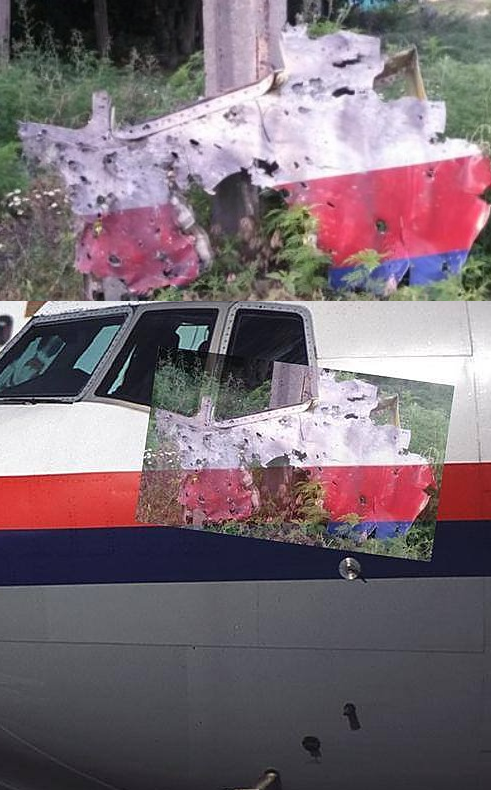
The image here of the hole near the cockpit might seem to indicate a smaller missile than the BUK- so if that was the case, likely an air to air missile or ,as has been suggested by the Russians with additional 30mm anti-tank bullets fired from a Ukrainian SU25 fighter aircraft ( The Russian RT new network reports that Russia had tracked two SU25s trailing the airliner)
Western media and the US government appear far too quick to attribute blame to the Russians and accuse the rebels of hiding evidence: a claim totally unsupported by OSCE observers –before any evidence is available either way. There are multiple other possible causes of the crash, including a bomb on board (Malaysian Airlines disgruntled ex-employee?), equipment malfunction, Western intelligence operatives hostile to Malaysia’s independent stance on Western war crimes, Kiev Government false-flag operation, Right Sektor neo-nazi activists acting independently from Kiev’s Preseident Poroshenko?-the list goes on and on Whether a dreadful accident or vicious attack, why then is the Western media and UK and US governments so quick to attribute the blame to the “demonic” Vladimir Putin -an unlikely culprit at best. I wonder…..
Postscript
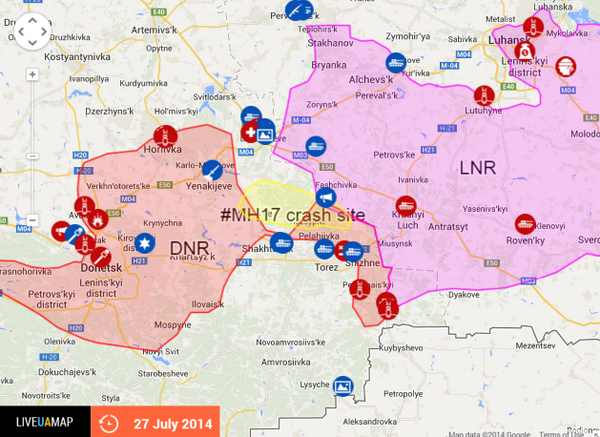
If the map below is correct, the location of the 50 km wide crash site provides an ideal buffer zone between the two separatist Eastern Ukraine areas; especially if they are policed by armed Western police/army units as has been proposed… qui bono?
Eastern Ukraine Crash-site
It would appear that the Kiev government military are doing their best (as of30th July) to ensure that OSCE observers and crash analysts do not get immediate access to the crash-site by increasing shelling and military assaults in the area
An interesting take on the shoot-down from Anderwelt Online (Google translation from German) , whose analysis of the plane’s fragments posted online to date, suggest a shoot-down by 30mm bullets and possibly air-to air missile. See this also noted at Investment Watchblog
A screenshot (below) from a video of the crash-site by a Canadian/Ukrainian OSCE observer
As Wayne Masden points out at Strategic Culture, the United States military had Aegis equipped and operational naval vessels in the Black Sea at the time of the shoot-down of MH17, which was monitoring all civilian and military air-traffic over a wide area of Ukraine and Southern Russia as part of a defence drill with Ukraine, and would have activated alarms in the Aegis system with the radar lock-on of a Buk21 or a fighter jet onto MH17. Strangely, those radar monitoring records have never been divulged by the United States…
The People’s Republic of Donestk was formed in 7th April 2014; breaking away from the state of Ukraine after a very informal referendum of its local population. The referendum was largely caused by the decisions of the Kiev interim Government, after it deposed the former elected ( but like almost every other President of Ukraine since independence from the Soviet Union in 1991 – extremely corrupt) president of Ukraine, Viktor Yanukovych. Yanukovych fled from power as a result of the Maidan protests and threats to his life, led by right wing extremists.
The interim Ukrainian government’s decision to effectively marginalise Russian speaking Ukrainians through banning the Russian language and subsequently calling anti-Maidan groups in the East, “terrorists”, led to the formation of pro-Russian paramilitary groups in the East, in the oblasts of Donestk and Luhansk. Their stated aim was to preserve their Ukrainian/Russian identity against the threats by neo-nazi extremists to “purify” Ukraine, in the new interim Kiev government; largely from within the Slovoda Party and Right Sektor paramilitary groups based in the West of Ukraine.
It is currently unclear what level of support the “self-proclaimed” (are not all state entities initially “self-proclaimed”?) Donestk People’s Republic has with the local population, with some very problematic opinion polls run out of Kiev and funded from the U.S. which state pro-Russian support at less than 40%. Facts on the ground would seem to suggest otherwise, especially since the killing of 39 people in the Trades Hall centre in Odessa on May 2 2014, apparently by right wing football hooligans from the West.
It is also problematic whether those currently running the administration of the Donestk PR have the best of the local population at heart, or are simply opportunists , ex-soldiers and thugs. In addition there is always the tendency with any revolution, especially when under pressure from the outside, to respond in more and more draconian and violent ways towards its own population. Are the Donetsk PR officials any less rascist, anti-Jew and voracious than those in Kiev?-time will tell.
Notwithstanding those concerns, the creation of this ‘people’s republic’ does present a unique opportunity for a better state not seen for perhaps almost a hundred years on this planet. The opportunity to begin afresh, untainted by cronyism, the powers of the corporates, the drive for “progress” at the expense of the planet. An opportunity for a state entity driven by altrusim, responsibility for the vulnerable and a respect for the environment. Impossible you say?- certainly improbable when we look at our current rapacious “growth” (read; money-for-the-rich and baubles for the poor) driven state entities.
What we need then, is the development of state structures that foster:
Community initiative and responsiveness- local town “councils” where every citizen has a voice and a right to be heard and responded to.
Central and local policies that recognise that “growth for growth’s sake’ is nonsensical and destroys both our own living environment and the other living things around us- ‘growth’ is the short term path to death
Central and local initiatives that encourage inter-connectivity between people- eg local community places within walking distance for food and product distribution, green spaces,
Town planning which “forces” people to mingle together to get their work done: eg small interconnected urban areas, green spaces and gardens
Local and central state welfare systems that all citizens buy into according to their capacity to pay through taxes, and all are recompensed equitably in times of trouble
Principles and policies that create respect for the other living beings interacting with the human population.
Training for all age groups in the art of mindfulness
An understanding that violence to others destroys oneself
an inalienable obstruction to business interests influencing state and local political decisions (i.e absolutely no capacity for corporates to finance politicians)
It can (and must) be done. For the sake of all of us on this little blue ball.
The current unstable and dangerous situation in the Ukraine where large elements of the Russian speaking part of the Ukrainian population in in Eastern and Southern Ukraine are apparently pushing for Russian annexation can be largely attributed to Ukraine’s turbulent and violent history.
Kiev, the capital city of Ukraine is considered by many Russians to be the birthplace of Russia, or “Kievan Rus” in the thirteenth century. While no longer a predominantly Russian speaking country, its principal connection has been with its more powerful northern neighbour over the last 800 years.
Ukraine ,or “the Ukraine” as it is often known, literally means “borderlands”, an indication of its status as a standalone state entity over the last 1000 years.
After the Partitions of Poland (1772–1795) (around the time of the US War of Independence), Ukraine was divided between Russia and Austria, with the largest part of Ukraine being integrated into the Russian Empire, and the rest under Austrian (known as the Austro-Hungarian Empire since 1849) control.
Gaining its independence briefly from the Russian Empire in the chaos following the Russian Bolsehvik Revolution of 1917 , Ukraine was forcibly incorporated under Soviet control in 1921 and remained a semi-autonomous republic of the Soviet Union until the collapse of the USSR in 1991, when it once again became independent.
During the rule of Stalin in the USSR in the 1930s, agrarian collectivisation policies were brutally enforced across the entire Soviet Union, but particularly in what has been referred to as the bread-basket of Russia; the Ukraine. Known as Holodomor, the communist collectivist policies resulted in at least 7.5 million deaths with mass starvation occurring amongst the peasantry of western Ukraine particularly. Ukraine has defined the process as genocide, and the brutal process of starvation and loss of lands was instrumental in the rise of right-wing groups in Western Ukraine, (whose populations tend to be more Eurocentred than the South-East), who supported the principles of both Mussolini’s fascist party in Italy and Nazi policies in Germany. The views were largely centred by 1943 in the actions of the Ukrainian Insurgent Army led by Stepan Bandera, in ethnic cleansing of Poles and Jews as well fighting with the Nazis against the Russians . Bandera’s Organization of Ukrainian Nationalists (OUN-B) was strongly supported by Western intelligence agencies and particularly the CIA after the second world war .
In addition to those horrors, in 1944 approximately 200,000 Crimean Tatars were forcibly deported to other parts of the USSR because of their presumed alliance with the Nazis, where a large percentage subsequently died of starvation. Those Tatars who have since returned to the Crimea remain fiercely hostile to the Russians and some have been implicated in anti-Russian warfare in other countries and also within Crimea and wider Ukraine.
Jews and Russians were seen to be the cause of the death, destruction and dispossession which occurred in the Holodomor. In retaliation, Ukrainian fascist and Nazi groups were formed which both fought alongside the Nazis against the Russians and also aided in the Nazi’s Jewish progroms in Western Ukraine. The Svoboda party and its activist group, the Pravyi Sekor (Right Sector), are the current manifestations of those nationalist movements. Members of these two groups have also fought alongside Chechnyan separatists and jihadists in Russia in the past few years. In addition the right -wing Ukrainian nationalist private army and political party, the Ukrainian National Assembly – Ukrainian National Self Defence (UNA-UNSO) , a violent and extreme right-wing and anti-Russian organisation, has been implicated in the sniper shootings of both police and demonstrators in Maidan Square in Kiev.
In 1954, Nikita Khrushchev, the Soviet President of the day, transferred the Crimea , to the Southeast of Ukraine and previously part of Russia itself , to the Ukraine republic .
The Wolfsangel, Svoboda’s first party logo (1991–2003) and now widely used as a uniform emblem by the Right Sector, is both a truncated swastika and the acronym “HH”- for “Heil Hitler”
The most defining reason for the recent demonstrations in Maidan Square in Kiev, against the corrupt but democratically elected president Viktor Yanukovych, was Yanukovych’s decision to switch from supporting alignment and eventual Ukrainian integration with the European Union (after IMF “re-alignment” of the economy), to alignment with Russia and its $15 billion no-strings loan. It is likely that many of those early demonstrators in Maidan Square saw their chance to escape a Ukraine of poverty, for the wealth and opportunity of Europe, slipping away. However the muscle on the ground at Maidan Square and even since the new government in Kiev was installed, has been the Svoboda Party (whose insignia up until 2003 was the Wolfsangel, both a symbol for the swastika and the acronym for “Heil Hitler”) and its hand-maiden, the ‘Right Sector’.
Alexander Muzychko (Sasha Biliy of the “Right Sector” ) “speaking” to a state prosecutor 27th Feb
While Svoboda has partially dissociated itself from its neo-Nazi past; its offspring, the Rights Sector or “Pravyi Sektor” regards “de-Russification” of Ukraine as its core ideology, along with ensuring the ethnic purity of the Ukrainian population including the exodus of Jewish populations, and good moral values.
Global Research notes that ” Canvas, formerly Otpor, received significant money from the US State Department in 2000 to stage the first successful Color Revolution against Slobodan Milosovic in then-Yugoslavia. Since then they have been transformed into a full-time “revolution consultancy” for the US, posing as a Serbian grass-root group backing “democracy.” While Poland under President Tusk, and Sweden have been pushing for Ukraine’s integration into the EU since the initial “colour revolution”, with the strong backing of the US State Department and CIA, they have perhaps inadvertently been also supporting and subsidizing the far right Ukrainian agenda, who have no interest in EU integration. Ostensibly EU/US support has been for the “technocrats” (ie those who support IMF financial “reforms” ) like ex-boxer Klitschko and the newly appointed acting president Oleksander Turchinov. (of Assistant Secretary of State for European Affairs Victoria Nuland’s “fuck EU” fame”)
However one of the first steps of the new government was to rescind the previous government’s recent legislation to legitimize Russian as an official language of the Ukraine. It is likely that that rescindment, more than any other factor, was the key reason for South-Eastern Ukrainians of Russian descent, many of whom solely speak Russian, to fear for their future in a ‘Ukraine for Ukrainians’.
The other major factor is undoubtedly the fear by Russia that the new Ukrainian government will also rescind the lease recently extended out to 2042 for Russia’s only warm water naval base. As the US is well aware, the Sevastopol base allows the Russians to re-supply its ally President Bashad in Syria against US, Turkish and Saudi funded extremists in the Syrian civil war. Loss of the warm water naval base in in the Crimea would have significant negative strategic impacts for the Russians, as the British and French are also only too aware of, after their battles, in alliance with the Turks to re-capture the Crimea and Sevastopol from the Russians in the Crimean War in 1853.
It should be noted also that the industrial base of Ukraine is predominantly in the South-Eastern parts of the country, where there are significant populations of Ukrainian ethnic Russians, and where it’s heavy industry was a key part of the Soviet economy. As with many ex-Soviet states, the factories are by Western standards, unproductive and out of date, and hence would require massive injections of IMF capital and machinery, along with massive layoffs of superfluous workers; a prospect for which Western industrialists have been rubbing their hands in glee since the Ukrainian Orange Revolution in 2004. (Post-script-see the great analysis of the neo-con plan for acquisition of Ukrainian/Russian assets by Michael Hudson here )
The complex interactions of internal Ukrainian and international players, create the opportunity for war. The Russian decision to send in more troops into the Crimea certainly escalates the situation. Additionally, other South-Eastern Ukrainian cities with varying proportions of Russian speaking populations, are now also rising up against the new Kiev anti-Russian government and establishing self-protection militias against the Right Sector and other far-right Ukrainian groups. How much support those Russophiles will get in the cities of Donetsk, Kharkov, Simferapol, Odessa Lugansk and Kerch, is currently unknown. Russia currently insists that its forces have not left their Crimean bases (25,000 Russian troops are permitted in the Crimea as part of the Ukraine /Russia lease agreement) and that all pro-Russian forces on the ground in Ukraine are pro-Russian Ukrainians – a statement disputed by the EU and the U.S.
Given the tragic history outlined above, it would appear the only rational solution to the problems exacerbated by foreign state actors, is negotiation. In the 1990s the 55-state member Organization for Security and Cooperation in Europe (the OSCE) was created to deal with détente in Europe and emerging post-cold war problems . The OSCE offers a unique and relatively non-partisan pathway to a negotiated settlement of the complex issues facing Ukraine. The alternative, despite the huff and puff from NATO and the US, may well be the secession of some part of what is now Ukraine to form a Russian speaking autonomous or semi-autonomous state, unless the power and hostility of the far right groups opposed to ethnic Russians in Ukraine can be controlled.

 (and also see The Guardian’s



 New Antarctica